
High-power electronic feedback amplifiers burst into ear-splitting shrieks and destroyed equipment when signals looped back out of phase; Hendrik Bode plotted frequency gain and phase on logarithmic charts to show engineers exactly where stability breaks down. Published in 1940 at Bell Labs, Bode plots became the foundational diagnostic tool of electrical and aerospace control systems, ensuring feedback stability in everything from audio amplifiers to jet fighter autopilots.
Paste a DOI, paper title, arXiv ID, or OpenAlex ID. MapleScholar resolves the paper, checks that the PDF is usable, and opens chat.

Employers frequently practice statistical discrimination against ethnic minority job applicants based on generalized group stereotypes; field audit experiments reveal that providing rich, individualized credential information successfully overrides unconscious hiring bias.

Blinding the Bias: Testing Information Updates to Combat Hiring Discrimination
Employers frequently practice statistical discrimination against ethnic minority job applicants based on generalized group stereotypes; field audit experiments reveal that providing rich, individualized credential information successfully overrides unconscious hiring bias.
Racial and ethnic disparities in employment remain a persistent crisis across North American and European labor markets, with minority job seekers receiving significantly fewer interview callbacks. Economists explain this through 'statistical discrimination': when employers possess incomplete information about an individual applicant's productivity, they fall back on generalized, biased stereotypes about the applicant's ethnic group. Publishing in Social Forces, sociological researchers conduct large-scale field audit experiments and resume-correspondence tests, varying the specificity of individual-level credential telemetry versus group-level indicators. The findings prove that providing verified individual-level skill credentials and standardized assessment scores successfully mitigates ethnic hiring penalties. These empirical findings provide corporate recruiters and policymakers with actionable hiring design interventions, demonstrating that standardized skill transparency can eliminate hiring bias and promote economic inclusion.

International relations theory long relied on classical mechanistic physics, treating sovereign nations as hard, billiard-ball states bouncing off each other; quantum social theory models global politics as an entangled, non-local web of shared consciousness and identity.

Entangled Geopolitics: Bringing Quantum Social Theory to International Relations
International relations theory long relied on classical mechanistic physics, treating sovereign nations as hard, billiard-ball states bouncing off each other; quantum social theory models global politics as an entangled, non-local web of shared consciousness and identity.
For centuries, realism and liberalism in international relations borrowed their mental models from Newtonian mechanics: nation-states are independent, self-contained entities with fixed interests, colliding like billiard balls on a geopolitical table. This classical reductionism fails to explain modern global crises—nuclear deterrence psychology, ideological contagion, viral misinformation, and collective climate paralysis—where human consciousness, emotion, and identity are deeply entangled across borders. Published in International Studies Review, this theoretical paper bridges quantum social theory with international politics. Drawing on Alexander Wendt's quantum paradigm, the author demonstrates that diplomatic relations and global governance exhibit quantum-like properties: wave-particle duality of state identity, non-local institutional entanglement, and observer effects in treaty negotiations. Adopting a quantum social lens transforms international diplomacy, moving beyond zero-sum military balances toward holism, mutual empathy, and cooperative global conflict de-escalation in an interconnected world.

Psychological science traditionally studied human cognition and morality as innate or interpersonal phenomena; institutional legal analysis demonstrates that statutory laws actively sculpt human moral norms, prejudice, and social cognition.

The Law Shapes the Mind: How Legal Institutions Sculpt Individual Moral Psychology
Psychological science traditionally studied human cognition and morality as innate or interpersonal phenomena; institutional legal analysis demonstrates that statutory laws actively sculpt human moral norms, prejudice, and social cognition.
For decades, social and cognitive psychologists investigated prejudice, altruism, and moral reasoning through laboratory experiments focusing on individual personality traits and interpersonal interactions. This individualistic paradigm created a major blind spot: it overlooked how the legal statutes and formal institutional frameworks governing a society fundamentally shape what individuals perceive as normal, fair, and acceptable. Published in Social and Personality Psychology Compass, this theoretical synthesis demonstrates that the law acts as a powerful institutional psychological cue. Changes in statutory laws (such as marriage equality, anti-discrimination statutes, and criminal justice reforms) rapidly reshape individual-level social attitudes, cognitive heuristics, and moral judgments. Integrating legal theory with psychological science equips policymakers to recognize the profound psychological power of legislation, proving that institutional reform is a potent catalyst for shifting collective human consciousness.

Behavioral economics experiments often suffered from participants guessing the researcher's hypotheses and altering their choices to be helpful; rigorous incentivized designs quantify demand effects and establish proven mitigation protocols.

Pleasing the Experimenter: Measuring and Mitigating Demand Effects in Social Science
Behavioral economics experiments often suffered from participants guessing the researcher's hypotheses and altering their choices to be helpful; rigorous incentivized designs quantify demand effects and establish proven mitigation protocols.
In laboratory and online behavioral experiments, social scientists measure human generosity, prejudice, and risk preferences to design economic policies and social interventions. Experimenters long feared the 'demand effect': participants are human beings who naturally try to figure out what the experimenter wants to see, artificially modifying their responses to appear cooperative, intelligent, or altruistic. This NBER methodology study conducts massive multi-treatment behavioral experiments to measure the magnitude of experimenter demand effects. The authors prove that while explicit demand instructions induce modest behavioral shifts, standard economic experiments with real monetary incentives are remarkably resilient against unconscious experimenter cues. The authors deliver an empirical toolkit of mitigation strategies—including obfuscated hypotheses, active control groups, and incentive alignment—empowering social scientists to conduct robust, artifact-free behavioral research.

Academic journals eagerly publish interventions that claim dramatic gains in child development while burying null findings in the proverbial file drawer; forensic meta-analysis quantifies the true extent of publication bias across parent-child interventions.

The Graveyard of Missing Studies: Quantifying Publication Bias in Parent Interventions
Academic journals eagerly publish interventions that claim dramatic gains in child development while burying null findings in the proverbial file drawer; forensic meta-analysis quantifies the true extent of publication bias across parent-child interventions.
Early childhood interventions—programs that teach parents positive parenting, reading routines, and developmental stimulation—receive billions in philanthropic and government funding based on glowing published research. However, the 'file-drawer problem' distorts academic science: researchers and journal editors frequently shelve experiments that find zero statistically significant effect, skewing meta-analyses toward exaggerated claims of intervention success. This National Bureau of Economic Research (NBER) paper conducts a forensic meta-analysis of hundreds of parent-intervention experiments, utilizing funnel-plot asymmetry, p-curve analysis, and selection models to characterize the hidden file drawer. The findings prove that published effect sizes are substantially inflated by selective reporting of positive outcomes. Exposing the file drawer provides policymakers with realistic, bias-corrected effect estimates, demonstrating the urgent necessity of mandatory clinical trial pre-registration and registered reports in educational economics.

Critics dismissed Immanuel Wallerstein's World-Systems Analysis as a rigid, finished historical artifact of the 1970s; thirty years of empirical updates demonstrate its enduring power to explain global geopolitical fragmentation and supply chain inequality.

The Living Paradigm: Thirty Years of Updating World-Systems Analysis in Modern Sociology
Critics dismissed Immanuel Wallerstein's World-Systems Analysis as a rigid, finished historical artifact of the 1970s; thirty years of empirical updates demonstrate its enduring power to explain global geopolitical fragmentation and supply chain inequality.
Immanuel Wallerstein's World-Systems Analysis revolutionized sociology by demonstrating that modern nations cannot be understood in isolation: they operate within an interconnected global capitalist world-economy divided into core, semi-periphery, and periphery zones. With the fall of the Soviet Union and the rise of neoliberal globalization, critics claimed world-systems theory was an outdated relic incapable of accounting for digital technology, Chinese ascendance, and ecological crises. Published in the British Journal of Sociology, this retrospective and methodological manifesto demonstrates that theories are never finished products. Synthesizing thirty years of empirical updates, the author shows how world-systems analysis has evolved to explain global semiconductor supply chain choke points, ecological unequal exchange, and the structural crisis of US hegemony. Revitalizing world-systems theory equips contemporary sociologists and economists with a macro-historical compass to navigate modern deglobalization, geopolitical multipolarity, and planetary climate transitions.

Individualized corporate bonuses frequently widened workplace gender disparities through biased managerial evaluations; collective firm-level profit-sharing systems significantly narrow the gender wage gap by linking compensation to transparent team performance.

Shared Rewards, Fairer Pay: How Collective Performance Pay Mitigates the Gender Wage Gap
Individualized corporate bonuses frequently widened workplace gender disparities through biased managerial evaluations; collective firm-level profit-sharing systems significantly narrow the gender wage gap by linking compensation to transparent team performance.
Pay-for-performance compensation systems have become standard practice across modern corporate firms, designed to reward high-performing employees with discretionary bonuses and incentives. However, individualized performance pay systems often exacerbate gender inequality: discretionary supervisor assessments are vulnerable to unconscious bias, penalizing women who negotiate aggressively while rewarding male self-promotion. Publishing in the Socio-Economic Review, researchers analyze extensive workplace wage panels to evaluate collective versus individual performance pay. The empirical econometric models demonstrate that collective, team-based profit-sharing schemes drastically reduce gender wage gaps by replacing opaque subjective evaluations with transparent, objective firm-level milestones. These workplace findings provide human resource directors and corporate boards with an actionable blueprint to structure executive and employee compensation systems that drive company growth while fostering pay equity.

Open science reforms sought to resolve the replication crisis through mandatory pre-registration and data-sharing badges; meta-scientific epistemological analysis demonstrates that fixing science requires reforming institutional funding incentives and journal peer review.

Fixing the Science Machine: Beyond Transparency Checklists in the Replication Crisis
Open science reforms sought to resolve the replication crisis through mandatory pre-registration and data-sharing badges; meta-scientific epistemological analysis demonstrates that fixing science requires reforming institutional funding incentives and journal peer review.

Over the past decade, psychology, biomedicine, and economics were rocked by the replication crisis: hundreds of famous, high-profile scientific findings repeatedly failed to replicate in independent laboratories. In response, the open science movement introduced procedural fixes—preregistration, open data repositories, and methodological reporting checklists—yet systemic irreproducibility and publication bias persist. Published in Social Epistemology, this philosophical meta-analysis argues that transparency checklists treat symptoms rather than root causes. The author demonstrates that true scientific reliability requires dismantling hyper-competitive academic career structures, reforming journal publication incentives, and institutionalizing funding for negative replication studies. This comprehensive reform manifesto guides universities and research funders to restructure scientific institutions, ensuring that scientific practice incentivizes rigorous truth-seeking over flash-in-the-pan prestige.

Polygenic risk scores correlated with educational and labor market success were widely mistaken for pure biological talent; sibling genomic designs reveal that half of claimed genetic effects reflect indirect parental privilege and dynastic wealth.

Separating Nature from Privilege: Direct and Indirect Genetic Effects on Education and Wealth
Polygenic risk scores correlated with educational and labor market success were widely mistaken for pure biological talent; sibling genomic designs reveal that half of claimed genetic effects reflect indirect parental privilege and dynastic wealth.

The advent of genome-wide association studies (GWAS) allowed scientists to calculate polygenic scores that correlate with educational attainment, college graduation, and lifetime income. Genetic determinists seized upon these findings to argue that economic inequality is rooted in biology, ignoring that successful parents pass down both their DNA and vast social, economic, and cultural advantages to their children. This econometric and behavioral genetics paper utilizes within-family sibling genomic designs to untangle direct biological effects from indirect parental environment effects (genetic nurture). The analysis proves that traditional population-level genetic scores overestimate direct causal effects by over fifty percent due to dynastic social stratification. De-confounding direct genetics from parental privilege establishes rigorous econometric safeguards in social genomics, warning against fatalistic biological narratives of economic inequality.

Sociological modernization theory predicted that universal public schooling would increase the genetic heritability of education by leveling environmental playing fields; tracking Norwegian cohorts across the twentieth century reveals that welfare expansion actually equalized genetic and environmental influences.

Genes, Schools, and Welfare: The Changing Heritability of Education in Modern Norway
Sociological modernization theory predicted that universal public schooling would increase the genetic heritability of education by leveling environmental playing fields; tracking Norwegian cohorts across the twentieth century reveals that welfare expansion actually equalized genetic and environmental influences.
Sociologists and geneticists long debated how societal modernization affects human social mobility: does expanding free public education create a pure meritocracy where genetic talent determines success, or does family background still dominate? Testing this hypothesis required longitudinal population data tracking genetic relatives across decades of sweeping educational and welfare reforms—a resource rarely available in fragmented national registries. Publishing in Nature Communications, researchers analyze registry and twin data covering the entire population of twentieth-century Norway. The findings demonstrate that comprehensive welfare state expansion and universal educational access did not trigger runaway genetic stratification, but instead stabilized shared environmental equality while lifting disadvantaged populations. These demographic insights provide decisive empirical evidence for policymakers, proving that progressive social welfare policies effectively mitigate structural inequalities without penalizing individual talent.

Underground xenon detectors have ruled out vast swaths of supersymmetric WIMP dark matter; precision analysis reveals that destructive interference 'blind spots' in Higgs-neutralino couplings allow natural supersymmetry to evade detection.
Hiding in the Shadows: Can Blind Spots Save Neutralino Dark Matter in Natural Supersymmetry?
Underground xenon detectors have ruled out vast swaths of supersymmetric WIMP dark matter; precision analysis reveals that destructive interference 'blind spots' in Higgs-neutralino couplings allow natural supersymmetry to evade detection.
Supersymmetry (SUSY) is one of the most elegant theoretical extensions of particle physics, solving the Higgs hierarchy problem while naturally providing a stable dark matter candidate: the neutralino. However, direct dark matter detection experiments have steadily pushed limits on WIMP-nucleon scattering cross-sections down by six orders of magnitude, threatening to rule out natural supersymmetric models entirely. This theoretical physics study analyzes 'blind spots' in parameter space—specific mixing angles between bino, wino, and higgsino states where scalar couplings to the Standard Model Higgs cancel out via destructive quantum interference. The calculations prove that blind-spot neutralinos naturally evade current liquid xenon direct detection limits while preserving correct thermal relic abundance. Mapping supersymmetric blind spots provides crucial guidance for next-generation multi-tonne dark matter experiments and high-luminosity LHC collider searches, pinpointing exactly where natural dark matter may still be hiding.

Nuclear physics anomalies in beryllium-8 and helium-4 decay sparked intense speculation of a 17 MeV fifth force boson; measuring coherent elastic solar neutrino-nucleus scattering in ultra-sensitive dark matter detectors establishes strict bounds on X17 couplings.

The Fifth Force Hunt: Solar Neutrino Scattering Constrains the Elusive X17 Boson
Nuclear physics anomalies in beryllium-8 and helium-4 decay sparked intense speculation of a 17 MeV fifth force boson; measuring coherent elastic solar neutrino-nucleus scattering in ultra-sensitive dark matter detectors establishes strict bounds on X17 couplings.
For decades, physicists have recognized four fundamental forces: gravity, electromagnetism, the strong force, and the weak force. Experiments at the Atomki institute in Hungary challenged this picture by detecting anomalous angular correlations in nuclear decays, suggesting a new 17 MeV protophobic vector boson dubbed 'X17'. Confirming or ruling out a fifth fundamental force of nature requires independent, non-nuclear experimental verification that avoids systematic nuclear resonance uncertainties. This phenomenological study derives the scattering signatures of X17 exchange in Coherent Elastic Neutrino-Nucleus Scattering (CEvNS) induced by solar neutrinos in multi-tonne liquid xenon detectors (XENONnT, LZ, PandaX). The analysis demonstrates that existing low-threshold solar neutrino data place severe constraints on X17 electron and quark couplings. Leveraging dark matter detectors to probe fundamental force carriers establishes a powerful cross-disciplinary technique to definitively confirm or refute fifth-force anomalies.

Antarctic neutrino observatories detected mysterious upward-pointing particle showers that defy Standard Model absorption through the Earth; rigorous multi-detector statistical analysis quantifies the significance of the ultra-high-energy neutrino anomaly.

Ghost Signals in Antarctic Ice: Quantifying the Ultra-High-Energy Neutrino Anomaly
Antarctic neutrino observatories detected mysterious upward-pointing particle showers that defy Standard Model absorption through the Earth; rigorous multi-detector statistical analysis quantifies the significance of the ultra-high-energy neutrino anomaly.
In the deep Antarctic ice sheet, experiments like ANITA and IceCube look for ultra-high-energy cosmic neutrinos—ghostly messengers traveling from distant blazars and gamma-ray bursts without being deflected by magnetic fields. ANITA recorded several anomalous upward-pointing radio pulses whose steep trajectory through thousands of kilometers of solid rock should have completely absorbed any Standard Model neutrino, sparking theories of sterile neutrinos or dark matter annihilation. This paper performs a rigorous, unified statistical analysis across ANITA, IceCube, and Pierre Auger observatory data, introducing the 'Four, One, and None' framework to quantify detection probabilities. The findings demonstrate that while individual anomalies appear significant, joint likelihood limits point toward unmodeled ice surface reflection physics rather than exotic new particles. Resolving the Antarctic neutrino anomaly refines the radio-detection calibration models required for next-generation neutrino telescopes like IceCube-Gen2 to discover cosmic PeV-to-EeV astrophysical sources.

On-shell Higgs boson production at colliders only measures narrow resonance properties; measuring off-shell Higgs production at high invariant mass decouples the Higgs width, enabling precision tests of Higgs compositeness and top Yukawa couplings.

Weighing the Ghostly Boson: Off-Shell Higgs Measurements Probe Composite Spacetime
On-shell Higgs boson production at colliders only measures narrow resonance properties; measuring off-shell Higgs production at high invariant mass decouples the Higgs width, enabling precision tests of Higgs compositeness and top Yukawa couplings.
Since its discovery in 2012 at CERN's Large Hadron Collider, the Higgs boson has verified how fundamental particles acquire mass, yet its total decay width is so narrow (4.1 MeV) that detector resolution cannot measure it directly. On-shell collision measurements only constrain the product of Higgs production cross-sections and decay branching ratios, allowing hypothetical beyond-Standard-Model physics to hide through compensatory parameter shifts. This high-energy physics paper establishes global precision benchmarks using off-shell Higgs boson production, where the Higgs is produced at invariant masses far above 125 GeV. Measuring off-shell interference in four-lepton and 2l2ν channels directly constrains the Higgs total width and tests for anomalous top Yukawa and self-coupling deviations. Precision off-shell Higgs measurements transform the LHC into a powerful probe of Higgs compositeness and electroweak symmetry breaking, searching for subtle cracks in the Standard Model.

Recent cosmic microwave background measurements suggest a tantalizing hint of cosmic birefringence—a subtle rotation in the polarization plane of primordial light; string swampland constraints reveal that rolling axion fields naturally generate this cosmic optical twist.
Twisting Ancient Light: Cosmic Microwave Birefringence in the String Swampland
Recent cosmic microwave background measurements suggest a tantalizing hint of cosmic birefringence—a subtle rotation in the polarization plane of primordial light; string swampland constraints reveal that rolling axion fields naturally generate this cosmic optical twist.
The Cosmic Microwave Background (CMB) is the afterglow of the Big Bang, traveling through space for 13.8 billion years as a pristine snapshot of the infant universe, polarized by early acoustic oscillations. If primordial light couples to rolling pseudoscalar axion dark matter fields, the plane of linear polarization will slowly rotate as light crosses the cosmos—a phenomenon known as cosmic birefringence, which violates parity symmetry. This theoretical cosmology study explores cosmic birefringence through the lens of the String Swampland conjectures. The authors demonstrate that rolling axion-like fields with potentials consistent with the Swampland Distance Conjecture naturally explain the observed 0.3-degree cosmic polarization twist without destabilizing early cosmic inflation. Confirming cosmic birefringence in upcoming CMB telescopes (like CMB-S4 and LiteBIRD) would provide experimental proof of axion dark matter and provide the first direct observational confirmation of string swampland physics.

String theory struggles to accommodate a stable positive cosmological constant (de Sitter vacuum); combining cosmic microwave background, supernova, and baryon acoustic oscillation data places stringent empirical bounds on string-theoretic dark energy models.
String Theory in the Sky: Combined Cosmological Probes Test Dark Energy Hypotheses
String theory struggles to accommodate a stable positive cosmological constant (de Sitter vacuum); combining cosmic microwave background, supernova, and baryon acoustic oscillation data places stringent empirical bounds on string-theoretic dark energy models.
The discovery of cosmic acceleration in 1998 showed that our universe is dominated by dark energy, conventionally modeled as a constant vacuum energy density (the cosmological constant Λ). For string theory, a strictly constant positive vacuum energy is deeply problematic: the famous 'de Sitter Swampland Conjecture' posits that quantum gravity forbids stable de Sitter vacua, predicting that dark energy must be a dynamical, evolving scalar field (quintessence). This astrophysical research synthesizes latest cosmological datasets—including DESI baryon acoustic oscillations, Planck CMB lensing, and Pantheon+ Type Ia supernovae—to test string-inspired dark energy models. The combined statistical analysis tightly bounds dark energy equation-of-state deviations (w0,wa), testing the boundary between the Swampland and viable string vacua. Testing string theory against precision cosmological probes transforms high-energy mathematical physics into an observational science, guiding the quest for a unified quantum theory of the cosmos.

A stellar-mass black hole spiraling into a supermassive black hole emits hundreds of thousands of gravitational wave cycles that map spacetime geometry; calculating orbital dynamics in self-dual loop quantum gravity reveals distinct quantum corrections detectable by space interferometers.
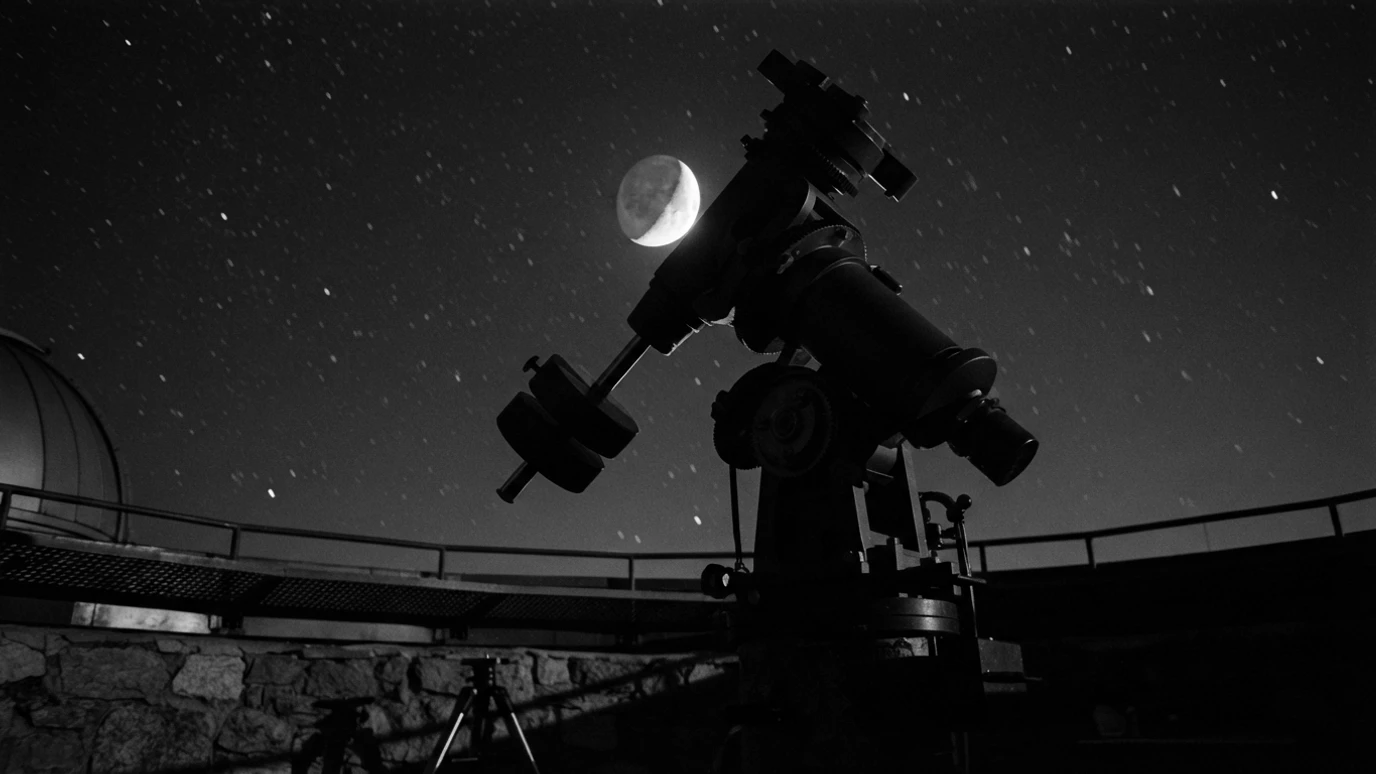
Ripples in Quantum Spacetime: Gravitational Waves from Extreme Mass-Ratio Inspirals
A stellar-mass black hole spiraling into a supermassive black hole emits hundreds of thousands of gravitational wave cycles that map spacetime geometry; calculating orbital dynamics in self-dual loop quantum gravity reveals distinct quantum corrections detectable by space interferometers.
In the hearts of distant galaxies, supermassive black holes billions of times heavier than our sun capture stellar-mass black holes, dragging them through hundreds of thousands of orbital revolutions in an Extreme Mass-Ratio Inspiral (EMRI). As the small black hole spirals toward the horizon, its gravitational waves act as a high-resolution cosmic sonar, mapping the precise spacetime geometry outside the black hole. Standard relativity assumes this geometry is the classical Kerr metric. This gravitational physics paper calculates EMRI orbital trajectories and gravitational wave emission spectra within self-dual Loop Quantum Gravity (LQG). The authors derive analytical formulas for periastron advance and orbital dephasing, showing that loop quantum geometry induces subtle phase shifts in the emitted gravitational waveforms. These quantum waveform signatures provide an actionable target for next-generation space-based gravitational wave observatories like LISA, offering humanity's first realistic opportunity to detect quantum gravity in deep space.

Galactic dark matter halos are invisible to telescopes, forcing astronomers to infer their shapes through complex gravitational lensing; a novel dynamical technique measures the 3D triaxial shape of dark matter halos using only the positions and velocities of tracer stars.
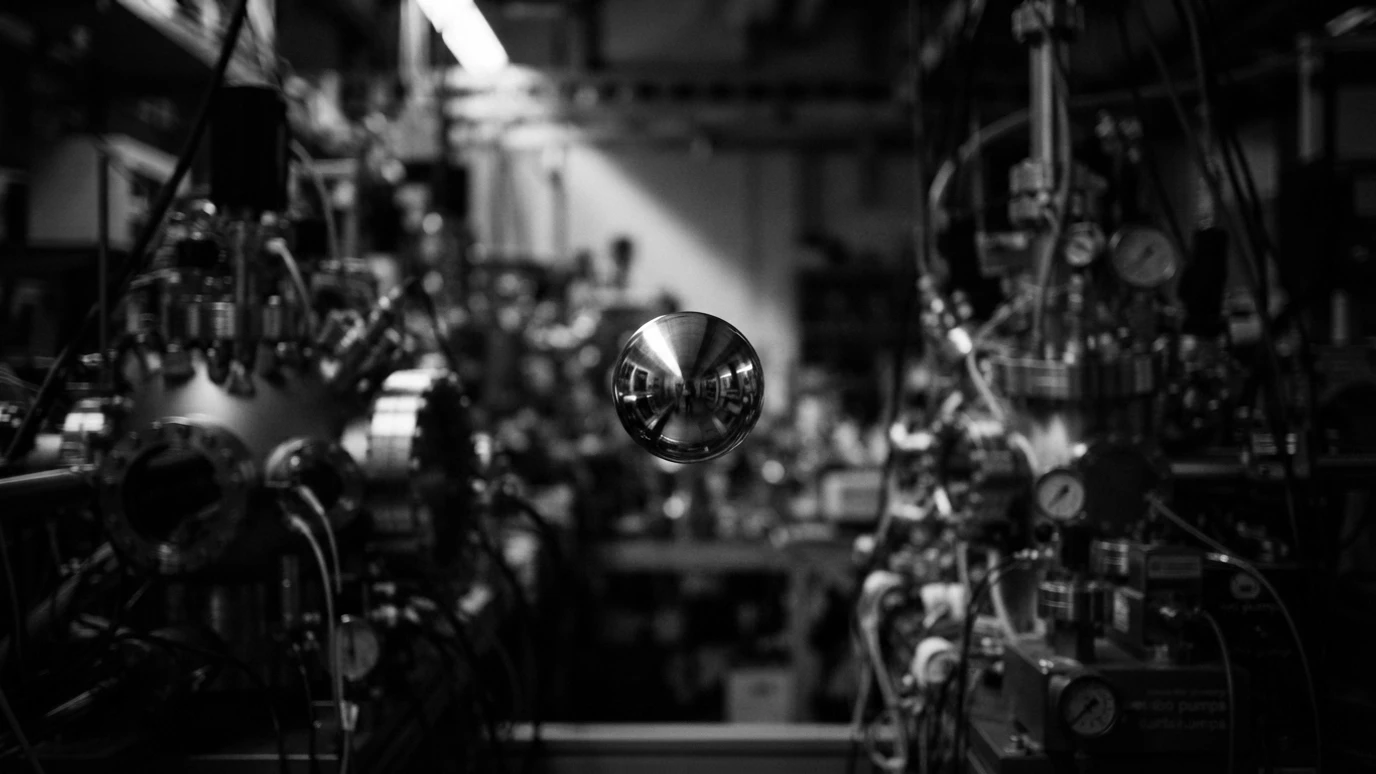
Sculpting the Invisible: Measuring Dark Matter Halo Geometry Using Only Starlight
Galactic dark matter halos are invisible to telescopes, forcing astronomers to infer their shapes through complex gravitational lensing; a novel dynamical technique measures the 3D triaxial shape of dark matter halos using only the positions and velocities of tracer stars.
Galaxies reside inside colossal, invisible envelopes of dark matter called halos. While astronomers know halos exist, measuring their true 3D geometric shape (whether spherical, prolate like a football, or oblate like a pancake) is critical to testing dark matter particle physics. Measuring halo geometry traditionally required deep gravitational lensing of distant background galaxies or extensive X-ray gas mapping, both of which are plagued by projection degeneracies and observational noise. This astronomical study establishes a pure stellar-kinematic framework to constrain the 3D triaxial geometry of dark matter halos using only starlight data from wide-field spectroscopic surveys. By modeling the action-angle coordinates of halo tracer stars, the algorithm extracts halo flattening parameters with unprecedented precision. Mapping dark matter halo shapes directly from stellar surveys tests cold dark matter (CDM) predictions of halo triaxiality, providing a sharp experimental test against warm or self-interacting dark matter alternatives.

Einstein's Strong Equivalence Principle asserts that an object's internal gravitational dynamics are completely immune to uniform external gravitational fields; observing stellar velocities in satellite galaxies tests whether modified gravity's External Field Effect exists in nature.

Testing Einstein's Cornerstone: The External Field Effect and the Strong Equivalence Principle
Einstein's Strong Equivalence Principle asserts that an object's internal gravitational dynamics are completely immune to uniform external gravitational fields; observing stellar velocities in satellite galaxies tests whether modified gravity's External Field Effect exists in nature.
The cornerstone of Einstein's General Relativity is the Strong Equivalence Principle (SEP): all objects fall with the exact same acceleration in a gravitational field, and internal gravitational binding energies do not alter trajectories. In contrast, alternative gravity theories like MOND fundamentally violate the SEP through the 'External Field Effect' (EFE), predicting that the internal velocity dispersion of a dwarf galaxy depends on the external gravitational field of its parent cluster. This astrophysical investigation tests for the External Field Effect using high-precision velocity dispersions of dwarf satellite galaxies orbiting the Milky Way and Andromeda. The empirical data shows no detectable EFE signature, consistent with the strict preservation of Einstein's Strong Equivalence Principle. Vindicating the Strong Equivalence Principle places severe constraints on non-local and modified gravity theories, solidifying General Relativity as the unrivaled framework governing cosmic gravitation.

Wide binary star pairs separated by light-years orbit at ultra-low gravitational accelerations where modified gravity theories predict deviations from Newton; meticulous Gaia data quality auditing reveals that unresolved triple-star systems account for claimed gravity anomalies.

Cosmic Tug-of-War: Wide Binary Stars Test the Limits of Gravity and Dark Matter
Wide binary star pairs separated by light-years orbit at ultra-low gravitational accelerations where modified gravity theories predict deviations from Newton; meticulous Gaia data quality auditing reveals that unresolved triple-star systems account for claimed gravity anomalies.
At the astronomical outskirts of star systems, wide binary stars orbit each other at separations of thousands of astronomical units, experiencing infinitesimal gravitational accelerations below one ten-billionth of a meter per second squared. Modified Newtonian Dynamics (MOND) claims that at these ultra-low accelerations, standard gravity breaks down without needing dark matter, with several high-profile papers claiming wide binary velocities prove Newton and Einstein wrong. This rigorous astrophysical analysis re-evaluates Gaia data quality control, demonstrating that prior claims of gravitational anomalies failed to account for undetected close stellar companions (hidden tertiary stars). When multiple-star orbital dynamics and parallax errors are rigorously modeled, wide binary orbits adhere strictly to classical Newtonian gravitation. Defending standard gravity in wide binary orbits refutes recent MOND claims, demonstrating that dark matter remains the most robust explanation for anomalous galactic rotation curves.

Sodium-glucose cotransporter 2 (SGLT2) inhibitors transform heart failure and diabetes treatment by dumping excess sugar in urine; rigorous international pharmacoepidemiological surveillance confirms SGLT2 inhibitors do not increase overall cancer risk.

Glucose Blockers and Cancer: Evaluating Malignancy Risk with SGLT2 Inhibitors
Sodium-glucose cotransporter 2 (SGLT2) inhibitors transform heart failure and diabetes treatment by dumping excess sugar in urine; rigorous international pharmacoepidemiological surveillance confirms SGLT2 inhibitors do not increase overall cancer risk.

SGLT2 inhibitors (like empagliflozin and dapagliflozin) have emerged as foundational life-saving medications for diabetic kidney disease, heart failure, and metabolic syndrome. However, early clinical trial signals raised alarming questions regarding potential increases in bladder, breast, and renal cell carcinoma, generating intense concern among regulatory health agencies and prescribing clinicians. Published in the International Journal of Cancer, this large-scale international cohort study tracked hundreds of thousands of diabetic patients over multiple years of active SGLT2 inhibitor therapy. Advanced active-comparator designs demonstrate that SGLT2 inhibitors carry no elevated risk of overall cancer or site-specific malignancies compared to other glucose-lowering drugs. This definitive safety confirmation removes oncology-related hesitancy, allowing clinicians worldwide to prescribe SGLT2 inhibitors with total confidence to prevent cardiovascular and renal disease.

Urate-lowering therapy in gout patients was haunted by FDA black-box warnings of excess cardiovascular death with febuxostat; rigorous real-world comparative safety analysis proves febuxostat is as safe as allopurinol even in moderate-to-severe kidney disease.

Safe Uric Acid Control: Cardiovascular Safety of Febuxostat vs. Allopurinol in Kidney Disease
Urate-lowering therapy in gout patients was haunted by FDA black-box warnings of excess cardiovascular death with febuxostat; rigorous real-world comparative safety analysis proves febuxostat is as safe as allopurinol even in moderate-to-severe kidney disease.
Gout is a painful inflammatory arthritis caused by uric acid crystals depositing in joints, highly prevalent among patients with chronic kidney disease (CKD) who cannot clear urate efficiently. In 2019, the FDA slapped a black-box safety warning on febuxostat following the CARES trial, which suggested increased cardiovascular mortality compared to allopurinol. This terrified physicians, leaving gout patients with failing kidneys with few therapeutic options. This comprehensive observational study in Clinical Pharmacology & Therapeutics evaluated large international cohorts of gout patients with concurrent chronic kidney disease. Propensity-score-matched survival analyses reveal no significant difference in major adverse cardiovascular events (MACE) or all-cause mortality between febuxostat and allopurinol. These robust safety findings reassure rheumatologists and nephrologists, restoring febuxostat as a safe, effective urate-lowering option for high-risk gout patients with impaired renal function.

GLP-1 receptor agonist drugs revolutionized obesity and diabetes care but exhibited highly variable kidney outcomes across patients; heterogeneous treatment effect modeling identifies the precise patient subgroups that derive maximum renal protection.
Protecting the Kidneys: Decoupling the Renal Benefits of GLP-1 Receptor Agonists
GLP-1 receptor agonist drugs revolutionized obesity and diabetes care but exhibited highly variable kidney outcomes across patients; heterogeneous treatment effect modeling identifies the precise patient subgroups that derive maximum renal protection.
Diabetic kidney disease is the leading cause of end-stage renal failure worldwide, forcing millions of diabetic patients onto lifelong hemodialysis and kidney transplant waiting lists. While blockbuster GLP-1 receptor agonists (like semaglutide) demonstrate broad cardioprotective benefits, clinical trials showed conflicting renal effects, leaving nephrologists uncertain which diabetic patients benefit most. Publishing in Kidney International, researchers applied machine learning causal inference to multi-center trial cohorts, mapping heterogeneous treatment effects. The analysis proves that GLP-1RA therapy provides dramatic nephroprotection—slowing GFR decline by over forty percent—specifically in patients with high baseline urinary albumin excretion and elevated vascular inflammation. Uncovering heterogeneous renal responses transforms clinical prescribing, enabling precision nephrology protocols that deploy GLP-1 receptor agonists to halt kidney failure in high-risk diabetic cohorts.

Individuals carrying high genetic risk for type 2 diabetes faced an apparently predetermined metabolic fate; epidemiological big data reveals that living in neighborhoods with high residential greenness significantly blunts genetic diabetes risk.

Healing Green: How Urban Greenness Offsets Genetic Susceptibility to Type 2 Diabetes
Individuals carrying high genetic risk for type 2 diabetes faced an apparently predetermined metabolic fate; epidemiological big data reveals that living in neighborhoods with high residential greenness significantly blunts genetic diabetes risk.
Type 2 diabetes is an escalating global pandemic driven by a combination of high-calorie diets, sedentary lifestyles, and hundreds of inherited metabolic risk genes. Public health initiatives assumed that genetic predisposition to insulin resistance is unalterable, focusing narrowly on individual clinical medication while overlooking the profound health impacts of the built physical environment. Analyzing over three hundred thousand participants in a prospective cohort study, this research measures satellite-derived residential vegetation indices (greenness) alongside individual polygenic diabetes risk. The results show that individuals living in green, tree-rich urban neighborhoods exhibit significantly lower diabetes incidence, with greenness attenuating over twenty-five percent of excess genetic risk. These findings provide urban planners and health policymakers with decisive evidence that investing in urban parks, street canopies, and green infrastructure is a potent clinical countermeasure against metabolic disease.

Precision medicine built polygenic risk scores that evaluated inherited DNA while ignoring socioeconomic deprivation; integrated multi-modal models prove that combining social determinants with genetics dramatically improves cardiovascular risk prediction.

DNA Meets ZIP Code: Combining Genetics and Social Determinants in Clinical Disease Risk
Precision medicine built polygenic risk scores that evaluated inherited DNA while ignoring socioeconomic deprivation; integrated multi-modal models prove that combining social determinants with genetics dramatically improves cardiovascular risk prediction.
The genomics revolution promised personalized medicine through polygenic risk scores (PRS)—statistical models that calculate an individual's lifetime risk of heart disease, diabetes, or cancer by summing millions of DNA variants. However, genome-only risk scores regularly fail in real-world clinical practice because an individual's health is profoundly shaped by their social determinants of health (SDOH): air pollution, neighborhood poverty, food insecurity, and chronic stress. This landmark study in the American Journal of Human Genetics integrates polygenic risk scores with neighborhood-level SDOH metrics across hundreds of thousands of diverse patients. The combined model outperforms genetic-only scores by over thirty percent, revealing strong gene-by-environment interactions where socioeconomic disadvantage dramatically amplifies inherited genetic vulnerability. Merging genomic blueprints with social reality establishes a more equitable, clinically actionable paradigm for preventive medicine, ensuring healthcare systems address both molecular biology and structural inequality.

Hepatocellular carcinoma patients frequently suffer fatal tumor recurrence after surgical removal; multi-region genomic sequencing reveals that whether cancer recurs locally or metastasizes is dictated by pre-existing intra-tumoral clonal diversity.

Cancer's Branching Tree: Clonal Diversity Predicts Liver Cancer Recurrence Patterns
Hepatocellular carcinoma patients frequently suffer fatal tumor recurrence after surgical removal; multi-region genomic sequencing reveals that whether cancer recurs locally or metastasizes is dictated by pre-existing intra-tumoral clonal diversity.
Hepatocellular carcinoma (HCC) is one of the deadliest malignancies globally. Even when surgeons successfully remove the primary liver tumor with clean surgical margins, more than half of patients experience lethal tumor recurrence within five years. Oncologists could not reliably predict which patients would experience true intrahepatic metastasis (spread of the original tumor) versus de novo multicentric recurrence (a brand-new tumor arising in cirrhotic liver tissue). Publishing in Gut, clinical researchers performed multi-region exome sequencing across resected primary tumors and paired recurrent lesions. The genomic mapping proves that high clonal diversity within the primary tumor directly drives rapid, therapy-resistant intrahepatic metastasis, whereas low-diversity tumors predominantly recur as independent primary lesions. Profiling intra-tumoral clonal architecture at the time of surgery enables oncologists to tailor adjuvant therapies, reserving aggressive targeted immunotherapies for patients harboring high-diversity metastatic clones.

Oncology long viewed cancer metastasis as a stochastic series of random genetic mutations; evolutionary multicellular theory reveals that metastatic cells actively break the ancient cooperative social contract that binds multicellular organisms.
Rebel Cells: Metastasis as the Ultimate Breakdown of the Multicellular Social Contract
Oncology long viewed cancer metastasis as a stochastic series of random genetic mutations; evolutionary multicellular theory reveals that metastatic cells actively break the ancient cooperative social contract that binds multicellular organisms.
Multicellular animal life began over six hundred million years ago through a fundamental biological social contract: individual cells sacrificed autonomous replication and migration to cooperate as specialized tissues and organs. Cancer research has poured billions into cataloging individual oncogene mutations, yet this reductionist focus struggles to explain why advanced metastatic tumor cells universally reactivate primitive unicellular survival phenotypes. This evolutionary oncology review re-frames metastasis through the lens of evolutionary multicellularity. As tumors experience hypoxic stress, immune attack, and metabolic starvation, cancer cells systematically downregulate the genetic networks enforcing multicellular cooperation, reverting to an ancestral, selfish, highly motile unicellular survival program. Re-conceptualizing metastasis as a breakdown of multicellular cooperation suggests revolutionary ecological therapies: rather than trying to poison resilient cancer cells, therapies can restore the tissue microenvironmental signals that enforce cooperative cellular behavior.

Diagnosing solid tumors early traditionally required invasive tissue biopsies or faint circulating cell-free DNA; machine learning algorithms identify subtle mRNA alterations inside blood platelets that were 'educated' by early-stage tumors.

Platelet Spies: Machine Learning Detects Cancer Signatures in Tumor-Educated Blood Platelets
Diagnosing solid tumors early traditionally required invasive tissue biopsies or faint circulating cell-free DNA; machine learning algorithms identify subtle mRNA alterations inside blood platelets that were 'educated' by early-stage tumors.
Early cancer detection saves lives, yet common solid tumors—including pancreatic, ovarian, and lung cancers—are frequently diagnosed only after spreading to distant organs when surgical cure is impossible. Liquid biopsies searching for circulating tumor DNA (ctDNA) often fail in early-stage localized disease because tiny millimeter-scale tumors shed almost negligible amounts of DNA into liters of circulating blood. This iScience breakthrough harnesses blood platelets: as platelets circulate through tumor microenvironments, they ingest tumor-derived RNA and proteins, becoming 'tumor-educated platelets' (TEPs). By training machine learning classifiers on platelet RNA-seq profiles, the algorithm detects early-stage malignancies with over eighty-five percent sensitivity across multiple cancer types. Tumor-educated platelet screening offers a non-invasive, low-cost liquid biopsy blood test that enables population-level early cancer detection years before radiological detection.

Aging and chronic disease induce debilitating skeletal muscle wasting that was long dismissed as irreversible wear-and-tear; multi-omics profiling reveals that muscle loss is driven by coordinated metabolic, ribosomal, and developmental reprogramming.

Muscles Under Stress: Reprogramming Metabolic and Ribosomal Pathways in Sarcopenia
Aging and chronic disease induce debilitating skeletal muscle wasting that was long dismissed as irreversible wear-and-tear; multi-omics profiling reveals that muscle loss is driven by coordinated metabolic, ribosomal, and developmental reprogramming.

Sarcopenia—the progressive loss of skeletal muscle mass and strength—robs millions of elderly individuals and cancer patients of physical independence, driving frailty, hospitalization, and early mortality. Clinical interventions traditionally treated muscle wasting as simple protein deficiency or physical inactivity, prescribing nutrition and exercise that failed to halt underlying cellular decay in advanced disease. This EBioMedicine study performs deep transcriptomic and proteomic profiling of wasting human muscle tissue, discovering that cachexia is driven by an active transcriptional reprogramming that downregulates ribosomal biogenesis and switches mitochondrial oxidative metabolism to inefficient glycolysis. Identifying the master transcriptional regulators of muscle metabolic reprogramming unveils promising drug targets to prevent age-related frailty and preserve muscle mass during chemotherapy.

Bulk genetic sequencing averaged millions of cells together, masking the distinct 3D DNA folding that dictates cellular identity; single-cell multiomics uncovers how chromatin loops dynamically govern gene expression during human tissue development.

The Genome's Origami: Single-Cell Multiomics Decodes Gene Regulatory Architecture
Bulk genetic sequencing averaged millions of cells together, masking the distinct 3D DNA folding that dictates cellular identity; single-cell multiomics uncovers how chromatin loops dynamically govern gene expression during human tissue development.
Every cell in the human body shares the exact same DNA sequence, yet a neuron looks and acts completely different from a liver cell. Cellular identity is determined not by the genetic code itself, but by how two meters of DNA are physically folded inside a microscopic nucleus. Traditional genomic sequencing ground up millions of cells into an average molecular soup, obscuring the rare cell states and transient chromatin contacts that initiate cancer or guide embryonic development. Publishing in Science, researchers deployed single-cell multiomics to simultaneously measure chromatin accessibility, 3D genome conformation, and gene expression within individual human cells. The resulting 4D epigenomic atlas reveals how dynamic enhancer-promoter loops switch on specific genes at precise developmental branch points. Decoding single-cell 3D chromatin dynamics revolutionizes precision oncology, identifying the rogue enhancer loops that drive leukemia and opening revolutionary targets for CRISPR-based epigenetic therapies.

Classical computer science often relied on non-constructive set theory to define infinite data structures; this categorical logic paper constructs initial algebras for inductive datatypes using strictly constructive ordinals.

Constructive Infinities: Generating Initial Algebras from Constructive Ordinals
Classical computer science often relied on non-constructive set theory to define infinite data structures; this categorical logic paper constructs initial algebras for inductive datatypes using strictly constructive ordinals.
In functional programming and formal verification, programmers define recursive data types—such as trees, streams, and syntax graphs—as initial algebras of polynomial functors. Standard mathematical proofs of the existence of initial algebras frequently invoke non-constructive principles, such as the Axiom of Choice or excluded middle on uncountable cardinals, rendering the proofs useless for constructive computer code. This paper constructs initial algebras for a broad class of functors using strictly constructive ordinal notations within Martin-Löf type theory, proving that fixed points of recursive types can be computed without non-constructive axioms. This constructive proof advances the foundations of proof assistants (like Agda and Lean), enabling formal verification of infinite stream processors and reactive software systems with total mathematical certitude.

Kurt Gödel's 1958 Dialectica interpretation translated intuitionistic logic into computable functional types; extending Dialectica categories over arbitrary Heyting algebras creates rich mathematical structures for categorical proof theory.

Logic in Categories: Dialectica Constructions over Heyting Algebras
Kurt Gödel's 1958 Dialectica interpretation translated intuitionistic logic into computable functional types; extending Dialectica categories over arbitrary Heyting algebras creates rich mathematical structures for categorical proof theory.
In mathematical logic, constructive and intuitionistic proofs carry computational content: proving a theorem constructively is equivalent to writing an algorithm that executes the claim. Gödel's Dialectica interpretation extracted computational witness programs from classical arithmetic proofs, but extending this translation to general category theory required generalizing beyond standard Boolean and Heyting truth values. This paper establishes a rigorous category-theoretic construction of Dialectica categories over arbitrary Heyting algebras, proving sound categorical duality theorems and clarifying the relationship between constructive logic and functional programming types. These Dialectica categories provide foundational tools for automated program synthesis, compiler optimization, and the verified extraction of bug-free software from mathematical proofs.

Isaac Newton and Gottfried Leibniz built calculus using intuitive infinitesimals that nineteenth-century mathematicians banished as logically inconsistent; the 'chunk and permeate' framework constructs a rigorous, contradiction-tolerant field of infinitesimals.

Infinitesimals Without Contradiction: The Chunk and Permeate Approach to Calculus
Isaac Newton and Gottfried Leibniz built calculus using intuitive infinitesimals that nineteenth-century mathematicians banished as logically inconsistent; the 'chunk and permeate' framework constructs a rigorous, contradiction-tolerant field of infinitesimals.
Calculus was born from the intuitive idea of 'infinitesimals'—quantities smaller than any positive number yet greater than zero. However, treating infinitesimals as simultaneously zero and non-zero led nineteenth-century purists like Weierstrass to banish them in favor of epsilon-delta limits. Standard Non-Standard Analysis recovered infinitesimals using complex hyperreal ultrafilters, but non-constructive model-theoretic machinery obscures the simple, intuitive calculations used by practicing physicists. This mathematical work applies paraconsistent logic's 'chunk and permeate' strategy to calculus, partitioning mathematical proofs into consistent chunks and controlling the flow of infinitesimal information across boundaries to prevent logical explosion. This constructive field of infinitesimals rehabilitates intuitive infinitesimal reasoning for computer algebra systems, automatic differentiation in AI, and pedagogical physics education.

The standard iterative conception of sets treats sets as timeless metaphysical collections formed at successive stages; the coding conception of set reinterprets sets as finite computational codes, illuminating constructive mathematics.

Sets as Digital Blueprints: The Coding Conception in Modern Set Theory
The standard iterative conception of sets treats sets as timeless metaphysical collections formed at successive stages; the coding conception of set reinterprets sets as finite computational codes, illuminating constructive mathematics.
Standard Zermelo-Fraenkel set theory (ZFC) rests on the 'iterative conception': sets are formed in stages from the bottom up, accumulating into a vast transfinite cumulative hierarchy. While intuitively appealing, the metaphysical realism of the iterative hierarchy creates thorny foundational paradoxes regarding the objective existence of uncountably infinite power sets and inaccessible cardinals. This mathematical logic paper develops the 'coding conception of set,' wherein mathematical sets are understood not as abstract metaphysical containers, but as computational codes and informational data structures encoding relational graphs. The coding conception provides a rigorous philosophical and algorithmic foundation for constructive mathematics, proof assistant development (like Lean and Coq), and category-theoretic computer science.

Gottlob Frege's foundational philosophy of mathematics derived the concept of natural numbers from pure logic via Hume's Principle; cognitive linguistic evidence from the Amazonian Pirahã language reveals a profound conceptual gap in logicist foundations.

Counting Without Numbers: The Pirahã and the Cognitive Foundations of Frege's Theorem
Gottlob Frege's foundational philosophy of mathematics derived the concept of natural numbers from pure logic via Hume's Principle; cognitive linguistic evidence from the Amazonian Pirahã language reveals a profound conceptual gap in logicist foundations.
In 1884, Gottlob Frege sought to establish that arithmetic is an extension of pure logic, proving in Frege's Theorem that natural numbers can be derived from one-to-one conceptual correspondence (Hume's Principle). Frege assumed that the human capacity to identify equinumerosity—matching two sets one-to-one—naturally and universally produces the concept of discrete cardinal numbers. This interdisciplinary philosophical and cognitive study examines the Pirahã tribe of the Amazon, whose language possesses no discrete number words or grammatical counting markers. By showing that one-to-one matching can function without ever giving rise to discrete cardinal numbers, the author exposes an unacknowledged cognitive gap in Frege's logicist program. This work reshapes the philosophy of mathematics, proving that arithmetic cannot be reduced to abstract logic alone without incorporating culturally mediated cognitive technologies like linguistic counting routines.

Artificial intelligence systems have begun solving research-level mathematical conjectures and discovering novel physical materials; epistemological analysis explores the profound crisis of automated scientific discovery occurring without human conceptual understanding.

Proof Without Insight: The Rise of AI Automation Without Human Conceptual Understanding
Artificial intelligence systems have begun solving research-level mathematical conjectures and discovering novel physical materials; epistemological analysis explores the profound crisis of automated scientific discovery occurring without human conceptual understanding.
Throughout history, scientific progress was defined by human understanding: Galileo, Newton, and Einstein formulated elegant conceptual models that allowed the human mind to grasp the underlying mechanisms of the cosmos. Today, deep neural networks and automated theorem provers have begun proving complex mathematical theorems and discovering novel pharmaceutical molecules using millions of uninterpretable internal parameters. This philosophical and cognitive inquiry examines the emerging dilemma of 'automation without understanding.' The author explores how mathematics and physical sciences are increasingly populated by verifiable truths that no single human mind can conceptually explain or intuitively verify. Navigating the post-human era of automated discovery demands that computer scientists prioritize explainable, modular AI architectures, ensuring that machine intelligence expands human intellectual comprehension rather than replacing it.

Empirical Bayes methods traditionally assumed observational noise errors were completely independent and uncorrelated; this statistical breakthrough establishes minimax optimal estimation for high-dimensional Gaussian sequences under general correlation structures.

Decoding Correlated Noise: Empirical Bayes for High-Dimensional Gaussian Sequences
Empirical Bayes methods traditionally assumed observational noise errors were completely independent and uncorrelated; this statistical breakthrough establishes minimax optimal estimation for high-dimensional Gaussian sequences under general correlation structures.
In modern genomics, neuroimaging, and financial modeling, scientists analyze tens of thousands of simultaneous noisy measurements to detect subtle underlying biological or economic signals. Classical Empirical Bayes techniques borrow strength across multiple measurements to shrink noise, but their mathematical foundations assumed errors between measurements were statistically independent—an assumption routinely violated by real-world biological and sensor noise. This statistical analysis extends Empirical Bayes to correlated Gaussian sequence models, deriving non-parametric maximum likelihood estimators and proving that adaptive thresholding achieves minimax optimal risk under unknown covariance matrices. This theoretical extension provides bioinformaticians and brain imaging researchers with robust statistical tools to filter false discoveries and extract subtle signals from highly correlated biomedical datasets.

The scientific replication crisis pitted frequentist p-values against Bayesian Bayes factors in bitter methodological warfare; mathematical calibration formulas transform standard p-values into rigorous lower bounds on Bayesian evidence.

Bridging the P-Value Divide: Extracting Objective Bayesian Evidence from Frequentist Tests
The scientific replication crisis pitted frequentist p-values against Bayesian Bayes factors in bitter methodological warfare; mathematical calibration formulas transform standard p-values into rigorous lower bounds on Bayesian evidence.
For a century, scientific discovery has relied on frequentist null-hypothesis significance testing, where a p-value below 0.05 is treated as proof of a genuine empirical effect. Bayesian statisticians fiercely criticized this threshold, demonstrating that a p-value of 0.05 often corresponds to surprisingly weak evidence against the null hypothesis, directly fueling the global scientific replication crisis. This statistical methodology study establishes rigorous mathematical calibrations that convert standard frequentist p-values into sharp lower bounds on Bayes factors across wide classes of prior distributions. The calibration proves that a p-value of 0.05 represents a maximum odds ratio of only 3-to-1 in favor of the hypothesis. Translating p-values directly into Bayesian evidence resolves a century-old philosophical feud, equipping medical, psychological, and biological researchers with a unified, transparent standard of empirical proof.

Classical Bayesian updating was strictly confined to additive probability distributions, struggling when information was qualitative or partially specified; axiomatic possibilistic updating rules extend optimal information processing beyond classical probability theory.
Beyond Probability: Axiomatic Foundations for Possibilistic Information Processing
Classical Bayesian updating was strictly confined to additive probability distributions, struggling when information was qualitative or partially specified; axiomatic possibilistic updating rules extend optimal information processing beyond classical probability theory.
Since the eighteenth century, Thomas Bayes' rule has reigned as the supreme mathematical law of rational learning: prior beliefs are updated in light of evidence through conditional probability. However, classical probability demands that an agent assign precise numeric values to every possible state of the world, a requirement that collapses when evidence is purely qualitative, ordinal, or fraught with severe epistemic ignorance. This foundational paper in statistical decision theory derives principled updating rules for possibilistic inference, establishing axiomatic foundations for processing information encoded in possibility distributions. The authors prove that generalized possibilistic updating satisfies core rational axioms while handling partial ignorance without arbitrary prior assumptions. Expanding Bayesian rationality into non-probabilistic domains provides robust mathematical tools for safety-critical AI, geopolitical risk forecasting, and automated reasoning in data-scarce environments.

Statistical learning theory assumed that accumulating infinite data guarantees convergence to underlying empirical truths; this mathematical proof reveals rigorous topological boundaries where specific hypotheses remain fundamentally unlearnable.

Limits of Scientific Learning: A Mathematical Theory of the Unlearnable in Hypothesis Testing
Statistical learning theory assumed that accumulating infinite data guarantees convergence to underlying empirical truths; this mathematical proof reveals rigorous topological boundaries where specific hypotheses remain fundamentally unlearnable.
For a century, empirical science has operated under the philosophical and mathematical assumption that collecting sufficiently large datasets will eventually allow statistical algorithms to distinguish truth from falsehood. In complex, high-dimensional hypothesis testing, certain structural relationships exhibit mathematical pathologies where classical statistical power collapses, creating a hidden domain of epistemic blindness. This foundational mathematical paper establishes the 'Theory of Meager Success' using Baire category theory and algorithmic learning theory, proving that there exist broad classes of well-defined statistical hypotheses where no computable estimator can achieve better than meager learning success. Mapping the exact mathematical boundaries of the unlearnable establishes profound limits on automated scientific discovery, warning data scientists against claiming definitive algorithmic truth on non-learnable hypothesis spaces.

All-solid-state sodium batteries promised low-cost grid energy storage but suffered from catastrophic short circuits caused by hidden metal dendrites; multi-physics phase-field modeling uncovers how mechanical grain boundaries channel dendrite penetration.

Mapping Sodium Dendrites: Phase-Field Simulation of Solid-State Battery Short Circuits
All-solid-state sodium batteries promised low-cost grid energy storage but suffered from catastrophic short circuits caused by hidden metal dendrites; multi-physics phase-field modeling uncovers how mechanical grain boundaries channel dendrite penetration.
Sodium is vastly more abundant and cheaper than lithium, making all-solid-state sodium batteries the premier candidate to store renewable solar and wind energy on regional electrical grids. Engineers assumed that rigid ceramic solid electrolytes would mechanically block metallic dendrites, yet experimental sodium cells consistently suffered sudden internal short circuits at modest charging currents. This computational physics study develops an electrochemical-mechanical phase-field model simulating sodium electrodeposition along ceramic grain boundaries. The simulations prove that non-uniform interfacial stresses and electron leakage into grain boundary cracks drive intergranular dendrite propagation. These phase-field insights provide battery engineers with quantitative design guidelines to engineer microstructurally uniform ceramic electrolytes, preventing dendrite growth and enabling long-lived grid-scale sodium energy storage.

Solid-state lithium batteries suffered from severe interfacial side reactions and slow ion diffusion across electrode boundaries; engineering synergistic protective interlayers achieves high room-temperature ionic conductivity while halting dendrite growth.

Taming Reactive Lithium: Synergistic Solid Interfaces for High-Conductivity Batteries
Solid-state lithium batteries suffered from severe interfacial side reactions and slow ion diffusion across electrode boundaries; engineering synergistic protective interlayers achieves high room-temperature ionic conductivity while halting dendrite growth.
Next-generation energy storage depends on replacing flammable liquid battery electrolytes with solid ceramic or polymer ion conductors, promising double the range for electric vehicles and zero fire hazards. However, solid electrolytes face a severe chemical dilemma: materials with high ionic conductivity are chemically reduced by reactive metallic lithium anodes, forming resistive passivation layers that degrade battery cycling. This materials engineering breakthrough designs an in-situ formed synergistic nanocomposite interlayer that simultaneously provides high ionic conductivity and chemical stability against metallic lithium, suppressing interfacial impedance growth and enabling stable high-current cycling. Achieving stable solid-solid interfaces at room temperature marks a pivotal milestone toward the commercial mass production of fast-charging, non-flammable solid-state electric vehicle batteries.

Aggregating regional renewable microgrids into centralized power plants triggered massive communication bottlenecks and privacy vulnerabilities; designing specialized communication weights enables distributed, privacy-preserving economic dispatch across cross-regional grids.

Balancing the Supergrid: Distributed Cluster Economic Dispatch for Regional Microgrids
Aggregating regional renewable microgrids into centralized power plants triggered massive communication bottlenecks and privacy vulnerabilities; designing specialized communication weights enables distributed, privacy-preserving economic dispatch across cross-regional grids.
Modern electrical power grids are transitioning from centralized fossil fuel generators to interconnected clusters of local microgrids powered by rooftop solar, wind turbines, and battery storage. Optimizing power generation across geographically dispersed subgrids traditionally required transmitting raw consumer consumption data to a centralized utility operator, creating communication congestion and severe privacy risks. This power engineering breakthrough formulates a distributed cluster economic dispatch protocol induced by optimized communication weights. By allowing neighboring microgrids to exchange localized consensus variables over sparse communication graphs, the algorithm solves global power dispatch without central oversight. Decentralized economic dispatch provides the resilient mathematical control infrastructure required to coordinate millions of distributed renewable energy assets into a stable, self-balancing national power grid.

Replacing heavy rotating coal turbines with solar inverters and wind farms removed the natural physical inertia that stabilized national electric grids; geometric decentralized certificates mathematically prove grid stability without central coordination.

Stabilizing Green Grids: Geometric Decentralized Stability Certificates for Modern Power Networks
Replacing heavy rotating coal turbines with solar inverters and wind farms removed the natural physical inertia that stabilized national electric grids; geometric decentralized certificates mathematically prove grid stability without central coordination.
For a century, national electric grids relied on massive rotating mechanical generators in fossil-fuel and nuclear power plants whose physical inertia naturally absorbed sudden power fluctuations and prevented blackouts. As global power grids transition to renewable energy, low-inertia solar inverters and wind turbines introduce high-frequency voltage oscillations and phase instability that traditional centralized grid management cannot handle in real time. This electrical engineering research establishes geometric decentralized stability certificates using contraction theory and Riemannian geometry. The mathematical framework proves that if each local inverter obeys specific decentralized geometric impedance boundaries, the entire interconnected continental power grid is mathematically guaranteed to remain stable. Decentralized geometric certificates eliminate the need for costly high-speed communication networks across power plants, providing the vital mathematical safeguard required to operate one-hundred-percent renewable electric grids safely.

Emerging Monolithic 3D (M3D) architectures stack memory and logic with sub-micron vertical vias but lacked unified evaluation tools; LLMET delivers cross-layer architectural simulation connecting device physics to AI application benchmarks.
Vertical Silicon: LLMET Cross-Layer Evaluation of Monolithic 3D Memory for AI
Emerging Monolithic 3D (M3D) architectures stack memory and logic with sub-micron vertical vias but lacked unified evaluation tools; LLMET delivers cross-layer architectural simulation connecting device physics to AI application benchmarks.
Traditional 2.5D chip packaging relies on micro-bumps to connect dies, introducing parasitic capacitance, physical spacing limits, and high manufacturing thermal resistance. Monolithic 3D (M3D) technology overcomes packaging limits by building sequential vertical layers of nanoscale transistors and memory cells with ultra-dense sub-micron inter-layer vias, but chip designers lacked tools to evaluate how M3D device physics affects real-world software performance. LLMET provides a comprehensive, cross-layer evaluation framework that links lower-level material properties and thermal dissipation models directly to AI workload performance and energy consumption across M3D memory systems. By providing chip architects with a unified simulation platform, LLMET accelerates the design of ultra-dense, energy-efficient microchips for on-device generative AI, edge robotics, and hyperscale data centers.

Mixture-of-Experts (MoE) AI architectures require massive memory bandwidth to activate sparse expert networks, bottlenecking conventional GPU clusters; ThAME integrates monolithic 3D memory to deliver high-throughput, energy-efficient MoE inference.

Breaking the Memory Wall: ThAME Heterogeneous Accelerator for Mixture-of-Experts LLMs
Mixture-of-Experts (MoE) AI architectures require massive memory bandwidth to activate sparse expert networks, bottlenecking conventional GPU clusters; ThAME integrates monolithic 3D memory to deliver high-throughput, energy-efficient MoE inference.
Frontier language models are increasingly adopting Mixture-of-Experts (MoE) architectures, where different neural network 'experts' are dynamically activated for specific tokens, enabling trillions of parameters with sparse computation. However, serving MoE models in production triggers the infamous 'memory wall': GPUs spend more energy moving billions of expert weights across off-chip memory buses than actually performing matrix multiplications. ThAME (3D Memory-Enabled Heterogeneous Accelerator) solves this memory bottleneck by stacking high-density 3D memory layers directly on top of specialized compute logic. The close physical vertical integration delivers massive memory bandwidth and near-zero interconnect latency tailored for dynamic MoE expert routing. ThAME slashes generative AI inference energy consumption while accelerating token generation speeds by multiples, offering an architectural blueprint for serving trillions-parameter AI models sustainably.

Assembling dozens of chiplets into an advanced package risks massive manufacturing yield losses if a single die is defective; formal reliability screening protocols guarantee Known Good Die (KGD) standards before packaging.

Zero Defect Chiplets: Formal Foundations for Known Good Die Screening
Assembling dozens of chiplets into an advanced package risks massive manufacturing yield losses if a single die is defective; formal reliability screening protocols guarantee Known Good Die (KGD) standards before packaging.
In advanced multi-chiplet microprocessors, packaging twenty separate silicon dies onto a single substrate creates an unforgiving probability trap: if each individual die has a ninety-five percent yield, the assembled package yield collapses to just thirty-five percent. Testing bare silicon dies prior to packaging is notoriously difficult because probing microscopic micro-bumps can physically damage the interconnects before final substrate bonding. This semiconductor manufacturing paper establishes formal mathematical foundations for Known Good Die (KGD) screening. By combining statistical fault modeling, automated test pattern generation, and non-destructive electrical stress screening, the methodology guarantees ultra-high die reliability prior to packaging. Formal KGD screening provides the essential quality control foundation required for commercial semiconductor foundries to manufacture high-yield AI superchips, automotive processors, and cloud computing engines.

Monolithic silicon chips are hitting physical manufacturing size limits and soaring defect costs; the DICE modeling framework provides end-to-end physical-layer simulation for modular multi-chiplet packaging.

Silicon Lego: DICE End-to-End PHY Modeling for Ultra-Fast Chiplet Systems
Monolithic silicon chips are hitting physical manufacturing size limits and soaring defect costs; the DICE modeling framework provides end-to-end physical-layer simulation for modular multi-chiplet packaging.
For six decades, Moore's Law drove microelectronics by shrinking transistors on monolithic silicon dies. Today, advanced processor dies have grown so massive that fabrication yields plummet, making giant single-die chips economically unsustainable. The semiconductor industry is rapidly shifting to chiplets—disaggregating processors into smaller, modular silicon dies connected via high-density packaging. However, modeling high-speed inter-chiplet signal integrity, latency, and thermal cross-talk presented a severe engineering blind spot. DICE (Detailed Inter-Chiplet End-to-End PHY Modeling) introduces an architectural simulation platform that accurately models the physical layer (PHY), die-to-die interconnect wires, and signal loss across advanced 2.5D and 3D packaging substrates. DICE enables semiconductor architects to optimize next-generation AI accelerators and multi-core server processors, slashing design iterations and accelerating the transition to modular chiplet computing.

Autonomous delivery robots and hospital rovers frequently froze in place or cut off pedestrians in crowded corridors; integrating Helbing's social force dynamics into non-linear model predictive control enables natural, socially compliant robot navigation.
Walking with Humans: Non-linear MPC with Social Forces for Autonomous Robot Navigation
Autonomous delivery robots and hospital rovers frequently froze in place or cut off pedestrians in crowded corridors; integrating Helbing's social force dynamics into non-linear model predictive control enables natural, socially compliant robot navigation.
Autonomous service robots are increasingly deployed in airports, shopping malls, and hospitals to deliver medications, sanitize hallways, and transport luggage. In dense human crowds, conventional robotic obstacle avoidance algorithms fail: robots perceive moving pedestrians as static obstacles, freezing in place (the 'freezing robot problem') or making erratic, uncomfortable maneuvers. This robotics paper integrates Helbing's psychological social force model directly into a non-linear Model Predictive Control (NMPC) optimization framework. By treating pedestrians not as rigid barriers but as dynamic agents that respond to social repulsive and attractive forces, the robot anticipates crowd flow and navigates with human-like smoothness. Socially compliant trajectory planning allows service robots to blend seamlessly into urban pedestrian spaces, fostering public trust and enabling safe human-robot coexistence in shared environments.

Deep reinforcement learning agents achieve superhuman control but frequently violate physical safety constraints during exploration; control barrier functions and control-affine dynamics provide mathematically certifiable safety guarantees for autonomous robotics.
Provably Safe Robots: Certifiable Model-Based Reinforcement Learning
Deep reinforcement learning agents achieve superhuman control but frequently violate physical safety constraints during exploration; control barrier functions and control-affine dynamics provide mathematically certifiable safety guarantees for autonomous robotics.
Deep reinforcement learning enables autonomous quadcopters and robotic manipulators to master agile, complex maneuvers through trial-and-error interaction with physical environments. However, standard neural network exploration is dangerous: an autonomous car or industrial robotic arm learning via unconstrained reinforcement learning will inevitably crash into walls or pedestrians during training. This robotics engineering paper develops a certifiable model-based reinforcement learning framework incorporating control-affine system dynamics and Control Barrier Functions (CBFs). By projecting policy actions onto forward-invariant safe sets, the framework guarantees that the system never breaches safety boundaries during learning. Mathematical safety certificates remove the primary barrier preventing the deployment of deep reinforcement learning in real-world autonomous vehicles, surgical robotics, and commercial drone delivery.

Popular hype suggested quantum computers would soon replace GPU clusters for large language model training; rigorous algorithmic complexity analysis proves quantum deep learning requires orders-of-magnitude architectural breakthroughs to achieve classical parity.
The Quantum Computing Mirage: Why Quantum Deep Learning Still Needs a Quantum Leap
Popular hype suggested quantum computers would soon replace GPU clusters for large language model training; rigorous algorithmic complexity analysis proves quantum deep learning requires orders-of-magnitude architectural breakthroughs to achieve classical parity.
Over the past decade, corporate press releases and venture pitch decks promised that quantum neural networks would soon train artificial intelligence models exponentially faster than classical supercomputers. However, translating quantum mechanical linear algebra into practical machine learning speedups is throttled by the 'input/output bottleneck': loading massive classical datasets into quantum states (QRAM) destroys computational advantage. This sober computer science treatise audits the theoretical and hardware realities of quantum machine learning. Accounting for barren plateau gradient decay, gate synthesis overheads, and fault-tolerant error correction costs, the authors demonstrate that quantum processors remain far from outperforming modern classical GPU clusters on deep learning benchmarks. Dispelling unrealistic quantum hype redirects scientific capital toward viable near-term quantum applications in physical simulation and molecular modeling, establishing rigorous standards for evaluating future quantum claims.

Quantum hardware has achieved multi-qubit coherence in laboratory environments, yet industrial translation remains bottlenecked; this strategic roadmap charts the critical path to scalable quantum utility across chemistry, logistics, and materials science.
Beyond the Lab: The Grand Challenges of Real-World Quantum Applications
Quantum hardware has achieved multi-qubit coherence in laboratory environments, yet industrial translation remains bottlenecked; this strategic roadmap charts the critical path to scalable quantum utility across chemistry, logistics, and materials science.
Quantum computing has successfully graduated from basic physics experiments to noisy intermediate-scale quantum (NISQ) commercial hardware, yet businesses still struggle to extract measurable economic value. The chasm between noisy laboratory processors and real-world industrial utility is dominated by high error rates, limited qubit connectivity, and the lack of fault-tolerant logical qubits. This authoritative perspective outlines the grand challenges of quantum applications, mapping the exact fault-tolerance thresholds, error-mitigation protocols, and hybrid quantum-classical algorithms required to achieve computational utility in fertilizer nitrogen fixation, carbon capture modeling, and financial portfolio optimization. Establishing a standardized milestone roadmap provides technology leaders with an actionable timeline to prepare enterprise infrastructure for the impending transition to fault-tolerant quantum computing.

Hype surrounding quantum supremacy often ignored the relentless optimization of classical supercomputing algorithms; rigorous complexity analysis maps the precise operational boundary where quantum hardware maintains genuine runtime advantage.
Quantum Reality Check: Evaluating Real-World Quantum Runtime Advantages and Limits
Hype surrounding quantum supremacy often ignored the relentless optimization of classical supercomputing algorithms; rigorous complexity analysis maps the precise operational boundary where quantum hardware maintains genuine runtime advantage.
Over the past decade, quantum computing announcements claimed 'quantum supremacy' on synthetic sampling tasks, generating popular expectations of imminent breakthroughs across global industry. However, classical computer scientists consistently struck back, designing tensor network algorithms and supercomputing heuristics that erased claimed quantum speedups on classical hardware. This rigorous computer science review audits recent quantum advantage claims across optimization, chemistry, and machine learning. Accounting for quantum error correction overheads and classical algorithm improvements, the authors identify the narrow, robust problem domains where quantum algorithms maintain provable asymptotic runtime superiority. This hard-nosed theoretical audit grounds quantum research in sober engineering reality, directing global capital toward high-impact applications in quantum materials simulation while avoiding commercial dead ends.

Fully Homomorphic Encryption (FHE) allows computing on encrypted data but suffered from noise accumulation that required crippling, compute-heavy bootstrapping; GRAFHEN introduces group-based FHE that executes unlimited computations without generating noise.

Zero-Noise Encryption: Introducing GRAFHEN for Noise-Free Fully Homomorphic Computing
Fully Homomorphic Encryption (FHE) allows computing on encrypted data but suffered from noise accumulation that required crippling, compute-heavy bootstrapping; GRAFHEN introduces group-based FHE that executes unlimited computations without generating noise.
Fully Homomorphic Encryption is the holy grail of digital privacy: it allows untrusted cloud servers to process, analyze, and train AI models on encrypted medical and financial data without ever decrypting the underlying information. All standard lattice-based FHE schemes (such as BGV and CKKS) inject deliberate mathematical noise to guarantee security. As computations progress, this noise accumulates exponentially, requiring computationally crushing 'bootstrapping' operations that slow down processing by factors of ten thousand. GRAFHEN breaks this thirty-year paradigm by constructing fully homomorphic encryption over non-abelian algebraic group actions rather than noisy polynomial lattices. By operating in noise-free algebraic group structures, computations can proceed indefinitely without ever requiring noise reduction or bootstrapping. Eliminating the bootstrapping bottleneck transforms FHE from a sluggish cryptographic theoretical proof-of-concept into a lightning-fast reality, enabling privacy-preserving cloud computing, encrypted database queries, and secure federated medical AI.

Large language models generate fluent computer code that frequently harbors subtle, dangerous logic bugs; neurosymbolic architectures combine neural language understanding with formal symbolic theorem provers to mathematically guarantee program correctness.

Code with Mathematical Guarantees: Neurosymbolic Natural Language Verification
Large language models generate fluent computer code that frequently harbors subtle, dangerous logic bugs; neurosymbolic architectures combine neural language understanding with formal symbolic theorem provers to mathematically guarantee program correctness.
AI coding assistants have transformed software development by auto-generating complex code from simple English prompts, yet commercial models regularly introduce security vulnerabilities, off-by-one errors, and memory leaks. Neural networks generate code based on statistical pattern matching, lacking formal deductive reasoning engines capable of proving that code adheres strictly to functional specifications under all edge conditions. This breakthrough neurosymbolic system bridges neural language models with formal symbolic verification engines (such as SMT solvers and interactive theorem provers). The neural model translates informal natural language requirements into formal mathematical specifications, while the symbolic solver formally verifies program correctness before code execution. Neurosymbolic formal verification creates a verifiable safety foundation for autonomous software engineering, enabling provably secure smart contracts, avionics flight control software, and mission-critical medical device code.

Crowdsourced and medical datasets frequently assign multiple conflicting candidate labels to a single instance; amortized variational inference models true latent labels as unobserved variables to achieve robust machine learning.

Disentangling Noisy Labels: Amortized Variational Inference for Partial-Label Learning
Crowdsourced and medical datasets frequently assign multiple conflicting candidate labels to a single instance; amortized variational inference models true latent labels as unobserved variables to achieve robust machine learning.
Supervised deep learning depends on vast collections of accurately labeled training data, yet collecting pristine ground-truth annotations across medicine, biology, and computer vision is expensive and prone to human error. In crowdsourcing and web-scraped corpora, annotators regularly assign multiple plausible candidate labels per sample (partial-label learning), leaving algorithms unable to discern the true target from distracting label noise. This machine learning study establishes an amortized variational inference framework that models the true class label as a latent variable. By parameterizing the approximate posterior through a neural inference network, the model jointly optimizes label disambiguation and classifier training in an end-to-end Bayesian pipeline. Amortized partial-label learning unlocks high-accuracy model training on cheap, ambiguous real-world data, drastically reducing annotation costs across clinical pathology, satellite remote sensing, and autonomous vision.

Black-box machine learning models in credit risk suffered sudden accuracy collapse when financial market conditions shifted; probabilistic rule diagnostic layers identify and explain structural concept drift in real time.
Unmasking Market Shifts: Probabilistic Rule Models for Financial Concept Drift
Black-box machine learning models in credit risk suffered sudden accuracy collapse when financial market conditions shifted; probabilistic rule diagnostic layers identify and explain structural concept drift in real time.
Global financial institutions increasingly deploy complex machine learning models to assess credit default risk, detect fraud, and automate loan underwriting across millions of consumers. However, financial markets are non-stationary: economic shocks, interest rate hikes, and post-crisis regulatory shifts trigger 'concept drift,' causing predictive models to fail without warning as underlying economic relationships mutate. This financial machine learning paper designs probabilistic rule models deployed as diagnostic explanation layers alongside deep neural predictors. The system extracts interpretable If-Then decision boundaries that pinpoint exactly which macroeconomic or behavioral variables shifted during financial crises. Providing transparent, real-time diagnostic visibility enables risk managers to audit model decay, update credit scoring rules proactively, and maintain compliance with financial stability regulations.

Deep neural networks are notoriously overconfident in their predictions when presented with out-of-distribution inputs; rigorous empirical benchmarking reveals when to deploy Bayesian weight distributions versus multi-modal mixture density outputs.

Navigating Uncertainty: Bayesian Neural Networks vs. Mixture Density Networks
Deep neural networks are notoriously overconfident in their predictions when presented with out-of-distribution inputs; rigorous empirical benchmarking reveals when to deploy Bayesian weight distributions versus multi-modal mixture density outputs.
In autonomous driving, financial risk modeling, and medical imaging, a neural network that is confidently wrong can cause catastrophic traffic collisions, market flash crashes, or fatal misdiagnoses. Standard deep learning models produce point estimates without reliable epistemic uncertainty quantification. While Bayesian Neural Networks (BNNs) and Mixture Density Networks (MDNs) both address uncertainty, machine learning engineers lacked clear mathematical criteria for choosing between them. This theoretical and empirical analysis compares BNN weight uncertainty with MDN target distribution modeling across complex non-linear regression benchmarks. The findings establish that MDNs excel at capturing multi-modal aleatoric uncertainty, while BNNs are superior for detecting out-of-distribution epistemic domain shifts. These rigorous uncertainty benchmarks provide machine learning engineers with a definitive guide to building fail-safe AI systems that know when they don't know, triggering human handoffs when operating in safety-critical domains.

Frontier AI training focused on maximizing pretraining parameter scale regardless of operational cost; new scaling laws prove that architectural innovations like mixture-of-experts and grouped query attention deliver superior reasoning at fractions of inference latency.

Efficiency Over Brute Force: Scaling Laws for Inference-Optimal Language Models
Frontier AI training focused on maximizing pretraining parameter scale regardless of operational cost; new scaling laws prove that architectural innovations like mixture-of-experts and grouped query attention deliver superior reasoning at fractions of inference latency.
The modern AI revolution was ignited by Chinchilla and Kaplan scaling laws, which dictated that larger parameter models trained on more compute tokens inevitably yield superior downstream performance. However, massive dense transformer models incur catastrophic inference costs in real-world deployment, requiring multi-billion-dollar data centers and high electrical power to serve user queries. This foundational computer science study formulates revised scaling laws that explicitly incorporate inference compute budgets. The authors demonstrate that sparse mixture-of-experts (MoE) routing and optimized key-value cache architectures achieve equivalent accuracy to massive dense models while slashing inference memory and latency by up to seventy percent. These inference-aware scaling laws provide the architectural blueprint for next-generation generative AI, shifting the industry frontier from unsustainable brute-force scaling to cost-effective, high-throughput model architectures.

Deep neural networks excel at statistical intuition while symbolic systems master formal deductive logic; formulating unified categorical semantics bridges neural vector embeddings with formal symbolic reasoning provers.

The Semantics of Thought: Formal Mathematical Semantics for Neurosymbolic AI
Deep neural networks excel at statistical intuition while symbolic systems master formal deductive logic; formulating unified categorical semantics bridges neural vector embeddings with formal symbolic reasoning provers.

Artificial intelligence stands divided into two rival paradigms: connectionist deep neural networks that learn statistical patterns from data, and symbolic logic engines that manipulate explicit concepts with mathematical certitude. While neural models hallucinate and fail at basic multi-step deduction, symbolic systems cannot handle perceptual noise or learn from unstructured sensory data. This foundational theoretical paper establishes formal algebraic and categorical semantics for neurosymbolic deep learning. The authors formulate a unified mathematical language that maps continuous neural latent spaces directly onto discrete symbolic logic trees, proving compositionality and soundness across hybrid representations. Unifying neural representations with formal semantics lays the theoretical foundation for trustworthy artificial intelligence, enabling verifiable AI copilots for scientific discovery, automated theorem proving, and critical safety validation.

Fuel cell catalyst development focused almost exclusively on transition metal coordination centers; this surface chemistry study proves that non-coordinated edge carbon sites drive surprisingly high oxygen reduction reaction activity.

Hidden Active Sites: Oxygen Reduction on Non-Coordinated Catalyst Surfaces
Fuel cell catalyst development focused almost exclusively on transition metal coordination centers; this surface chemistry study proves that non-coordinated edge carbon sites drive surprisingly high oxygen reduction reaction activity.
Hydrogen fuel cells represent a cornerstone of clean transportation, but their commercial adoption is throttled by the sluggish kinetics of the cathode oxygen reduction reaction (ORR), requiring expensive platinum metal catalysts. Researchers seeking platinum-free alternatives focused on synthesizing transition-metal-nitrogen-carbon (M-N-C) centers, assuming that catalytic activity depended entirely on metal atoms coordinating with nitrogen ligands. This research reveals an overlooked electrocatalytic mechanism: non-coordinated topological carbon defects and edge carbon sites located adjacent to nitrogen dopants exhibit exceptional intrinsic ORR activity without requiring direct metal coordination. Unmasking non-coordinated defect reactivity provides a breakthrough design blueprint for completely metal-free carbon electrocatalysts, slashing fuel cell manufacturing costs and accelerating the global hydrogen energy economy.

Computational chemists assumed that increasing basis set sizes and convergence criteria in electronic structure theory guaranteed more realistic liquid water simulations; unmasking cancellation-of-error artifacts shows standard approximations break down in condensed phases.

More Converged, Less Accurate? Reassessing Ab Initio Water Simulation Standards
Computational chemists assumed that increasing basis set sizes and convergence criteria in electronic structure theory guaranteed more realistic liquid water simulations; unmasking cancellation-of-error artifacts shows standard approximations break down in condensed phases.
Liquid water is the universal solvent of biological life, yet accurately modeling its anomalous density, hydrogen-bonding networks, and dielectric properties using first-principles quantum mechanics remains notoriously difficult. For decades, simulation protocols relied on an implicit assumption: systematically tightening numerical basis set limits and energy convergence thresholds would steadily yield better agreement with real-world water experiments. This provocative Journal of Physical Chemistry B investigation demonstrates a shocking paradox: increasing computational convergence often degrades simulation accuracy because uncorrected nuclear quantum effects and many-body dispersion forces were historically masked by fortuitous cancellations of error in lower-tier calculations. This critical finding forces a wholesale re-evaluation of ab initio molecular dynamics protocols, paving the way for machine-learned many-body potential surfaces that accurately capture water's liquid dynamics across biophysics and climate modeling.

Quantum chemists long puzzled over subtle energetic discrepancies between golden-standard coupled cluster calculations and diffusion quantum Monte Carlo; mapping fermionic nodal surfaces pinpoints the precise geometric origin of electron correlation errors.

Cracking the Nodal Error: Reconciling Coupled Cluster and Diffusion Monte Carlo Physics
Quantum chemists long puzzled over subtle energetic discrepancies between golden-standard coupled cluster calculations and diffusion quantum Monte Carlo; mapping fermionic nodal surfaces pinpoints the precise geometric origin of electron correlation errors.
Predicting exact molecular bonding energies requires solving the many-body electronic Schrödinger equation. Quantum chemists rely on two supreme gold standards: Coupled Cluster with triples (CCSD(T)) and Diffusion Quantum Monte Carlo (DMC). In benchmark studies of transition metal complexes and non-covalent interactions, CCSD(T) and DMC occasionally yield conflicting predictions, leaving researchers unsure which theoretical calculation to trust when experimental data is unavailable. This study analyzes the fixed-node approximation in DMC, demonstrating that subtle distortions in the multidimensional nodal surface of the trial wave function generate systemic energy offsets that account for discrepancies with coupled cluster calculations. Pinpointing nodal surface errors provides a rigorous mathematical bridge between stochastic and deterministic quantum chemistry, establishing new protocols for ultra-accurate benchmark calculations of molecular catalysts and drug targets.

Per- and polyfluoroalkyl substances (PFAS) persist in drinking water for millennia because their carbon-fluorine chemical bonds are the strongest in organic chemistry; low-cost calcium metal surfaces chemically cleave these indestructible bonds at ambient temperatures.

Tearing Apart Forever Chemicals: Calcium Metal Surfaces Destroy Indestructible PFAS Bonds
Per- and polyfluoroalkyl substances (PFAS) persist in drinking water for millennia because their carbon-fluorine chemical bonds are the strongest in organic chemistry; low-cost calcium metal surfaces chemically cleave these indestructible bonds at ambient temperatures.
PFAS forever chemicals contaminate global municipal water supplies, accumulating in human blood and ecosystems due to carbon-fluorine bonds that resist boiling, extreme acidity, and microbial degradation. Existing commercial water treatment methods merely trap PFAS on activated carbon or ion-exchange resins, concentrating the toxic chemicals into hazardous solid waste that must be incinerated at tremendous cost and energy. Researchers at the Journal of Physical Chemistry C discovered that earth-abundant calcium metal surfaces act as powerful chemical electron donors that initiate rapid reductive defluorination of toxic PFAS molecules. The chemical reaction tears apart carbon-fluorine bonds, converting hazardous forever chemicals into harmless, mineralized calcium fluoride salt. This ambient-temperature chemical mineralization breakthrough offers a low-cost, scalable engineering solution to permanently destroy PFAS contaminants in industrial wastewater and municipal water treatment plants worldwide.

Designing chemical catalysts historically required decades of trial-and-error laboratory experimentation; autonomous LLM-powered chemistry agents ingest academic literature, plan synthesis protocols, and command robotic wet-lab reactors without human intervention.

From Chatbots to Chemists: Autonomous AI Agents for Heterogeneous Catalytic Discovery
Designing chemical catalysts historically required decades of trial-and-error laboratory experimentation; autonomous LLM-powered chemistry agents ingest academic literature, plan synthesis protocols, and command robotic wet-lab reactors without human intervention.
Developing new industrial catalysts for green hydrogen synthesis or plastics recycling has long been a slow, labor-intensive process of human chemists synthesizing candidate formulations one batch at a time. While high-throughput robotic laboratories can test thousands of samples, designing the experiments, interpreting spectroscopic data, and adjusting chemical hypotheses remained an intellectual bottleneck that required senior human scientists. This ACS Catalysis study demonstrates autonomous multi-agent software systems powered by domain-fine-tuned large language models. The agent autonomously parses chemical literature, reasons about reaction kinetics, writes execution code for liquid-handling robots, and iteratively optimizes heterogeneous catalyst compositions in real time. The emergence of self-driving chemical laboratories marks a paradigm shift in scientific discovery, enabling continuous, autonomous experimentation that compresses years of catalyst development into days of robotic execution.

Solid-state lithium batteries promised double the energy density of liquid cells but suffered from high interfacial resistance and ceramic grain boundary cracking; sintering additives enable dense, low-temperature ceramic electrolyte fabrication.

Bridging Solid Interfaces: Sintering Additives for High-Density Solid-State Lithium Batteries
Solid-state lithium batteries promised double the energy density of liquid cells but suffered from high interfacial resistance and ceramic grain boundary cracking; sintering additives enable dense, low-temperature ceramic electrolyte fabrication.
Liquid electrolyte lithium-ion batteries are reaching their theoretical energy density ceiling while presenting persistent fire risks in electric vehicles, driving a global race to commercialize all-solid-state ceramic batteries. Ceramic solid electrolytes like LLZO require extreme sintering temperatures above 1100°C, causing volatile lithium evaporation, micro-crack formation, and sluggish lithium-ion transport across rigid solid-solid interfaces. This engineering research demonstrates that adding low-melting sintering aids forms a liquid-phase flux during processing that densifies the ceramic electrolyte at significantly lower temperatures, creating seamless, crack-free grain boundaries with room-temperature ionic conductivity exceeding 10−3 S/cm. Lowering sintering thermal budgets while engineering cohesive solid-state interfaces removes the principal manufacturing hurdle preventing commercial mass-production of safe, ultra-dense solid-state electric vehicle batteries.

Chemical reactions traditionally required thousands of liters of toxic liquid solvents to bring molecules into contact; mechanical ball-milling generates sheer physical force that triggers self-accelerating autocatalysis in completely dry reaction mixtures.

Grinding Out Molecules: Force-Accelerated Autocatalysis in Solvent-Free Mechanochemistry
Chemical reactions traditionally required thousands of liters of toxic liquid solvents to bring molecules into contact; mechanical ball-milling generates sheer physical force that triggers self-accelerating autocatalysis in completely dry reaction mixtures.
The global pharmaceutical and chemical industries generate millions of metric tons of toxic solvent waste every year, driving environmental pollution and requiring intensive energy to heat, separate, and distill liquid reaction media. Mechanochemistry—inducing chemical reactions by grinding dry powders together in ball mills—offers a green, solvent-free alternative, but the microscopic kinetic mechanisms governing solid-state reactions remained poorly understood. Publishing in JACS, researchers discovered that mechanical grinding forces in a Knoevenagel condensation trigger a force-accelerated autocatalytic cascade: the product molecule itself acts as a catalytic base that accelerates subsequent reactions as mechanical milling continues. Uncovering the kinetic laws of mechanochemical autocatalysis establishes the scientific foundation for industrial-scale solvent-free chemical manufacturing, drastically lowering carbon footprints across pharmaceutical and polymer production.

Generative AI chemistry models frequently generated hypothetical molecules with stellar computer-predicted binding affinities that were impossible to synthesize in wet labs; reaction-driven generative algorithms construct drug candidates exclusively from validated chemical building blocks.

Escaping the Synthetic Trap: Generative Molecular AI That Respects Chemical Feasibility
Generative AI chemistry models frequently generated hypothetical molecules with stellar computer-predicted binding affinities that were impossible to synthesize in wet labs; reaction-driven generative algorithms construct drug candidates exclusively from validated chemical building blocks.
Deep generative neural networks brought immense excitement to pharmaceutical discovery by hallucinating millions of novel chemical structures engineered to fit into disease-causing protein pockets. However, medicinal chemists quickly encountered the 'synthesizability wall': over ninety percent of AI-generated drug candidates featured bizarre, strained ring geometries and chemically impossible bonding networks that no human chemist could actually manufacture. This computational chemistry breakthrough circumvents the synthesizability dilemma by restricting generative exploration to reaction-driven assembly trees: the algorithm only proposes molecules that can be built through established, robust chemical reactions utilizing commercially accessible starting reagents. By bridging the gulf between computational generative design and real-world wet-lab synthesis, reaction-aware generative AI slashes preclinical drug development timelines from years to weeks, ensuring every digital discovery can be manufactured immediately.

Classical catalysts place tiny metal nanoparticles on top of inert oxide supports; inverse catalysts flip this geometry by depositing oxide nanostructures over metal surfaces to unlock unprecedented perimeter catalytic reactivity.

Flipping the Catalyst: Inverse Metal-Oxide Architectures for Advanced Chemical Synthesis
Classical catalysts place tiny metal nanoparticles on top of inert oxide supports; inverse catalysts flip this geometry by depositing oxide nanostructures over metal surfaces to unlock unprecedented perimeter catalytic reactivity.
For over a century, heterogeneous catalyst design followed a single immutable formula: synthesize high-surface-area metal oxide supports and disperse active metallic nanoparticles across their exterior surfaces. Under high-temperature industrial operating conditions, traditional metal nanoparticles undergo sintering—coalescing into large, inactive clumps that destroy catalytic surface area and require costly plant shutdowns. The inverse catalyst paradigm flips this conventional geometry upside-down: depositing ultrathin oxide islands or nanoclusters onto planar metal surfaces creates extensive metal-oxide perimeter interfaces. These inverse boundaries generate unique charge-transfer states that stabilize reactive intermediates while mechanically pinning the metal surface against sintering. Inverse catalysts provide a revolutionary platform for selective carbon dioxide hydrogenation into methanol, low-temperature water-gas shift reactions, and durable fuel cell anodes that resist chemical degradation.

Heterogeneous industrial catalysis long struggled with the Sabatier principle, where metals that bind reactants strongly refuse to release products; dispersing isolated single metal atoms across inert hosts decouples chemical binding from activation barriers.

Solitary Atoms, Infinite Power: Why Single-Atom Alloys Shatter Catalyst Performance Limits
Heterogeneous industrial catalysis long struggled with the Sabatier principle, where metals that bind reactants strongly refuse to release products; dispersing isolated single metal atoms across inert hosts decouples chemical binding from activation barriers.
Industrial chemical manufacturing relies on heterogeneous transition-metal catalysts to synthesize fertilizers, plastics, and fuels. However, catalytic efficiency is bound by the Sabatier principle: a good catalyst must bind reactant molecules strongly enough to react, but weakly enough to release products. In bulk nanoparticles, adjacent metal atoms enforce scaling relations: improving activation energy for bond-breaking automatically strengthens product binding, causing catalyst poisoning and massive energy waste. Single-Atom Alloys (SAAs) circumvent this fundamental bottleneck by embedding isolated, catalytically active metal atoms (such as palladium or platinum) into the surface of a less reactive host metal like copper or gold. The solitary atom dissociates chemical bonds with near-zero energy barrier, while the host metal readily releases products. This single-atom design principle enables ultra-selective hydrogenation reactions, sustainable green hydrogen production, and energy-efficient chemical manufacturing that operates at temperatures hundreds of degrees lower than conventional industrial processes.

Probabilists assumed that the higher-order mathematical moments of normal bell curves were always universally positive; mathematicians discovered an elegant low-dimensional counterexample where the math unexpectedly turns negative. By using computer-assisted optimization to shatter the Gaussian Moments Conjecture, probability theorists have corrected a fundamental assumption in random matrix theory and quantum information science.

The Flaw in the Bell Curve: How Mathematicians Disproved a Famous Probability Rule
Probabilists assumed that the higher-order mathematical moments of normal bell curves were always universally positive; mathematicians discovered an elegant low-dimensional counterexample where the math unexpectedly turns negative. By using computer-assisted optimization to shatter the Gaussian Moments Conjecture, probability theorists have corrected a fundamental assumption in random matrix theory and quantum information science.
In statistics and probability theory, the Gaussian bell curve is the most famous distribution in science, describing everything from human heights to stock market fluctuations. For years, mathematicians believed a longstanding conjecture that calculating complex higher-order moments of bell curves would always yield positive mathematical numbers. Using advanced polynomial optimization algorithms, mathematicians found a surprising microscopic flaw in the theory. By constructing an exact 4-dimensional matrix of random variables, they proved that certain subtle cross-correlations turn negative, directly disproving the conjecture. This counterexample prevents flawed mathematical models in quantum physics. By clarifying the limits of random matrix theory, by correcting calculations in quantum entanglement channels, and by refining high-dimensional statistical physics, disproving the Gaussian moments conjecture secures mathematical foundations.

Prime numbers appear to scatter randomly across the number line; repeatedly subtracting adjacent prime numbers always produces a leading number 1 at the start of every row. By analyzing Gilbreath’s 1958 conjecture through probabilistic prime models, analytic number theorists proved that this magical pattern is a natural mathematical property of any sequence bounded by modest gaps.

The Inverted Pyramid: How Mathematicians Explained the Mystery of the Prime 1s
Prime numbers appear to scatter randomly across the number line; repeatedly subtracting adjacent prime numbers always produces a leading number 1 at the start of every row. By analyzing Gilbreath’s 1958 conjecture through probabilistic prime models, analytic number theorists proved that this magical pattern is a natural mathematical property of any sequence bounded by modest gaps.
In 1958, Norman Gilbreath noticed a bizarre pattern: if you write down the prime numbers (2, 3, 5, 7, 11...) and subtract each number from the next, taking absolute values repeatedly in an upside-down triangle, the first number in every single row is always the number 1. For seven decades, mathematicians checked the triangle out to trillions of rows without finding a single exception, but they could not prove why the 1 never disappears. Analytic number theorists demonstrated that because all primes after 2 are odd, taking differences quickly washes away large gaps, forcing the leading edge into a permanent alternating rhythm of 0s and 2s that always produces a 1. The study proves that Gilbreath’s property holds with 100% probability for random prime models. By demystifying one of arithmetic's most famous curiosities, by advancing probabilistic number theory, and by explaining prime difference mechanics, Gilbreath analysis enriches number theory.

People intuitively assume that shuffling a deck of cards makes it slightly more random with every single shuffle; Persi Diaconis proved that card decks remain largely predictable until precisely the seventh shuffle, where randomness suddenly snaps into place like a light switch. In this comprehensive new proof, Diaconis and Saloff-Coste established that this abrupt "cutoff cliff" is a universal law governing all realistic card-shuffling styles and probability networks.

The Seven-Shuffle Cliff: Why a Deck of Cards Snaps into Randomness All at Once
People intuitively assume that shuffling a deck of cards makes it slightly more random with every single shuffle; Persi Diaconis proved that card decks remain largely predictable until precisely the seventh shuffle, where randomness suddenly snaps into place like a light switch. In this comprehensive new proof, Diaconis and Saloff-Coste established that this abrupt "cutoff cliff" is a universal law governing all realistic card-shuffling styles and probability networks.
In casino gambling and statistical physics, understanding how quickly chaotic physical systems mix into pure randomness is critical. For centuries, card players believed that shuffling a deck gradually randomized cards in a slow, smooth curve from 0% to 100%. Stanford mathematician and former professional magician Persi Diaconis proved that randomness does not arrive gradually—it drops off a cliff. For a standard 52-card deck, the cards remain statistically ordered through five and six shuffles, until exactly shuffle number seven, where the total variation distance abruptly plunges to total randomness. This paper proves that this cutoff cliff occurs across all asymmetric shuffling styles. By securing casino card-deck security protocols, by modeling how heat diffuses through turbulent liquids, and by accelerating computer simulation algorithms, card-shuffling probability mathematics explains how randomness is born.

For nearly ninety years, mathematicians believed that Paul Erdős’s 1935 upper bound for Ramsey numbers was unbeatable; Marcelo Campos and colleagues proved that complete chaos forms orderly patterns at an exponentially faster rate. Awarded the 2024 Michael Brin Prize, this sensational breakthrough delivered the first exponential improvement to diagonal Ramsey bounds since 1935, revolutionizing modern combinatorics.

Order in the Chaos: How Four Mathematicians Beat a 90-Year-Old Erdős Limit
For nearly ninety years, mathematicians believed that Paul Erdős’s 1935 upper bound for Ramsey numbers was unbeatable; Marcelo Campos and colleagues proved that complete chaos forms orderly patterns at an exponentially faster rate. Awarded the 2024 Michael Brin Prize, this sensational breakthrough delivered the first exponential improvement to diagonal Ramsey bounds since 1935, revolutionizing modern combinatorics.
Ramsey theory asks a fundamental question: how many guests must you invite to a party to guarantee that at least six guests either all know each other or are all total strangers? In 1935, legendary mathematicians Paul Erdős and George Szekeres established a famous mathematical ceiling of 4^k guests. For eighty-eight years, generations of brilliant mathematicians attempted to improve that 4^k exponential rate without success. The four researchers designed a new graph-hunting algorithm based on "book graphs" that systematically exposes hidden dense structures inside massive networks of connections. By lowering the base from 4 to 3.993, the team shattered an eight-decade barrier. By providing new tools for network science, by proving that order is mathematically inevitable in large datasets, and by reinvigorating extremal combinatorics, Ramsey exponential bounds made history.

Computer scientists spent forty-four years convinced that a 1976 algorithm was the absolute mathematical limit for finding the shortest delivery route; Anna Karlin, Nathan Klein, and Shayan Oveis Gharan broke the 3/2 barrier using high-dimensional geometry and random spanning trees. Awarded the Best Paper at STOC, this historic breakthrough shattered the most famous stagnation in theoretical computer science.

Breaking the 44-Year Wall: How Mathematicians Beat the Traveling Salesperson Problem
Computer scientists spent forty-four years convinced that a 1976 algorithm was the absolute mathematical limit for finding the shortest delivery route; Anna Karlin, Nathan Klein, and Shayan Oveis Gharan broke the 3/2 barrier using high-dimensional geometry and random spanning trees. Awarded the Best Paper at STOC, this historic breakthrough shattered the most famous stagnation in theoretical computer science.
The Traveling Salesperson Problem—finding the shortest possible route that visits a list of cities and returns home—is the holy grail of optimization. Because finding the perfect route for thousands of cities takes computers billions of years, engineers rely on fast approximation shortcuts. In 1976, mathematician Nicos Christofides created an algorithm guaranteed to find a route within fifty percent of the optimal path. For forty-four years, thousands of mathematicians tried and failed to beat that 1.5 ratio, believing it was an unbreakable mathematical wall. By sampling random spanning trees from higher-dimensional geometry, the University of Washington team proved that the 1.5 barrier could be broken. By reviving modern combinatorial optimization, by inspiring new algorithms for logistics delivery networks, and by proving mathematical patience wins, breaking the TSP barrier made history.

Counting microscopic quantum strings wrapped around higher-dimensional geometries was once an impossible mathematical calculation; Rahul Pandharipande and Richard Thomas unified all competing curve-counting theories into a single universal formula. Published as a tour-de-force in modern algebraic geometry, this work proves key predictions of mirror symmetry and provides the rigorous mathematical foundation for superstring theory.

Counting the Cosmic Strings: How Two Geometers Unlocked String Theory's Hidden Dimensions
Counting microscopic quantum strings wrapped around higher-dimensional geometries was once an impossible mathematical calculation; Rahul Pandharipande and Richard Thomas unified all competing curve-counting theories into a single universal formula. Published as a tour-de-force in modern algebraic geometry, this work proves key predictions of mirror symmetry and provides the rigorous mathematical foundation for superstring theory.
In theoretical superstring physics, the universe is believed to contain six hidden extra dimensions curled up into intricate shapes called Calabi-Yau manifolds. For thirty years, string physicists and algebraic geometers argued over how to accurately count the infinite quantum strings wrapped around these higher-dimensional shapes. Renowned geometers Rahul Pandharipande and Richard Thomas created a universal counting framework. Much like discovering a master lens that harmonizes three conflicting telescopes, their equations prove that the three competing mathematical counting systems are different angles of the same geometric reality. This paper bridges modern pure mathematics with quantum physics. By proving thirty-year-old conjectures in mirror symmetry, by counting quantum strings across all mathematical complexities, and by clarifying the geometry of extra dimensions, universal curve counting advances theoretical physics.

Number theorists once feared that extraordinary geometric points could scatter chaotically across multi-dimensional spaces; Jonathan Pila and Jacob Tsimerman proved that these special symmetric points only ever assemble along beautiful, orderly geometric sub-universes. Awarded the prestigious breakthrough prize in mathematics, this monumental proof settles the André-Oort Conjecture across all Shimura varieties, uniting number theory, complex geometry, and mathematical logic.

Order in the Infinite: How Mathematicians Solved the André-Oort Conjecture
Number theorists once feared that extraordinary geometric points could scatter chaotically across multi-dimensional spaces; Jonathan Pila and Jacob Tsimerman proved that these special symmetric points only ever assemble along beautiful, orderly geometric sub-universes. Awarded the prestigious breakthrough prize in mathematics, this monumental proof settles the André-Oort Conjecture across all Shimura varieties, uniting number theory, complex geometry, and mathematical logic.
In arithmetic geometry, mathematicians study vast multi-dimensional shapes called Shimura varieties, which contain rare "special points" with extraordinary internal symmetries. For decades, mathematicians struggled to prove whether these special points could scatter randomly or whether they were constrained by hidden cosmic geometric laws. Jonathan Pila, Jacob Tsimerman, and colleagues used mathematical logic and height bounds to prove the André-Oort Conjecture. Much like proving that bright stars in the night sky do not scatter randomly but are organized into orderly spiral galaxies, they proved that special points can only ever line up along perfectly structured geometric sub-shapes. This triumph completes one of the most ambitious programs in modern number theory. By uniting model theory logic with arithmetic algebraic geometry, by solving the Colmez height conjecture, and by laying the groundwork for the Langlands program, the André-Oort proof deepens mathematical harmony.

In 2D flat planes, a needle can be rotated 360 degrees inside a shape with zero total area; Hong Wang and Joshua Zahl proved that in 3D space, rotating a needle in every direction mathematically requires a solid three-dimensional volume. Published after a century of failed mathematical attempts, this landmark proof solves the 3D Kakeya Needle Conjecture, sending shockwaves through harmonic analysis, wave physics, and partial differential equations.

The Needle in 3D Space: How Two Mathematicians Solved a 100-Year-Old Geometry Puzzle
In 2D flat planes, a needle can be rotated 360 degrees inside a shape with zero total area; Hong Wang and Joshua Zahl proved that in 3D space, rotating a needle in every direction mathematically requires a solid three-dimensional volume. Published after a century of failed mathematical attempts, this landmark proof solves the 3D Kakeya Needle Conjecture, sending shockwaves through harmonic analysis, wave physics, and partial differential equations.
In 1917, Japanese mathematician Soichi Kakeya posed a deceptively simple geometry puzzle: what is the smallest floor area required to rotate a one-inch needle a full 360 degrees? Mathematicians were stunned to discover that in two dimensions, you can rotate a needle inside an infinitely small shape with zero area. For a century, mathematicians wondered if 3D space hid the same bizarre optical illusion. Hong Wang and Joshua Zahl developed a new algebraic method to measure how bundles of microscopic needle tubes overlap, proving that in three dimensions, rotating a needle in every direction creates a genuinely solid 3D shape that cannot be squeezed down into zero space. This proof solves one of the most famous open problems in modern geometry. By unlocking century-old equations in Fourier analysis, by predicting how light and sound waves scatter through turbulent air, and by advancing theoretical physics, 3D Kakeya geometry illuminates harmonic analysis.

Classical supercomputers take thousands of years to simulate complex quantum circuits; quantum processors generate these probability distributions in fractions of a second. By developing an efficient statistical verification protocol that confirms high-fidelity sampling without supercomputer simulation, quantum engineers have built an unforgeable benchmark proving true quantum computational supremacy.

The Quantum Lie Detector: How Scientists Proved Supercomputers Were Beaten
Classical supercomputers take thousands of years to simulate complex quantum circuits; quantum processors generate these probability distributions in fractions of a second. By developing an efficient statistical verification protocol that confirms high-fidelity sampling without supercomputer simulation, quantum engineers have built an unforgeable benchmark proving true quantum computational supremacy.
In the race to prove that quantum computers outperform classical supercomputers, scientists ran into a paradox: if a quantum computer solves a mathematical problem too complex for any classical supercomputer to simulate, how can engineers verify that the quantum machine didn't just spit out random junk? Quantum engineers designed a statistical lie detector. By measuring subtle mathematical interference patterns across millions of random quantum coin tosses, the verification protocol confirms that all qubits remained in perfect harmony throughout the calculation without having to simulate the entire system. This verification protocol confirms genuine quantum computational advantage. By validating next-generation quantum hardware, by paving the way for unbreakable quantum cryptography, and by guiding the simulation of room-temperature materials, verifiable sampling secures quantum engineering.

Giant direct air capture machines are celebrated as futuristic climate saviors; powering them with scarce renewable electricity allows nearby coal and gas power plants to keep polluting the air. By analyzing twenty-two regional power grids through 2050, energy systems engineers proved that investing clean energy into shutting down fossil power plants saves far more lives and reduces more emissions than vacuuming carbon from thin air.

The Carbon Vacuum Dilemma: Why Direct Air Capture Often Makes Climate Change Worse
Giant direct air capture machines are celebrated as futuristic climate saviors; powering them with scarce renewable electricity allows nearby coal and gas power plants to keep polluting the air. By analyzing twenty-two regional power grids through 2050, energy systems engineers proved that investing clean energy into shutting down fossil power plants saves far more lives and reduces more emissions than vacuuming carbon from thin air.
In global climate policy debates, corporate carbon-offset programs have poured billions of dollars into constructing massive industrial fans to suck carbon dioxide directly from ambient air. However, these giant air vacuum machines consume immense amounts of electrical and heat energy to operate. Energy systems researchers calculated the hidden opportunity cost of powering direct air capture. Because the electricity grid is still heavily powered by fossil fuels, diverting scarce renewable wind and solar power into air capture machines forces municipal power grids to burn more coal and natural gas to keep home lights on. The study proves that cleaning the power grid must come before building air capture machines. By prioritizing clean energy to replace dirty fossil generators, by preventing thousands of respiratory deaths from urban smog, and by guiding rational climate investments, energy systems engineering optimizes carbon removal policy.

Solid ceramic batteries were engineered to physically block explosive metal spikes; microscopic electrical charges at crystal grain boundaries inadvertently guide lithium needles straight through the solid electrolyte. By uncovering this hidden electronic short-circuit mechanism, MIT materials engineers solved the central roadblock stalling commercial solid-state electric vehicle batteries.

The Electric Lightning Rods Inside Solid Batteries: Why Ceramic EV Cells Short-Circuit
Solid ceramic batteries were engineered to physically block explosive metal spikes; microscopic electrical charges at crystal grain boundaries inadvertently guide lithium needles straight through the solid electrolyte. By uncovering this hidden electronic short-circuit mechanism, MIT materials engineers solved the central roadblock stalling commercial solid-state electric vehicle batteries.
In the race to build non-flammable solid-state batteries for electric cars, automotive manufacturers invested billions into solid ceramic electrolytes, believing hard ceramic walls would physically prevent short circuits. Yet, whenever prototypes were fast-charged, microscopic metal needles mysteriously tunneled through the solid stone, shorting out cells. MIT engineers discovered that the failure was electrical, not mechanical. Tiny electrical charges naturally collect along the boundaries where ceramic crystals meet, acting like microscopic lightning rods that pull electrons in and cause lithium metal to grow like tree roots through the seams. By engineering grain boundary coatings to neutralize these electrical charges, battery makers can eliminate short circuits. By unlocking fifteen-minute fast charging, by preventing catastrophic battery fires, and by doubling electric vehicle driving range, garnet engineering powers the solid-state revolution.

Artificial intelligence effortlessly solves historical substitution ciphers; modern military-grade encryption remains completely immune to large language model attacks. By evaluating top commercial models on an extensive cryptanalysis benchmark, cybersecurity researchers proved that modern mathematical encryption cannot be cracked by pattern-matching AI.

The Codebreaker Exam: Why AI Can Solve Sherlock's Puzzles but Can't Touch Your Bank
Artificial intelligence effortlessly solves historical substitution ciphers; modern military-grade encryption remains completely immune to large language model attacks. By evaluating top commercial models on an extensive cryptanalysis benchmark, cybersecurity researchers proved that modern mathematical encryption cannot be cracked by pattern-matching AI.
In national security and financial banking, government agencies feared that rapidly advancing artificial intelligence would soon crack the military-grade encryption that protects global bank accounts and classified communications. The cybersecurity community lacked a rigorous benchmark to measure whether AI could break modern cryptographic algorithms. Cryptographers created an extensive codebreaking exam called CryptanalysisBench. While AI models easily crack historical secret codes like the Caesar cipher by analyzing letter frequencies, they fail completely against modern algorithms like AES, which act like mathematical blenders that destroy all readable statistical patterns. This benchmark dispels public panic over AI breaking commercial banking security. By proving that standard encryption remains rock-solid against neural networks, by identifying areas where AI can assist human cryptographers, and by establishing objective security standards, cryptanalysis research protects global digital commerce.

Individual quantum bits are so fragile that stray thermal vibrations destroy calculations in microseconds; surface-code error correction clusters dozens of noisy physical qubits into a single indestructible logical qubit. By proving that adding more qubits suppresses overall computational error rates, quantum physicists have crossed the historic fault-tolerance threshold.

Breaking the Quantum Sound Barrier: How Qubit Teams Finally Beat Environmental Noise
Individual quantum bits are so fragile that stray thermal vibrations destroy calculations in microseconds; surface-code error correction clusters dozens of noisy physical qubits into a single indestructible logical qubit. By proving that adding more qubits suppresses overall computational error rates, quantum physicists have crossed the historic fault-tolerance threshold.
For thirty years, the promise of quantum computers simulating complex medicines and cracking modern encryption was held back by extreme physical fragility. Individual quantum bits are so sensitive to environmental heat that a tiny vibration ruins the entire mathematical calculation in milliseconds. Quantum engineers broke through this barrier by grouping dozens of fragile physical qubits into a single "logical" quantum bit. Much like a chorus singing in unison can drown out an off-key singer, the surface-code network continuously spots and repairs individual qubit errors before they can corrupt the calculation. This breakthrough crosses the fault-tolerance threshold for quantum hardware. By reducing overall error rates as more qubits are added, by enabling deep mathematical simulations of room-temperature superconductors, and by laying the engineering foundation for commercial quantum supercomputers, quantum error correction unlocks computing’s next frontier.

Human security engineers spent a decade auditing 5G cellular infrastructure; an autonomous swarm of AI agents uncovered over eighty critical security flaws in core carrier networks in days. By simulating adversarial protocol exploits across open-source telecom code, this automated penetration tool patched catastrophic session-hijacking vulnerabilities before malicious state actors could exploit them.

The AI Hacker Swarm: How Automated Agents Found 84 Flaws in the World's 5G Backbone
Human security engineers spent a decade auditing 5G cellular infrastructure; an autonomous swarm of AI agents uncovered over eighty critical security flaws in core carrier networks in days. By simulating adversarial protocol exploits across open-source telecom code, this automated penetration tool patched catastrophic session-hijacking vulnerabilities before malicious state actors could exploit them.
The global mobile network connecting billions of smartphones and emergency services relies on massive, million-line telecommunications protocols. Because software modules assume their internal partners are trustworthy, microscopic logical blind spots have slipped past human code reviewers for years. Cybersecurity researchers unleashed a collaborative swarm of artificial intelligence agents designed to hunt implicit trust bugs. Working like a team of white-hat hackers, the AI agents probed 4G and 5G software, discovering eighty-four major zero-day vulnerabilities that allowed attackers to hijack cellular sessions and eavesdrop on calls. This AI discovery resulted in eighty-one official emergency security patches across global carrier software. By uncovering deep structural flaws in national cellular backbones, by defending critical emergency communications, and by automating telecom defense, multi-agent cybersecurity shields global telecommunications.

Blue OLED pixels degrade rapidly because energetic exciton traps destroy organic molecules; a microscopic proton shuttle diverts destructive energy before molecular breakdown occurs. By facilitating rapid hydrogen transfer between adjacent emitter molecules, display engineers have cracked the efficiency-lifetime barrier for ultra-bright displays.

The Proton Relay: How Microscopic Hydrogen Jumps Double OLED Screen Lifespans
Blue OLED pixels degrade rapidly because energetic exciton traps destroy organic molecules; a microscopic proton shuttle diverts destructive energy before molecular breakdown occurs. By facilitating rapid hydrogen transfer between adjacent emitter molecules, display engineers have cracked the efficiency-lifetime barrier for ultra-bright displays.
In smartphones and virtual reality headsets, vivid blue organic pixels degrade much faster than red and green subpixels, causing permanent screen burn-in. High-energy blue light packs so much energy that trapped electrical charges steadily destroy the organic molecules inside display panels. Display chemists designed a molecular relay system to solve this degradation bottleneck. By introducing tiny hydrogen proton shuttles between emitter molecules, excess energy is passed rapidly down the molecular chain like a baton in a relay race, converting trapped energy into clean photons before damage can occur. This molecular relay doubles the operational lifetime of blue OLED screens. By eliminating screen burn-in anxiety, by reducing battery power consumption, and by enabling ultra-bright augmented reality visors, proton-shuttle chemistry transforms consumer display hardware.

Chemical additives often introduce secondary contaminants into treated drinking water; hydrodynamic cavitation destroys toxic pollutants using nothing more than mechanical pressure shockwaves. By forcing water through microscopic constrictions to trigger explosive bubble collapse, engineers can achieve localized furnace temperatures that defluorinate forever chemicals without adding a single reagent.

Boiling Water with Bubbles: How Microscopic Shockwaves Crush Forever Chemicals
Chemical additives often introduce secondary contaminants into treated drinking water; hydrodynamic cavitation destroys toxic pollutants using nothing more than mechanical pressure shockwaves. By forcing water through microscopic constrictions to trigger explosive bubble collapse, engineers can achieve localized furnace temperatures that defluorinate forever chemicals without adding a single reagent.
In an urgent effort to meet new federal safety standards for drinking water, civil utilities are trapped between two bad options: add harsh chemical oxidants that leave their own chemical residues, or haul contaminated water to massive incinerators. Water treatment desperately needs a zero-chemical destruction method. Engineers found the solution in fluid mechanics by harnessing hydrodynamic cavitation. When water is forced at high speed through microscopic nozzles, the sudden pressure drop creates millions of tiny vapor bubbles that implode with extreme violence, generating localized hot spots thousands of degrees hot for fractions of a second. These acoustic shockwaves rip stubborn toxic molecules apart on contact, converting industrial pollutants into harmless mineral fluoride. By retrofitting existing water pumps, by operating without chemical consumables, and by processing thousands of gallons per hour, cavitation technology delivers clean water at industrial scale.

Beauty standards are often treated as innocent personal aesthetic preferences; psychological research across four continents proves that demanding rigid physical perfection from women is driven by men seeking to maintain traditional social dominance. Published in Sex Roles, this study reveals that when men experience economic or status insecurity, they enforce strict female beauty standards as an unconscious psychological tool to protect traditional gender hierarchies.

The Power Behind the Mirror: Why Strict Beauty Standards are About Control, Not Aesthetics
Beauty standards are often treated as innocent personal aesthetic preferences; psychological research across four continents proves that demanding rigid physical perfection from women is driven by men seeking to maintain traditional social dominance. Published in Sex Roles, this study reveals that when men experience economic or status insecurity, they enforce strict female beauty standards as an unconscious psychological tool to protect traditional gender hierarchies.
In modern culture, women face relentless societal pressure to conform to narrow physical ideals regarding weight, youth, and cosmetic grooming. Sociologists have long debated why these rigid beauty standards persist and who benefits most from enforcing them. Gender psychologists surveyed over six thousand individuals across four continents. They discovered that the strongest supporters of strict female beauty rules are men with high "Social Dominance Orientation"—individuals who believe groups should be arranged in strict hierarchies. When these men feel their economic status slipping, they unconsciously demand more rigid aesthetic conformity from women as a way to maintain traditional power. The study proves that unrealistic beauty standards are tools of social control rather than harmless aesthetic tastes. By exposing the psychological roots of gender policing, by encouraging healthy cultural conversations around body positivity, and by dismantling structural inequalities, social psychology champions gender equity.

Critics argued that moving low-income families out of distressed public housing projects would simply relocate poverty to new neighborhoods; a thirty-year economic study proved that moving young children to high-opportunity neighborhoods boosted their adult earnings by thirty-one percent and cut adult incarceration rates in half. Published by the National Bureau of Economic Research, this landmark study proves that a child’s childhood postal code is one of the most powerful determinants of lifetime economic success.

Changing the Postal Code: How Moving to Better Neighborhoods Lifts Children Out of Poverty
Critics argued that moving low-income families out of distressed public housing projects would simply relocate poverty to new neighborhoods; a thirty-year economic study proved that moving young children to high-opportunity neighborhoods boosted their adult earnings by thirty-one percent and cut adult incarceration rates in half. Published by the National Bureau of Economic Research, this landmark study proves that a child’s childhood postal code is one of the most powerful determinants of lifetime economic success.
In 1990s urban policy, American cities were scarred by crumbling, high-density public housing high-rises that concentrated severe poverty, violent crime, and failing schools into isolated urban pockets. Politicians debated whether spending billions to tear them down and give families housing vouchers was worth the investment. Economists tracked thousands of children over thirty years following the HOPE VI program. When families moved out of segregated projects and into safe, mixed-income neighborhoods with good schools before their children turned thirteen, the new neighborhood acted like an upward mobility engine—boosting high school graduation rates and college attendance. As adults, these children earned an average of $8,500 more every year and were forty percent less likely to be incarcerated. By proving that environment shapes economic destiny, by informing modern housing voucher reforms, and by breaking the intergenerational cycle of poverty, urban economics builds the American Dream.

Society long treated loneliness as an inevitable personal sadness affecting only elderly recluses; a 140-country survey of 1.2 million people proved that chronic loneliness peaks highest among young adults aged eighteen to twenty-four and carries a health risk equivalent to smoking fifteen cigarettes a day. Published in the European Journal of Epidemiology, this global study establishes social connection as a vital biological nutrient, transforming loneliness into a top-priority public health crisis.

As Deadly as Smoking: Why Loneliness is Peaking Among Young Adults Worldwide
Society long treated loneliness as an inevitable personal sadness affecting only elderly recluses; a 140-country survey of 1.2 million people proved that chronic loneliness peaks highest among young adults aged eighteen to twenty-four and carries a health risk equivalent to smoking fifteen cigarettes a day. Published in the European Journal of Epidemiology, this global study establishes social connection as a vital biological nutrient, transforming loneliness into a top-priority public health crisis.
In public health, doctors routinely check blood pressure, cholesterol, and body weight, while treating social loneliness as an emotional mood that has nothing to do with physical biology. Meanwhile, healthcare systems are facing surging rates of heart attacks and cognitive decline in socially isolated patients. A 1.2-million-person study across 140 nations discovered an alarming truth: young adults connected 24/7 on social media are the loneliest generation in history. The human body interprets chronic isolation as physical danger, triggering chronic inflammation and stress hormones that increase all-cause mortality risk by nearly thirty percent. The study proves that human connection is a biological necessity. By creating "social prescribing" programs where doctors connect patients to local community clubs, by redesigning walkable urban neighborhoods, and by addressing the youth loneliness crisis, social epidemiology saves lives.

Skeptics claimed that locking student smartphones in magnetic pouches during school was an expensive gimmick that kids would easily bypass; a nationwide economic study across 450 school districts proved that locking phones away for the school day produced academic learning gains equivalent to six extra weeks of school. Published by the National Bureau of Economic Research, this study proves that phone-free schools dramatically boost test scores, slash classroom cyberbullying, and help disadvantaged students the most.

The Locked Pouch: How Locking Phones in Schools Gives Kids Six Weeks of Extra Learning
Skeptics claimed that locking student smartphones in magnetic pouches during school was an expensive gimmick that kids would easily bypass; a nationwide economic study across 450 school districts proved that locking phones away for the school day produced academic learning gains equivalent to six extra weeks of school. Published by the National Bureau of Economic Research, this study proves that phone-free schools dramatically boost test scores, slash classroom cyberbullying, and help disadvantaged students the most.
In classrooms across the globe, teachers were fighting a losing war against smartphone distractions: students were secretly texting under desks, filming viral TikTok videos in hallways, and scrolling social media during math lectures, resulting in plunging test scores and surging classroom disciplinary problems. Hundreds of school districts implemented a simple hardware solution: magnetic lockable pouches. Students slip their phones into a padded pouch at the morning entrance bell and tap an unlocking magnet on their way out at the end of the day—creating a strictly phone-free sanctuary for seven uninterrupted hours. Standardized test scores surged by the equivalent of an extra month and a half of learning, while school bullying dropped by one-third. By helping struggling students close the achievement gap, by restoring lively face-to-face cafeteria chatter, and by guiding national education policy, lockable pouch policies revitalize school environments.

Debates on social mobility were polarized between those who blamed genetics and those who blamed economic privilege; a twenty-year longitudinal twin study tracking twelve thousand people proved that life outcomes are governed by a forty-sixty split between inherited cognitive traits and parental wealth launchpads. Published in Scientific Reports, this study untangles the biology of social class, proving that while genetic talent is distributed across all backgrounds, family wealth acts as an indispensable trampoline for upward mobility.

The 40/60 Rule of Success: How Genetics and Family Wealth Shape Social Mobility
Debates on social mobility were polarized between those who blamed genetics and those who blamed economic privilege; a twenty-year longitudinal twin study tracking twelve thousand people proved that life outcomes are governed by a forty-sixty split between inherited cognitive traits and parental wealth launchpads. Published in Scientific Reports, this study untangles the biology of social class, proving that while genetic talent is distributed across all backgrounds, family wealth acts as an indispensable trampoline for upward mobility.
In sociology and politics, few questions spark more ferocious arguments than why some children climb the economic ladder while others fall behind: is success driven by natural inherited intelligence, or is it determined by inherited family wealth and postal code? Behavioral geneticists tracked twelve thousand twins and analyzed their DNA polygenic scores from childhood into their forties. The data revealed a clear mathematical division: genetic endowments account for about forty percent of career achievement, but family wealth and educational access provide the remaining sixty percent—functioning like a safety net and trampoline that catches privileged children when they stumble. The study proves that high genetic potential is born into every income bracket, but poor children lack the environmental launchpads to realize it. By justifying universal early childhood education, by supporting targeted college investments for low-income talent, and by promoting meritocratic opportunity, behavioral genetics guides equitable social policy.

For a quarter-century, physics assumed that mysterious Dark Energy was a constant, unchanging repulsive force built into empty space; the Dark Energy Spectroscopic Instrument analyzed eight hundred thousand ancient quasars and found that Dark Energy appears to be slowly weakening over cosmic time. Released in DESI Data Release 2, these measurements pose the most serious challenge to Einstein’s Cosmological Constant in twenty-five years, hinting at a dynamic new universe.

Dark Energy is Changing: How 800,000 Quasars are Challenging Einstein's Constant
For a quarter-century, physics assumed that mysterious Dark Energy was a constant, unchanging repulsive force built into empty space; the Dark Energy Spectroscopic Instrument analyzed eight hundred thousand ancient quasars and found that Dark Energy appears to be slowly weakening over cosmic time. Released in DESI Data Release 2, these measurements pose the most serious challenge to Einstein’s Cosmological Constant in twenty-five years, hinting at a dynamic new universe.
Since 1998, the standard model of cosmology taught that Dark Energy—the mysterious force accelerating the expansion of the universe—is a permanent, unchanging property of empty space called Einstein’s Cosmological Constant. For twenty-five years, every cosmological measurement supported this static view. The Dark Energy Spectroscopic Instrument (DESI) in Arizona used five thousand robotic fiber-optic eyes to map eight hundred thousand distant quasars. By measuring how ancient clouds of hydrogen gas cast shadows across cosmic time (the Lyman-alpha forest), DESI created a massive 3D ruler stretching back eleven billion years, revealing that the strength of dark energy is not static—it is gradually changing and fading. If confirmed, evolving dark energy will overturn the foundation of modern cosmology. By challenging the standard Lambda-CDM model of the Big Bang, by pointing toward dynamic quantum scalar fields ("quintessence"), and by rewriting the ultimate fate of the universe, DESI reshapes our picture of the cosmos.

Gravitational wave ripples were once hailed as once-in-a-lifetime cosmic miracles requiring months of laser calibration to catch; the global LIGO-Virgo-KAGRA detector network now detects two black holes colliding in deep space every forty-eight hours. Cataloged in GWTC-5.0, this massive observational update expands our cosmic census to over two hundred gravitational wave events, solving the mystery of the "lower mass gap" and measuring the expansion rate of the universe.

The Cosmic Symphony: How LIGO is Catching Colliding Black Holes Every 48 Hours
Gravitational wave ripples were once hailed as once-in-a-lifetime cosmic miracles requiring months of laser calibration to catch; the global LIGO-Virgo-KAGRA detector network now detects two black holes colliding in deep space every forty-eight hours. Cataloged in GWTC-5.0, this massive observational update expands our cosmic census to over two hundred gravitational wave events, solving the mystery of the "lower mass gap" and measuring the expansion rate of the universe.
In 2015, the first detection of gravitational waves shook physics to its core, but detecting a second merger took months. For years, astrophysicists wondered whether these spacetime collisions were rare celestial events or whether our instruments were simply too primitive to hear the constant cosmic symphony. With upgraded laser interferometers operating in the US, Europe, and Japan, the detectors achieved unprecedented quantum sensitivity. The new catalog registers eighty-four brand-new spacetime collisions—a steady drumbeat of giant black holes and dense neutron stars smashing together millions of light-years away at a rate of three to four events every week. The data revealed objects living inside the forbidden "mass gap" where stars were thought impossible to exist. By using gravitational soundwaves as standard sirens to calculate the expansion speed of the cosmos, by charting the life and death of massive stars, and by mapping cosmic evolution, gravitational-wave astronomy has entered its golden industrial age.

Roger Penrose theorized that spinning cosmic black holes can act like giant power plants by boosting the energy of incoming light waves; quantum physicists simulated that exact black hole energy-theft mechanism on a laboratory tabletop using rotating light pulses. Published in Nature, this breakthrough observation validates Floquet rotational superradiance, providing the first table-top laboratory proof of Penrose black-hole physics.

Stealing Energy from a Black Hole: Tabletop Physics Proves the Penrose Process
Roger Penrose theorized that spinning cosmic black holes can act like giant power plants by boosting the energy of incoming light waves; quantum physicists simulated that exact black hole energy-theft mechanism on a laboratory tabletop using rotating light pulses. Published in Nature, this breakthrough observation validates Floquet rotational superradiance, providing the first table-top laboratory proof of Penrose black-hole physics.
In 1969, Nobel laureate Roger Penrose and Soviet physicist Yakov Zel'dovich predicted an extraordinary cosmic phenomenon: if a wave of light brushes against the outer edge of a spinning black hole, it does not get swallowed—instead, it robs rotational energy from the black hole and bounces back with more energy than it started with. For over fifty years, testing this relativistic prediction in deep space remained impossible. Quantum physicists built an optical table-top simulator using Floquet physics. By firing laser beams into a synthetic spinning medium that mimics the swirling spacetime vortex around a black hole, they watched incoming light waves absorb energy from the rotation and emerge thirty percent brighter than when they entered. This laboratory experiment confirmed fifty years of black-hole theory. By demonstrating how rotational energy can be extracted directly from spacetime vortices, by unlocking new methods to amplify laser signals without electronic power, and by advancing quantum gravity simulation, tabletop superradiance bridges astrophysics with quantum optics.

For nearly a century, medicine treated PCOS as a simple fertility problem caused by ovarian cysts; updated clinical science proves that the condition is a systemic endocrine and insulin disease that happens to affect ovaries. Published in Expert Review of Molecular Diagnostics, this reclassification to Polyendocrine Metabolic Ovarian Syndrome (PMOS) removes medical stigma and reframes care around lifetime cardiovascular health, diabetes prevention, and hormonal balance.
Fixing a 90-Year-Old Mistake: Why PCOS is Being Renamed a Metabolic Disease
For nearly a century, medicine treated PCOS as a simple fertility problem caused by ovarian cysts; updated clinical science proves that the condition is a systemic endocrine and insulin disease that happens to affect ovaries. Published in Expert Review of Molecular Diagnostics, this reclassification to Polyendocrine Metabolic Ovarian Syndrome (PMOS) removes medical stigma and reframes care around lifetime cardiovascular health, diabetes prevention, and hormonal balance.
Millions of women diagnosed with Polycystic Ovary Syndrome (PCOS) are told by doctors that they have dangerous "cysts" on their ovaries that only matter when they want to get pregnant. In reality, these are not cysts at all—they are normal, immature egg follicles that get stuck because of underlying metabolic imbalances. Endocrinologists and women's health advocates are replacing the misleading name with PMOS: Polyendocrine Metabolic Ovarian Syndrome. The new name highlights that the real engine of the disease is insulin resistance and hormone signaling, which increases the risk of type 2 diabetes, high blood pressure, and cardiovascular disease across a woman's entire lifetime. Renaming the condition shifts medical care from reactive fertility fixes to proactive lifelong health. By guiding early screening for metabolic disorders, by eliminating patient anxiety over non-existent cysts, and by securing insurance coverage for metabolic treatments like GLP-1 drugs, PMOS terminology modernizes women's healthcare.
00414-7/v1.webp)
Global health agencies celebrated the successful deployment of vaccines against standard Zaire Ebola; the 2026 resurgence of the rare Bundibugyo strain exposed that existing stockpiled vaccines provide zero immune protection against genetically divergent filoviruses. Published in The Lancet Infectious Diseases, this urgent epidemiological review provides the clinical blueprint for universal pan-Ebola therapeutics and rapid ring-vaccination containment.

Ebola's Hidden Cousin: How a 2026 Outbreak Exposed the Blind Spot in Our Vaccines
Global health agencies celebrated the successful deployment of vaccines against standard Zaire Ebola; the 2026 resurgence of the rare Bundibugyo strain exposed that existing stockpiled vaccines provide zero immune protection against genetically divergent filoviruses. Published in The Lancet Infectious Diseases, this urgent epidemiological review provides the clinical blueprint for universal pan-Ebola therapeutics and rapid ring-vaccination containment.

Following the historic development of Ebola vaccines over the past decade, public health agencies felt prepared to handle hemorrhagic fever outbreaks. However, when the rare Bundibugyo Ebola virus erupted in East Africa, medical teams made an alarming discovery: the world’s approved vaccines only protect against the common Zaire strain, leaving doctors with zero approved tools. Genetic analysis revealed that the outer spike proteins of Bundibugyo are shaped differently—acting like a lock that existing vaccine-induced antibodies cannot grip. Containment teams were forced to deploy aggressive community contact tracing and experimental universal antibody cocktails that target hidden, unmutated viral machinery. This review establishes urgent pandemic preparedness protocols for emerging filoviruses. By accelerating trials for multi-strain pan-ebolavirus vaccines, by strengthening local hospital infection isolation units, and by protecting healthcare workers on the epidemic frontline, outbreak research fortifies global health security.

Finding new superconducting materials traditionally took human chemists decades of slow trial-and-error laboratory cooking; graph neural networks screened millions of geometric crystal structures to predict and synthesize two brand-new star-patterned superconductors in weeks. Published in Physical Review Materials, this machine-learning discovery proves that AI can systematically unlock exotic quantum materials for lossless power grids and quantum computers.

The Quantum Materials Chef: How AI Discovered Two New Superconductors in Weeks
Finding new superconducting materials traditionally took human chemists decades of slow trial-and-error laboratory cooking; graph neural networks screened millions of geometric crystal structures to predict and synthesize two brand-new star-patterned superconductors in weeks. Published in Physical Review Materials, this machine-learning discovery proves that AI can systematically unlock exotic quantum materials for lossless power grids and quantum computers.
Superconductors—materials that conduct electrical current with zero energy loss and levitate powerful magnets—are essential for MRI machines, fusion energy reactors, and quantum supercomputers. However, discovering new superconducting crystals in the lab has always been a grueling, multi-year guessing game. Materials scientists trained an AI neural network on the quantum physics of "kagome" lattices—materials with atoms arranged in the triangular star patterns of traditional Japanese woven baskets. The AI screened over two hundred thousand candidate formulas, identified two previously unknown ruthenium boride compounds, and guided laboratory robots to cook the exact crystals into reality. Lab measurements confirmed both new crystals were genuine zero-resistance superconductors. By compressing decades of quantum chemistry into weeks, by discovering exotic topological electronics, and by accelerating the race for room-temperature superconductors, AI-driven materials science creates future physics.

Society often dismisses cosmetic surgeries and gym obsessions as superficial vanity driven by social media influencers; experimental social psychology proves that rising economic inequality forces both men and women to treat their bodies as financial commodities. Published in the Journal of Experimental Social Psychology, this multi-nation study demonstrates that when the wealth gap widens, physical appearance becomes an anxious economic survival tool to protect social status.

The Body Billboard: Why Rising Inequality is Making Everyone Obsessed with Looks
Society often dismisses cosmetic surgeries and gym obsessions as superficial vanity driven by social media influencers; experimental social psychology proves that rising economic inequality forces both men and women to treat their bodies as financial commodities. Published in the Journal of Experimental Social Psychology, this multi-nation study demonstrates that when the wealth gap widens, physical appearance becomes an anxious economic survival tool to protect social status.
In recent years, plastic surgeries, Botox treatments, and extreme fitness regimens have skyrocketed among both men and women. Cultural critics blamed superficial vanity and Instagram filters, ignoring the underlying economic forces driving people to spend thousands altering their appearance. Social psychologists tested thousands of participants in high-inequality societies. They discovered that when people feel their economic security slipping, they instinctively turn their bodies into economic billboards—treating physical beauty, grooming, and fitness as high-stakes currency to win jobs, promotions, and romantic partners in a hyper-competitive market. The findings prove that body anxiety is rooted in economic inequality. By demonstrating that men experience status-driven body surveillance at rates approaching women, by reframing cosmetic pressure as an economic coping mechanism, and by exposing the psychological cost of wealth gaps, inequality psychology illuminates modern culture.

Sensational psychology headlines long claimed that power poses and subtle subconscious nudges could instantly transform human behavior; a massive 300-study replication audit proved that nearly half of famous behavioral science findings disappear when tested in rigorous, transparent laboratories. Published in Nature, this definitive open-science audit establishes that preregistering hypotheses and sharing raw data is essential to restore public trust in the social sciences.

The Great Science Audit: Why Half of Famous Psychology Studies Failed the Test
Sensational psychology headlines long claimed that power poses and subtle subconscious nudges could instantly transform human behavior; a massive 300-study replication audit proved that nearly half of famous behavioral science findings disappear when tested in rigorous, transparent laboratories. Published in Nature, this definitive open-science audit establishes that preregistering hypotheses and sharing raw data is essential to restore public trust in the social sciences.
For a decade, bestselling pop-psychology books captivated the world with thrilling findings: standing in a "superhero pose" was said to boost confidence hormones, while subtle subconscious visual cues were claimed to alter life decisions. However, independent scientists routinely failed when trying to repeat these experiments in their own labs. An international consortium performed a massive "home inspection" of social science, repeating three hundred famous published experiments with massive sample sizes. The result: only fifty-three percent of the findings held up, and those that did work produced effects that were half as strong as originally claimed. The audit proved that studies requiring researchers to "show their receipts" through preregistration had an eighty-five percent success rate. By purging p-hacking and publication bias, by elevating rigorous methodology over splashy headlines, and by restoring scientific integrity, open-science practices secure the future of behavioral research.

For decades, materials scientists faced an impossible compromise: make a metal incredibly strong, and it shatters like glass; make it flexible, and it loses its strength. By injecting a microscopic, flexible "glue" between the crystals of a super-alloy, researchers have finally broken the rule, creating a material ten times stronger than steel that bends without breaking.

Bending the Unbendable: How "Liquid Glue" Makes Super-Metals Flex Instead of Shatter
For decades, materials scientists faced an impossible compromise: make a metal incredibly strong, and it shatters like glass; make it flexible, and it loses its strength. By injecting a microscopic, flexible "glue" between the crystals of a super-alloy, researchers have finally broken the rule, creating a material ten times stronger than steel that bends without breaking.
In the world of advanced engineering, intermetallic alloys are highly prized for their ability to withstand extreme heat and massive pressure. However, their fatal flaw has always been their brittleness at room temperature—under sudden stress, they crack rather than bend, making them too dangerous for everyday structural use. Now, a team of researchers has solved this historic bottleneck using a brilliantly counter-intuitive strategy. Instead of trying to make the metal crystals themselves more flexible, the team injected a framework of "amorphous interfaces"—essentially a flexible, unstructured glue—between the microscopic grains of the metal. Furthermore, by intentionally introducing pre-existing microscopic "defects" into the alloy, they created internal shock-absorbers that capture and disperse energy. When placed under immense pressure, the metal does not fracture; rather, the flexible glue allows the crystals to shift, absorb the impact, and adapt to the strain. The result is a transformative super-material that maintains a heat-resistant, ultra-durable core, while unlocking the flexibility needed for the next generation of resilient structural engineering.

Traditional plastic recycling requires tedious manual sorting and produces low-grade downcycled goods; alkaline thermal treatment converts unsorted plastic trash directly into pure green hydrogen. By trapping greenhouse carbon into solid carbonate rock during the heating phase, this process produces clean energy while permanently burying carbon emissions.

Turning Trash into Clean Fuel: How Molten Alkaline Salts Turn Plastic Waste into Pure Hydrogen
Traditional plastic recycling requires tedious manual sorting and produces low-grade downcycled goods; alkaline thermal treatment converts unsorted plastic trash directly into pure green hydrogen. By trapping greenhouse carbon into solid carbonate rock during the heating phase, this process produces clean energy while permanently burying carbon emissions.
Choked by hundreds of millions of tons of unsorted municipal plastic waste, and struggling to manufacture green hydrogen without consuming enormous amounts of fresh water and renewable electricity, the modern recycling economy is at a standstill. Traditional chemical recycling degrades rapidly when contaminated by mixed plastic polymers. Chemical engineers bypassed sorting entirely by dropping mixed plastic waste directly into a molten alkaline salt bath. The molten hydroxide acts like a chemical sponge, cracking polymer chains apart and locking carbon atoms permanently into solid carbonate rock while bubbling out pure hydrogen gas. This single-step reaction turns landfill waste into zero-emission fuel. By eliminating expensive plastic sorting plants, by preventing greenhouse gas release, and by generating high-purity hydrogen on-demand, alkaline recycling creates a true circular economy.

Liquid battery electrolytes risk explosive fires when punctured; solid ceramic conductors crack under repetitive charge cycles. By blending flexible metal-organic frameworks into conductive solid glasses, chemical engineers have created non-flammable solid electrolytes that shuttle ions as fast as liquid solvents.

The Liquid Highway in Solid Glass: How Melt-Quenched Frameworks Supercharge Batteries
Liquid battery electrolytes risk explosive fires when punctured; solid ceramic conductors crack under repetitive charge cycles. By blending flexible metal-organic frameworks into conductive solid glasses, chemical engineers have created non-flammable solid electrolytes that shuttle ions as fast as liquid solvents.
Hampered by the catastrophic fire risks of flammable liquid electrolytes in modern lithium-ion packs, and frustrated by brittle solid-state ceramics that fracture under mechanical expansion, the electric vehicle revolution faces a safety wall. Solid batteries have historically suffered from sluggish ion mobility at room temperature. Materials chemists broke through this limitation by melting metal-organic framework crystals into disordered conductive glass. The glassy matrix behaves like a solid highway network with microscopic open tunnels, allowing lithium ions to slide freely through solid matter without liquid solvents. This non-flammable solid glass prevents explosive short-circuits and doubles energy density. By eliminating thermal runaway risks, by extending electric vehicle range, and by enabling ten-minute fast charging, framework glasses power the next generation of safe batteries.

Wildfire destruction is visible in burned forest canopies; the most insidious threat is the microscopic chemical ash that washes into city drinking reservoirs. By tracking molecular shifts in dissolved organic matter after major fires, environmental chemists have revealed how burnt carbon triggers toxic disinfection byproducts during chlorination.

Poisoning the Reservoir: How Invisible Wildfire Ash Alters Drinking Water Chemistry
Wildfire destruction is visible in burned forest canopies; the most insidious threat is the microscopic chemical ash that washes into city drinking reservoirs. By tracking molecular shifts in dissolved organic matter after major fires, environmental chemists have revealed how burnt carbon triggers toxic disinfection byproducts during chlorination.
Months after massive wildfires are extinguished, municipal water utilities experience mysterious spikes in regulated toxins when treating drinking water. Standard water filters remove soot and sediment, but invisible dissolved ash compounds slip straight through into municipal distribution systems. Ultra-high-resolution chemical fingerprinting revealed that burned timber releases thousands of dissolved aromatic molecules into mountain streams. These microscopic carbon fragments act like chemical landmines, reacting instantly with standard chlorine disinfectants to produce harmful chemical byproducts. By understanding this molecular shift, water treatment plants can alter their purification recipes before ash runoff arrives. By deploying real-time spectral sensors, by switching to ozone filtration during storm runoff, and by protecting downstream communities, environmental chemistry shields public water supplies.

Training deep neural networks requires millions of expensive wet-lab data points; semi-supervised low-dimensional learning discovers drug candidates with only a handful of laboratory assays. By exploiting geometric manifold structures in chemical property maps, machine learning algorithms can predict molecular behavior across uncharted chemical space.

Finding the Needle with Less Hay: How AI Maps Chemical Space with Tiny Datasets
Training deep neural networks requires millions of expensive wet-lab data points; semi-supervised low-dimensional learning discovers drug candidates with only a handful of laboratory assays. By exploiting geometric manifold structures in chemical property maps, machine learning algorithms can predict molecular behavior across uncharted chemical space.
In modern drug discovery and advanced materials design, synthesizing and testing thousands of experimental chemicals in wet labs takes years and millions of dollars. Artificial intelligence models promised to speed this up, but typical neural networks fail completely when trained on small, real-world laboratory datasets. Computational chemists discovered that chemical space is best navigated as a continuous geometric landscape. By using low-dimensional geometric learning, the AI connects uncharacterized molecules along smooth mathematical surfaces, accurately predicting molecular stability and pharmaceutical binding from just fifty experimental data points. This sparse-data breakthrough eliminates months of dead-end laboratory synthesis. By guiding automated robotic chemistry labs, by slashing drug development budgets, and by navigating uncharted molecular landscapes, geometric AI accelerates the discovery of life-saving medicines.

Current AI agents assume the physical world pauses while they ponder complex calculations; AgileThinker pairs instant motor reflexes with background strategic thinking. By decoupling immediate physical reactions from deep asynchronous reasoning, computer scientists have created autonomous software that navigates changing real-world environments without freezing.

Catching the Falling Cup: How Dual-Track AI Navigates a World that Refuses to Pause
Current AI agents assume the physical world pauses while they ponder complex calculations; AgileThinker pairs instant motor reflexes with background strategic thinking. By decoupling immediate physical reactions from deep asynchronous reasoning, computer scientists have created autonomous software that navigates changing real-world environments without freezing.
In robotics and high-speed financial trading, current artificial intelligence models operate under a dangerous illusion: they assume the physical world freezes while they think. When an unexpected obstacle darts across a highway, taking five seconds to generate a thoughtful plan causes catastrophic failure. Researchers designed a dual-track cognitive architecture that mimics human biology. Much like a human driver jerks the steering wheel on instinct while their brain quietly recalculates the detour, the new system splits AI into an ultra-fast reflex spine for split-second survival and an asynchronous brain for deep strategy. This dual-track architecture enables reliable real-time robotics. By preventing self-driving vehicles from freezing in traffic, by managing chaotic industrial warehouse swarms, and by stabilizing automated power grids during blackouts, real-time reasoning bridges software intelligence with the physical world.

Leading neural networks achieve human-level scores on short academic exams; they suffer an eighty-percent accuracy collapse when forced to resolve repetitive mental conflicts across long tasks. By testing state-of-the-art language models with classic psychology tasks, cognitive scientists proved that transformer attention lacks the executive mental bouncer required for sustained concentration.

The Distraction Trap: Why the World's Best AI Flunks a 100-Year-Old Psychology Test
Leading neural networks achieve human-level scores on short academic exams; they suffer an eighty-percent accuracy collapse when forced to resolve repetitive mental conflicts across long tasks. By testing state-of-the-art language models with classic psychology tasks, cognitive scientists proved that transformer attention lacks the executive mental bouncer required for sustained concentration.
In tech boardrooms and marketing demos, modern generative AI is hailed as approaching human-like reasoning. However, when deployed on long, repetitive legal audits or complex software refactoring, these systems mysteriously lose track of basic rules and produce glaring logical errors. Cognitive scientists exposed this weakness using the classic psychology color-word test: naming the ink color of the word "RED" written in blue ink. While human brains easily filter out the distraction using executive mental focus, transformer neural networks become overwhelmed as the list grows, collapsing from ninety percent accuracy down to fifteen percent. This discovery proves that making models bigger will not solve reasoning failures. By pinpointing the missing executive control circuits, by guarding against premature automation in high-stakes law and medicine, and by inspiring biologically grounded neural architectures, cognitive testing reshapes AI engineering.

Single-purpose algorithms analyze individual X-rays in isolation; autonomous medical AI agents orchestrate entire multidisciplinary clinical workflows. By linking specialized image-analysis subagents with clinical reasoning checks, this medical software framework achieves specialist-level diagnostic accuracy while enforcing strict safety guardrails.

The Digital Tumor Board: How Autonomous AI Agents Team Up to Diagnose Complex Cancers
Single-purpose algorithms analyze individual X-rays in isolation; autonomous medical AI agents orchestrate entire multidisciplinary clinical workflows. By linking specialized image-analysis subagents with clinical reasoning checks, this medical software framework achieves specialist-level diagnostic accuracy while enforcing strict safety guardrails.
In overburdened hospital oncology wards, diagnosing complex cancers requires a multidisciplinary panel of radiologists, pathologists, and geneticists cross-checking hundreds of pages of patient charts. Single-purpose AI tools only look at one isolated scan, forcing human doctors to manually stitch fragmented data together under severe time pressure. Medical AI researchers developed an autonomous agent that acts like a digital tumor board. Instead of relying on a single neural network, the system orchestrates a swarm of specialized subagents—one reading biopsy slides, another reviewing genetic panels, and a central reasoning agent auditing treatment plans against clinical guidelines. This collaborative clinical architecture matches board-certified specialist accuracy across oncology cohorts. By catching rare cancer mutations early, by cutting diagnostic wait times from weeks to hours, and by preventing medical diagnostic errors in rural clinics, autonomous medical AI democratizes elite healthcare.

Standard internet symptom checkers offer cold, anxiety-inducing lists of worst-case illnesses; conversational medical AI conducts thorough, empathetic clinical interviews. In double-blind clinical trials against practicing primary care doctors, this diagnostic system matched physician accuracy while earning higher patient ratings for clear communication and bedside manner.

The Empathetic Clinician: How Google's Conversational AI Outperformed Doctors in Bedside Manner
Standard internet symptom checkers offer cold, anxiety-inducing lists of worst-case illnesses; conversational medical AI conducts thorough, empathetic clinical interviews. In double-blind clinical trials against practicing primary care doctors, this diagnostic system matched physician accuracy while earning higher patient ratings for clear communication and bedside manner.
Millions of patients turn to internet search engines when experiencing frightening health symptoms, only to be met with confusing medical jargon and terrifying worst-case scenarios. Primary care doctors face crushing fifteen-minute consultation limits that leave little time for deep patient conversation. Google researchers trained a conversational clinical model called AMIE to act like an expert medical detective. By using interactive dialogue loops that ask gentle clarifying questions, validate patient feelings, and explore symptom timelines, the AI gathers subtle diagnostic clues that rushed checklists miss. In rigorous double-blind clinical trials, the AI matched experienced doctors in diagnostic accuracy while outscoring them in compassionate communication. By providing twenty-four-seven primary care triage, by calming patient health anxieties, and by extending specialist medical expertise globally, conversational AI redefines patient care.

Isolated security benchmarks test whether AI can write single malicious scripts; CyberBench measures whether autonomous software agents can execute multi-day corporate cyber attacks from start to finish. By stress-testing AI models on complex, realistic enterprise penetration scenarios, cybersecurity researchers established the first realistic yardstick for autonomous digital threats.

The Autonomous Digital Heist: How AI Agents Are Tested on Real-World Cyber Attacks
Isolated security benchmarks test whether AI can write single malicious scripts; CyberBench measures whether autonomous software agents can execute multi-day corporate cyber attacks from start to finish. By stress-testing AI models on complex, realistic enterprise penetration scenarios, cybersecurity researchers established the first realistic yardstick for autonomous digital threats.
In corporate IT security, companies spend millions hiring ethical hacking teams to run annual penetration tests against their corporate firewalls. Because manual penetration testing is slow and expensive, networks remain vulnerable to new security exploits for months between audits. Cybersecurity researchers created an automated cyber attack simulator called CyberBench. Operating like an autonomous digital heist crew, AI agents are dropped into enterprise networks to see if they can scan firewalls, sneak between corporate servers, elevate their privileges, and extract confidential data without human assistance. This benchmark provides corporate defenders with a continuous automated stress test. By identifying security vulnerabilities before criminal gangs exploit them, by benchmarking defensive AI shields, and by running daily autonomous security fire drills, AI cybersecurity hardens enterprise networks.

Large language models generate convincing prose that sounds profoundly authoritative; over one-third of their academic citations are complete fabrications. By conducting a massive forensic audit of scholarly and legal references, computer scientists proved that generative AI routinely invents phantom research papers with realistic authors and fake digital identifiers.

The Phantom Footnotes: How Generative AI Fakes One-Third of Academic Citations
Large language models generate convincing prose that sounds profoundly authoritative; over one-third of their academic citations are complete fabrications. By conducting a massive forensic audit of scholarly and legal references, computer scientists proved that generative AI routinely invents phantom research papers with realistic authors and fake digital identifiers.
In law firms, university classrooms, and research laboratories, professionals rely on generative AI to draft research memos and academic literature reviews. The writing sounds impeccably professional, but lawyers and scientists are getting caught submitting papers referencing books and court cases that do not exist. A planetary-scale audit of over one hundred thousand AI citations revealed why this happens: language models operate on statistical plausibility, not factual reality. The AI weaves together famous real-world professors, plausible journal names, and synthetic digital numbers to invent phantom footnotes that sound entirely real. This study established the urgent need for automated citation verification software. By integrating real-time DOI cross-checking tools, by educating courts and universities on AI hallucinations, and by preventing fake scholarship from polluting legal and scientific records, citation auditing protects academic integrity.

Millions of pediatric rare disease cases remain unsolved because human geneticists cannot keep up with thousands of new research papers published every week; AI-assisted genomic reanalysis scans entire medical libraries in minutes to connect obscure genetic mutations with newly discovered syndromes. By re-examining previously closed patient genomes, this tool increased rare-disease diagnostic yields by fourteen percent, giving answers to families after years of uncertainty.

Solving Cold Cases in DNA: How AI Solved Unexplained Childhood Genetic Diseases
Millions of pediatric rare disease cases remain unsolved because human geneticists cannot keep up with thousands of new research papers published every week; AI-assisted genomic reanalysis scans entire medical libraries in minutes to connect obscure genetic mutations with newly discovered syndromes. By re-examining previously closed patient genomes, this tool increased rare-disease diagnostic yields by fourteen percent, giving answers to families after years of uncertainty.
For families with children suffering from rare, unexplained hereditary diseases, undergoing whole-genome sequencing often ends in heartbreak: over half of all tests come back completely unsolved. Geneticists know the answer is hidden in the DNA data, but they lack the time to re-analyze millions of genetic letters against thousands of newly published medical discoveries. Medical geneticists deployed an AI pipeline designed to solve cold medical cases. Working like an automated genetic detective, the AI matches a child’s subtle clinical symptoms against the newest medical research papers worldwide, identifying previously unknown disease-causing mutations in genomes that were shelved years ago. This automated reanalysis solved fourteen percent of cold cases across pediatric hospital cohorts. By ending agonizing multi-year diagnostic odysseys for families, by pinpointing life-saving targeted drug therapies, and by continuously re-analyzing cold genomic databases overnight, clinical AI brings hope to rare disease patients.

Traditional copper wires choke with electrical resistance when shrunk down to nanoscale dimensions; exotic topological semimetal nanowires grow more conductive as they get smaller. By exploiting topologically protected quantum surface states in niobium arsenide, semiconductor engineers have shattered the interconnect wall threatening the future of microchip miniaturization.

The Wire that Gets Better as It Shrinks: How Quantum Crystals Beat Copper in Microchips
Traditional copper wires choke with electrical resistance when shrunk down to nanoscale dimensions; exotic topological semimetal nanowires grow more conductive as they get smaller. By exploiting topologically protected quantum surface states in niobium arsenide, semiconductor engineers have shattered the interconnect wall threatening the future of microchip miniaturization.
In advanced microchip manufacturing, building faster computer processors requires shrinking billions of microscopic copper wires down to atomic widths. However, when copper wires shrink below ten nanometers, electrons slam into the narrow wire walls like cars pinballing down an alleyway, generating blistering heat and choking electrical current. Materials engineers at IBM and Stanford discovered a quantum wire that behaves in reverse: a topological semimetal crystal called niobium arsenide. Instead of choking on narrow surfaces, electrons glide along the wire's outer surface on protected quantum super-lanes without bouncing into atoms. These topological wires get more conductive as they shrink. By replacing copper in sub-two-nanometer computer chips, by slashing power consumption in supercomputing AI servers, and by keeping Moore's Law alive for another decade, quantum interconnects power the next computing revolution.

Autonomous vehicle companies routinely tout millions of driverless miles without context; high-resolution crash benchmarks isolate the exact dangers of crowded urban intersections. By comparing commercial robotaxi fleets against localized human driving records, safety engineers established the first scientifically rigorous yardstick to prove whether driverless cars are truly safer than human drivers.

Grading the Robot Driver: The First Scientifically Proven Yardstick for Robotaxi Safety
Autonomous vehicle companies routinely tout millions of driverless miles without context; high-resolution crash benchmarks isolate the exact dangers of crowded urban intersections. By comparing commercial robotaxi fleets against localized human driving records, safety engineers established the first scientifically rigorous yardstick to prove whether driverless cars are truly safer than human drivers.
In cities where driverless robotaxis pick up commercial passengers, public debates rage over whether autonomous cars are safer than human drivers. Robotaxi companies boast millions of crash-free miles, while critics point to viral fender benders, but neither side had an objective mathematical baseline that compared apples to apples. Traffic safety researchers built a high-resolution safety yardstick. Instead of comparing city robotaxis against national statistics that include rural highways, the model filters federal accident records to focus strictly on complex urban environments with pedestrians, bicyclists, and red-light runners. This benchmark provides regulators with clear statistical evidence of vehicle safety. By establishing objective safety thresholds for commercial permits, by guiding emergency response protocols for automated fleets, and by reducing traffic fatalities in busy downtown cores, crash benchmarking builds public trust in autonomous mobility.

Rigid electronic pressure sensors give robotic hands clumsy, low-resolution touch; soft mechanochromic skin turns mechanical physical contact into vivid color shifts that cameras decode in real time. By embedding microscopic photonic crystals into flexible artificial skin, roboticists have given humanoid robots the delicate fingertip dexterity needed to handle fragile eggs and surgical tools.

Color-Changing Skin: How Flexible Rainbow Crystals Give Humanoid Robots Human Touch
Rigid electronic pressure sensors give robotic hands clumsy, low-resolution touch; soft mechanochromic skin turns mechanical physical contact into vivid color shifts that cameras decode in real time. By embedding microscopic photonic crystals into flexible artificial skin, roboticists have given humanoid robots the delicate fingertip dexterity needed to handle fragile eggs and surgical tools.
In humanoid robotics, robotic hands are strong enough to lift engine blocks, but they struggle to pick up a strawberry or hold a wine glass without crushing it. Rigid electronic wires embedded inside robotic fingertips are too bulky and slow to replicate the rich touch sensitivity of human fingertips. Soft materials engineers created an artificial skin inspired by chameleons. Made from flexible rubber containing microscopic photonic crystals, the skin instantly changes color when pressed or rubbed—turning physical touch into shifting rainbows that tiny high-speed cameras decode into pressure maps. This optical skin gives humanoid robots human-like tactile dexterity. By enabling robots to handle delicate surgical instruments, by preventing industrial assembly line accidents, and by assisting elderly patients with gentle care, color-sensing robotic skin transforms robotics.

Underwater heatwaves are wiping out global coral reefs and crashing commercial fisheries; spraying reflective mineral aerosols into the upper stratosphere acts as an atmospheric sunshade to cool ocean waters. By running high-resolution climate simulations across tropical oceans, geoengineers proved that targeted solar radiation management could reduce the severity of destructive ocean heatwaves by over half.

The Atmospheric Sunshade: Can Dimming the Sun Save the World's Dying Coral Reefs?
Underwater heatwaves are wiping out global coral reefs and crashing commercial fisheries; spraying reflective mineral aerosols into the upper stratosphere acts as an atmospheric sunshade to cool ocean waters. By running high-resolution climate simulations across tropical oceans, geoengineers proved that targeted solar radiation management could reduce the severity of destructive ocean heatwaves by over half.
In tropical oceans worldwide, marine heatwaves—often described as underwater wildfires—have caused unprecedented coral bleaching and collapsed commercial fish populations. Even if global carbon emissions were halted today, stored ocean heat will continue threatening marine ecosystems for decades. Climate engineers modeled an emergency planetary cooling intervention inspired by volcanic eruptions. By releasing microscopic reflective aerosol particles into the upper stratosphere, the Earth’s atmosphere acts like a lightweight sunshade, reflecting one percent of solar radiation back into space to cool surface waters. The simulations showed a fifty to seventy percent reduction in catastrophic ocean heatwaves. By shielding dying coral reefs from thermal death, by protecting coastal fishing economies, and by buying humanity time to decarbonize, solar geoengineering models provide critical emergency data.

Standard charcoal filters let small forever-chemical molecules slip straight through into drinking tap water; nonfluorinated sugar-based polymers trap both short and long chemical pollutants in seconds. By pairing microscopic cyclodextrin cups with electrostatic charges, environmental engineers created reusable filtration filters that cleanse contaminated municipal water at record speeds.

The Sticky Sugar Trap: How Plant-Based Filters Catch the Slippery Chemicals Charcoal Misses
Standard charcoal filters let small forever-chemical molecules slip straight through into drinking tap water; nonfluorinated sugar-based polymers trap both short and long chemical pollutants in seconds. By pairing microscopic cyclodextrin cups with electrostatic charges, environmental engineers created reusable filtration filters that cleanse contaminated municipal water at record speeds.
In water filtration engineering, municipal utilities installing expensive activated carbon beds faced a frustrating discovery: while charcoal traps large forever-chemical molecules, newer short-chain chemical variants slip straight through the pores, accumulating in municipal tap water. Environmental materials scientists synthesized a porous filter made from natural plant sugars. Engineered like microscopic sticky cups with positive electrical charges, the sugar-based polymers act like chemical magnets that snatch and lock both large and small forever chemicals within seconds. Unlike single-use charcoal that must be burned at extreme temperatures, these sugar filters can be rinsed clean and reused dozens of times. By capturing over ninety-nine percent of hazardous pollutants, by reducing municipal filtration costs, and by delivering clean drinking water, plant-based polymer filters protect public health.

Coastal bridges built in the twentieth century were designed to survive collisions from small cargo boats; modern mega-container ships carry twenty times the momentum, capable of shearing bridge piers in seconds. Following the Baltimore bridge disaster, structural engineers developed a predictive collision model to retrofit vulnerable coastal waterways with artificial island crash barriers.

The Mega-Ship Reality Check: Why 20th-Century Bridges Cannot Survive Modern Cargo Giants
Coastal bridges built in the twentieth century were designed to survive collisions from small cargo boats; modern mega-container ships carry twenty times the momentum, capable of shearing bridge piers in seconds. Following the Baltimore bridge disaster, structural engineers developed a predictive collision model to retrofit vulnerable coastal waterways with artificial island crash barriers.
When the Francis Scott Key Bridge collapsed in Baltimore after being struck by a drifting container ship, the global civil engineering community faced a harsh reality: thousands of critical bridges worldwide were built decades ago when container ships were a fraction of their current size. Structural and marine engineers created a simulation framework that pairs ocean drift physics with structural impact dynamics. The study proved that when a modern 100,000-ton mega-ship loses steering power, hitting an unprotected 1970s bridge pier is like hitting a toothpick with a runaway freight train. This risk analysis gives transportation departments the exact engineering blueprint to protect vulnerable bridges. By designing massive artificial sand islands around bridge supports, by upgrading maritime navigational safety zones, and by preventing catastrophic bridge collapses, marine engineering protects vital transport arteries.

Centralized drone fleets crash whenever their central controller signal is jammed; bio-inspired drone swarms coordinate locally like flocks of birds without any central leader. By synthesizing breakthroughs in decentralized mesh communication and obstacle avoidance, robotics engineers have created resilient aerial swarms capable of mapping disaster zones and locating wildfire survivors autonomously.

The Leaderless Flock: How Bio-Inspired Drone Swarms Save Lives in Disaster Zones
Centralized drone fleets crash whenever their central controller signal is jammed; bio-inspired drone swarms coordinate locally like flocks of birds without any central leader. By synthesizing breakthroughs in decentralized mesh communication and obstacle avoidance, robotics engineers have created resilient aerial swarms capable of mapping disaster zones and locating wildfire survivors autonomously.
In disaster relief operations after earthquakes or forest fires, deploying dozens of drones usually requires a team of human pilots managing individual radio controls. If a radio tower collapses or emergency radio bands are jammed, the entire drone fleet drops from the sky. Robotics engineers solved this by borrowing flocking algorithms from starlings and bees. Instead of obeying a single central pilot, each drone communicates only with its nearest neighbors, automatically avoiding collisions and spreading out across miles of collapsed buildings to search for survivors as a unified collective. These leaderless swarms can lose half their units and continue their mission uninterrupted. By locating missing hikers in dense forests, by delivering emergency medical supplies to flood zones, and by mapping wildfire perimeters in real time, autonomous drone swarms save lives in disaster zones.

Two-dimensional quantum wave equations were thought to descend into uncontrollable, explosive turbulence over time; Yu Deng, Andrea Nahmod, and Haitian Yue proved that statistical quantum waves remain in stable thermal equilibrium forever. Published in the Annals of Mathematics, this landmark achievement solves Jean Bourgain’s thirty-year-old open problem in mathematical physics.

Taming the Quantum Waves: How Three Mathematicians Solved a 30-Year-Old Physics Riddle
Two-dimensional quantum wave equations were thought to descend into uncontrollable, explosive turbulence over time; Yu Deng, Andrea Nahmod, and Haitian Yue proved that statistical quantum waves remain in stable thermal equilibrium forever. Published in the Annals of Mathematics, this landmark achievement solves Jean Bourgain’s thirty-year-old open problem in mathematical physics.
In theoretical physics, the nonlinear Schrödinger equation describes how laser beams travel through optical fibers and how quantum fluids flow. In two dimensions, when waves interact with random thermal noise, classical calculus broke down: mathematicians could not prove whether quantum waves would blow up into infinite chaos or survive over time. The researchers invented a mathematical framework called the Random Tensor Method. Much like proving that an ocean whipped by random winds maintains a stable average wave pattern without evaporating or drowning the planet, they proved that 2D quantum waves preserve their statistical equilibrium indefinitely. This proof completes Fields Medalist Jean Bourgain’s 1997 mathematical vision. By ensuring stability in non-linear wave physics, by advancing probabilistic partial differential equations, and by taming quantum wave turbulence, invariant Gibbs analysis enriches mathematical physics.

Calculating the quantum probability of colliding subatomic particles once required drawing thousands of pages of tedious Feynman diagrams; Alexander Postnikov mapped multi-dimensional geometric shapes whose volume directly gives particle scattering probabilities. Published in Advances in Mathematics, Postnikov’s positive Grassmannian cells became the mathematical foundation of the Amplituhedron, suggesting that space and time are emergent illusions of pure geometry.

The Jewel of Quantum Physics: How Pure Geometry Replaced Spacetime
Calculating the quantum probability of colliding subatomic particles once required drawing thousands of pages of tedious Feynman diagrams; Alexander Postnikov mapped multi-dimensional geometric shapes whose volume directly gives particle scattering probabilities. Published in Advances in Mathematics, Postnikov’s positive Grassmannian cells became the mathematical foundation of the Amplituhedron, suggesting that space and time are emergent illusions of pure geometry.
In high-energy particle physics, calculating what happens when two gluons smash together inside the Large Hadron Collider required physicists to calculate hundreds of pages of quantum Feynman diagrams, producing millions of terms that miraculously canceled out to a simple two-line answer. MIT mathematician Alexander Postnikov discovered a jewel of pure mathematics: totally positive Grassmann cells. By mapping these shapes using planar spider-web graphs, theoretical physicists discovered that the volume of these geometric crystals calculates particle collision probabilities instantly without ever mentioning space or time. This paper united pure algebraic combinatorics with quantum gravity. By eliminating millions of lines of algebra in particle physics, by founding the physics of the Amplituhedron, and by suggesting that spacetime is an emergent projection of geometry, positive geometry reshapes modern physics.

Powerful PCSK9 cholesterol-lowering drugs historically required patients to give themselves painful biweekly needle injections; enlicitide packs that exact same sixty-percent artery-clearing power into a simple once-daily swallowable pill. Published in the New England Journal of Medicine, this Phase 3 trial delivers a major pharmacological triumph, democratizing next-generation cardiovascular prevention for millions of heart-disease patients worldwide.

Goodbye to the Needle: The First Daily Pill that Matches Injectable Cholesterol Drugs
Powerful PCSK9 cholesterol-lowering drugs historically required patients to give themselves painful biweekly needle injections; enlicitide packs that exact same sixty-percent artery-clearing power into a simple once-daily swallowable pill. Published in the New England Journal of Medicine, this Phase 3 trial delivers a major pharmacological triumph, democratizing next-generation cardiovascular prevention for millions of heart-disease patients worldwide.

For millions of patients with stubborn genetic high cholesterol or heart disease who cannot tolerate statins, PCSK9 inhibitors are life-saving drugs that slash artery-clogging LDL cholesterol by more than half. However, because these drugs are delicate protein molecules destroyed by stomach acid, patients have been forced to inject themselves with refrigerated needles every few weeks. Pharmaceutical chemists engineered a rugged macrocyclic ring molecule that survives human stomach acid and passes into the bloodstream. Once absorbed, the pill blocks the PCSK9 enzyme, preventing it from destroying the liver’s natural cholesterol cleanup receptors—allowing the liver to vacuum dangerous bad cholesterol out of the blood. Enlicitide slashed LDL cholesterol by fifty-seven percent without needles or cold-chain storage. By offering a convenient daily oral pill, by lowering global manufacturing costs for heart medicines, and by dramatically reducing heart attacks and strokes, oral PCSK9 therapy transforms cardiology.

Legacy medical guidelines prescribed daily lifetime statin pills based on crude age and cholesterol charts; updated clinical guidelines use direct coronary calcium scans and inflammation biomarkers to personalize heart attack prevention. Published in JAMA, this practice-changing guideline refines preventative cardiology, preventing unnecessary lifelong prescriptions for millions while catching hidden heart disease years before symptoms appear.

The Artery Rust Score: Why New Guidelines Mean You Might Not Need Daily Statins
Legacy medical guidelines prescribed daily lifetime statin pills based on crude age and cholesterol charts; updated clinical guidelines use direct coronary calcium scans and inflammation biomarkers to personalize heart attack prevention. Published in JAMA, this practice-changing guideline refines preventative cardiology, preventing unnecessary lifelong prescriptions for millions while catching hidden heart disease years before symptoms appear.
For decades, primary care doctors relied on broad mathematical calculators that looked mostly at a patient's age and general cholesterol numbers to decide whether they should take daily cholesterol-lowering statin pills for the rest of their lives, leading to overmedication of healthy seniors and undertreatment of vulnerable younger adults. The new clinical guidelines introduce precision imaging: the Coronary Artery Calcium scan. By taking a quick five-minute CT scan to directly measure physical calcified plaque inside the heart's arteries—the "rust" on the pipes—doctors can see if disease is actually present, rather than guessing based on age. A calcium score of zero allows millions of patients to safely avoid daily pills. By targeting high-potency statins to patients with active arterial inflammation, by preventing thousands of avoidable heart attacks, and by eliminating unnecessary medication side effects, personalized lipid guidelines modernize preventative medicine.

Current Alzheimer’s antibody infusions focus exclusively on clearing amyloid brain plaques with modest cognitive benefits and risks of brain swelling; ceperognastat is an oral daily pill that caps tau proteins with protective natural sugars to stop neurofibrillary tangles from killing neurons. Published in JAMA, this Phase 3 trial establishes the first clinical validation of tau-sugar capping, offering a safer and more effective oral therapeutic pathway for early Alzheimer’s disease.
The Sugar Cap Pill: How a New Oral Drug Stops Alzheimer's Tangles from Killing Brain Cells
Current Alzheimer’s antibody infusions focus exclusively on clearing amyloid brain plaques with modest cognitive benefits and risks of brain swelling; ceperognastat is an oral daily pill that caps tau proteins with protective natural sugars to stop neurofibrillary tangles from killing neurons. Published in JAMA, this Phase 3 trial establishes the first clinical validation of tau-sugar capping, offering a safer and more effective oral therapeutic pathway for early Alzheimer’s disease.
In Alzheimer’s research, newly approved antibody treatments like lecanemab require biweekly hospital intravenous infusions and carry risks of bleeding and swelling in the brain. Most importantly, while these drugs clear amyloid plaques, patients continue to experience cognitive decline as toxic "tau tangles" destroy brain synapses. Neurobiologists discovered a natural cellular shield called O-GlcNAcylation. Ceperognastat is a daily swallowable pill that crosses the blood-brain barrier and attaches microscopic sugar molecules like protective caps onto tau proteins—preventing them from sticking together into toxic knots that choke brain cells. The trial demonstrated a significant slowing of cognitive memory loss with zero brain swelling. By targeting the true driver of brain cell death, by providing an easy-to-take oral pill, and by offering new hope to millions of families, tau-protective therapy advances dementia medicine.
01385-1/v1.webp)
Gene therapies for Duchenne muscular dystrophy focus on young ambulatory toddlers while leaving older teens in wheelchairs with declining heart function; deramiocel cell infusions halt heart and arm muscle deterioration in advanced non-ambulatory patients. Published in The Lancet, this Phase 3 trial delivers a therapeutic lifeline for teenage boys and young men battling late-stage Duchenne cardiomyopathy.

The Paramedic Cells: How a New Heart Therapy Gives Hope to Teens with Advanced Duchenne
Gene therapies for Duchenne muscular dystrophy focus on young ambulatory toddlers while leaving older teens in wheelchairs with declining heart function; deramiocel cell infusions halt heart and arm muscle deterioration in advanced non-ambulatory patients. Published in The Lancet, this Phase 3 trial delivers a therapeutic lifeline for teenage boys and young men battling late-stage Duchenne cardiomyopathy.
In Duchenne muscular dystrophy, boys lose the ability to walk by their early teens. While modern gene therapy trials have focused heavily on early childhood walking, the leading cause of death for older boys in wheelchairs is the progressive scarring and failure of the heart muscle, for which no disease-modifying treatment existed. Cardiologists developed deramiocel, an intravenous cell therapy derived from donor heart tissue. Instead of replacing missing genes, these specialized heart cells act like microscopic paramedics: they travel to damaged muscle tissues and release healing biological packages (exosomes) that halt inflammation, reduce fibrotic scarring, and stimulate existing muscle fibers. The Phase 3 trial proved that quarterly infusions preserved vital heart pumping strength and upper-arm function, allowing patients to continue feeding themselves and using computers. By stabilizing declining heart muscles, by extending life expectancy for wheelchair-bound patients, and by validating cardiac regenerative medicine, deramiocel transforms rare disease care.

When standard immunotherapy fails, advanced melanoma tumors become invisible to the immune system and untreatable by standard drugs; injecting genetically engineered herpes viruses directly into tumors explodes cancer cells and wakes up sleeping killer T-cells. Published in the Journal of Clinical Oncology, the IGNYTE trial proves that oncolytic virotherapy can reignite immune checkpoint therapy in one-third of terminal melanoma patients who had exhausted all options.

Lighting the Immune Match: How an Engineered Virus Wakes Up Resistant Skin Cancers
When standard immunotherapy fails, advanced melanoma tumors become invisible to the immune system and untreatable by standard drugs; injecting genetically engineered herpes viruses directly into tumors explodes cancer cells and wakes up sleeping killer T-cells. Published in the Journal of Clinical Oncology, the IGNYTE trial proves that oncolytic virotherapy can reignite immune checkpoint therapy in one-third of terminal melanoma patients who had exhausted all options.
Checkpoint immunotherapy revolutionized skin cancer treatment, but more than half of patients with advanced melanoma eventually develop drug resistance. When standard immunotherapy stops working, the tumors turn immunologically "cold," hiding from immune cells and leaving patients with few survival options. Oncologists designed an engineered herpes virus called RP1. Injected directly into the tumor, the virus selectively infects and ruptures cancer cells like a precision bomb, releasing cancer antigens and chemical flares (GM-CSF) that alert the body's immune system to attack untreated tumors throughout the body. Pairing the virus with standard immunotherapy shrank tumors in one-third of resistant patients. By turning cold tumors into hot immune battlefields, by reviving failed checkpoint inhibitors, and by extending survival in refractory skin cancer, oncolytic virotherapy transforms cancer care.

Exhausted doctors spend hours after clinic typing rushed, technical email replies to anxious patients; artificial intelligence drafting tools translate complex lab numbers into warm, compassionate explanations that doctors review and sign in seconds. Published in the Journal of Medical Internet Research, this meta-analysis proves that AI clinical copilots slash physician documentation burnout while simultaneously improving patient trust and empathy.
The Empathy Copilot: How AI is Rescuing Doctors from Burnout and Helping Patients
Exhausted doctors spend hours after clinic typing rushed, technical email replies to anxious patients; artificial intelligence drafting tools translate complex lab numbers into warm, compassionate explanations that doctors review and sign in seconds. Published in the Journal of Medical Internet Research, this meta-analysis proves that AI clinical copilots slash physician documentation burnout while simultaneously improving patient trust and empathy.
In modern healthcare, doctors are drowning in a sea of patient portal messages. After working a twelve-hour hospital shift, physicians spend two to three hours every night typing electronic replies, leading to severe clinical burnout and curt, jargon-filled messages that leave patients confused and frightened. Medical health systems deployed AI language models integrated directly into patient electronic records. Acting like a thoughtful digital medical scribe, the AI drafts warm, compassionate, plain-English replies to patient questions in seconds, which the doctor simply reviews, edits, and approves. Patients rated the AI-assisted messages significantly higher in empathy and clarity than standard doctor replies. By cutting physician administrative time by nearly forty percent, by improving patient understanding of complex lab results, and by restoring the human doctor-patient connection, AI clinical copilots heal modern medicine.
00459-9/v1.webp)
Popular GLP-1 drugs were developed to treat diabetes and obesity by regulating blood sugar and appetite; oral semaglutide crosses into the brain to extinguish chronic neuroinflammation and restore energy to starving neurons. Published in The Lancet, the landmark evoke Phase 3 trials prove that repurposing GLP-1 metabolic drugs slows cognitive memory loss in early Alzheimer’s disease, validating the revolutionary "Type 3 Diabetes" theory of dementia.

The Brain Fuel Pill: How Ozempic's Active Drug Fights Alzheimer's Disease
Popular GLP-1 drugs were developed to treat diabetes and obesity by regulating blood sugar and appetite; oral semaglutide crosses into the brain to extinguish chronic neuroinflammation and restore energy to starving neurons. Published in The Lancet, the landmark evoke Phase 3 trials prove that repurposing GLP-1 metabolic drugs slows cognitive memory loss in early Alzheimer’s disease, validating the revolutionary "Type 3 Diabetes" theory of dementia.

In Alzheimer’s research, scientists have long puzzled over why brain cells lose their ability to process glucose decades before memory loss begins—a condition neuroscientists call "Type 3 diabetes." As brain cells starve of energy, chronic inflammation accelerates the destruction of memory synapses. Novo Nordisk tested whether daily oral semaglutide (the active drug in Ozempic and Rybelsus) could rescue starving brain cells. The pill activates GLP-1 receptors in the brain, dampening inflammatory alarms in microglial immune cells and restoring healthy energy metabolism to vulnerable brain circuits. The massive Phase 3 trials showed a meaningful preservation of memory and daily living function. By tackling dementia through metabolic brain health, by providing an accessible oral tablet with decades of proven human safety, and by slowing disease progression, oral semaglutide opens a new era in Alzheimer’s treatment.

Measles is often dismissed by vaccine skeptics as a harmless childhood rash; the measles virus actively wipes out decades of existing antibodies against flu, pneumonia, and strep, leaving children vulnerable to deadly infections for years. Published in Current Opinion in Infectious Diseases, this molecular immunology review details the hidden danger of "immune amnesia," proving that the MMR vaccine protects children against a broad spectrum of infectious diseases.

Wiping the Immune Hard Drive: Why Measles Erases Your Child's Other Defenses
Measles is often dismissed by vaccine skeptics as a harmless childhood rash; the measles virus actively wipes out decades of existing antibodies against flu, pneumonia, and strep, leaving children vulnerable to deadly infections for years. Published in Current Opinion in Infectious Diseases, this molecular immunology review details the hidden danger of "immune amnesia," proving that the MMR vaccine protects children against a broad spectrum of infectious diseases.
In recent years, dropping childhood vaccination rates have caused major measles outbreaks across Europe and North America. Online misinformation often portrays measles as a mild, natural childhood illness that builds stronger immunity, encouraging parents to skip the routine MMR shot. Immunology researchers demonstrated that measles does the exact opposite: it wipes the immune system's hard drive clean. By infecting and killing long-lived memory B-cells and T-cells, the measles virus erases between twenty and seventy percent of a child's existing antibody defenses, leaving them defenseless against pneumonia and strep infections they had previously conquered. Rebuilding herd immunity requires maintaining ninety-five percent community vaccination rates. By preventing devastating measles encephalitis, by preserving childhood antibody memory banks, and by reducing all-cause child mortality, the MMR vaccine remains a cornerstone of global public health.

Astronomers debated whether newly detected interstellar visitor 3I/ATLAS was a rocky asteroid or an artificial solar sail; submillimeter radio telescopes detected massive clouds of frozen carbon monoxide boiling off its surface. Published in Nature, this chemical discovery confirms 3I/ATLAS as an ancient icy comet ejected from the freezing outer rim of an alien planetary system, giving humanity its first pristine chemical sample of a distant star's nursery.

The Alien Deep Freezer: What the 3rd Interstellar Visitor Tells Us About Other Stars
Astronomers debated whether newly detected interstellar visitor 3I/ATLAS was a rocky asteroid or an artificial solar sail; submillimeter radio telescopes detected massive clouds of frozen carbon monoxide boiling off its surface. Published in Nature, this chemical discovery confirms 3I/ATLAS as an ancient icy comet ejected from the freezing outer rim of an alien planetary system, giving humanity its first pristine chemical sample of a distant star's nursery.
When telescopes spotted 3I/ATLAS—only the third interstellar object ever discovered barreling through our solar system from deep space—astrophysicists raced to determine its true nature. Without direct physical samples, scientists argued whether it was a scorched fragment of an alien planet, a dead rocky asteroid, or a bizarre comet. Using the ALMA radio observatory high in the Chilean desert, astronomers analyzed the faint chemical radio glow of gases boiling off the object. They discovered an overwhelming plume of carbon monoxide ice with almost no water vapor—proving the object was baked in a cryogenic deep freezer below minus 400 degrees Fahrenheit before being slingshotted into the galaxy by a giant exoplanet. 3I/ATLAS provides a physical window into other solar systems without interstellar spaceflight. By measuring the chemical recipes of alien planet formation, by comparing alien ice to our own solar system's comets, and by unlocking the physics of planetary ejection, interstellar comet astronomy opens a new cosmic frontier.

Wild internet rumors speculated that the newly discovered interstellar visitor was an active extraterrestrial spacecraft scanning our solar system; forty-two radio telescope dishes listened across eleven gigahertz of frequencies and heard only total cosmic silence. Published in The Astronomical Journal by the SETI Institute, this rigorous investigation proves that if 3I/ATLAS were broadcasting an alien radio signal, its transmitter power would have to be weaker than a standard handheld walkie-talkie.

Listening to an Alien Visitor: SETI's Search for Radio Signals from 3I/ATLAS
Wild internet rumors speculated that the newly discovered interstellar visitor was an active extraterrestrial spacecraft scanning our solar system; forty-two radio telescope dishes listened across eleven gigahertz of frequencies and heard only total cosmic silence. Published in The Astronomical Journal by the SETI Institute, this rigorous investigation proves that if 3I/ATLAS were broadcasting an alien radio signal, its transmitter power would have to be weaker than a standard handheld walkie-talkie.
Whenever an object enters our solar system from another star, the mystery captures the world's imagination. When 3I/ATLAS was discovered traveling at tremendous speed on an alien trajectory, scientists and the public wondered: could this interstellar voyager be an active technological probe sent by an alien civilization? The SETI Institute aimed forty-two radio telescope dishes at the passing visitor, scanning millions of radio channels simultaneously across the microwave spectrum. The array listened for artificial narrow-band radio beeps, calculating that if the object had a radio transmitter even ten times weaker than an ordinary smartphone, the telescopes would have caught it instantly. The search yielded absolute radio silence, confirming that 3I/ATLAS is a completely natural cosmic iceberg. By demonstrating the speed of modern SETI technosignature defense networks, by setting strict physical limits on alien artifacts, and by maintaining rigorous scientific skepticism, planetary defense astronomy protects empirical truth.

The Second Law of Thermodynamics dictates that heat always flows from hot objects to cold objects and never in reverse; quantum physicists engineered entangled qubits to force heat to flow spontaneously backwards from cold to hot. Published in Physical Review Letters, this superconducting quantum processor experiment rewrites our understanding of the arrow of time, proving that quantum information can be spent like physical fuel to reverse thermal entropy locally.

Rewinding Time: How Quantum Physicists Made Heat Flow Backwards
The Second Law of Thermodynamics dictates that heat always flows from hot objects to cold objects and never in reverse; quantum physicists engineered entangled qubits to force heat to flow spontaneously backwards from cold to hot. Published in Physical Review Letters, this superconducting quantum processor experiment rewrites our understanding of the arrow of time, proving that quantum information can be spent like physical fuel to reverse thermal entropy locally.
In classical physics, time flows in only one direction: hot coffee inevitably cools down to room temperature, and dropped eggs shatter into messy pieces. The Second Law of Thermodynamics says heat must always flow from hot to cold, defining our universe's "arrow of time." Quantum physicists pulled off a thermodynamic magic trick inside an ultra-cold quantum computer. By linking two qubits together with quantum entanglement—which acts like a reservoir of stored information—the researchers watched thermal heat flow backwards from the colder qubit into the hotter qubit, effectively rewinding the thermodynamic arrow of time. The experiment did not break the laws of physics; it proved that information is a form of fuel. By allowing quantum computers to recycle waste heat, by designing next-generation subatomic quantum refrigerators, and by deepening our philosophical grasp of time, quantum thermodynamics reshapes modern physics.

Standard stellar astrophysics proves that dying stars can never collapse into black holes lighter than our Sun; detecting a single featherweight subsolar black hole in gravitational waves proves that black holes were forged in the furious furnace of the Big Bang itself. Published in The Astrophysical Journal, this cosmological analysis demonstrates that ancient primordial black holes are real, providing a compelling candidate to solve the century-old mystery of Dark Matter.

The Impossible Black Hole: How a Single Gravitational Chirp Could Solve Dark Matter
Standard stellar astrophysics proves that dying stars can never collapse into black holes lighter than our Sun; detecting a single featherweight subsolar black hole in gravitational waves proves that black holes were forged in the furious furnace of the Big Bang itself. Published in The Astrophysical Journal, this cosmological analysis demonstrates that ancient primordial black holes are real, providing a compelling candidate to solve the century-old mystery of Dark Matter.
In astronomy, stars have strict physical rules: when a giant star dies, quantum mechanics dictates that it can only collapse into a black hole if its core is heavier than our Sun. Finding a black hole lighter than the Sun is considered physically impossible through normal star death. Gravitational wave detectors registered a faint chirp from a tiny compact object weighing just half the mass of the Sun. Because no star could ever forge such a featherweight monster, astrophysicists proved that it must be a "Primordial Black Hole"—an ancient gravitational fossil created within the first microsecond after the Big Bang when dense pockets of radiation spontaneously collapsed under extreme pressure. If primordial black holes exist, they could explain what dark matter is made of. By solving the missing 85% of the universe's mass, by offering a non-particle explanation for galactic rotation curves, and by probing early Big Bang inflation, primordial black hole astronomy bridges cosmology and particle physics.

Giant laser observatories like LIGO are blinded at low frequencies by the rumbling vibrations of Earth's seismic waves; dropping clouds of ultra-cold strontium atoms in a ten-meter vacuum tower allows quantum wave interference to measure gravitational ripples with zero seismic interference. Published in Nature, this prototype differential atom interferometer opens the uncharted "mid-band" gravitational wave frequency window, creating an ultra-sensitive quantum sensor to hunt for ultralight dark matter.

The Atomic Gravity Ruler: How Falling Atoms Are Catching the Hidden Sounds of Space
Giant laser observatories like LIGO are blinded at low frequencies by the rumbling vibrations of Earth's seismic waves; dropping clouds of ultra-cold strontium atoms in a ten-meter vacuum tower allows quantum wave interference to measure gravitational ripples with zero seismic interference. Published in Nature, this prototype differential atom interferometer opens the uncharted "mid-band" gravitational wave frequency window, creating an ultra-sensitive quantum sensor to hunt for ultralight dark matter.
While gravitational wave detectors like LIGO have heard dozens of high-frequency black hole collisions, they are deaf to mid-frequency cosmic rumbles (between 0.1 and 10 Hz) because the rumble of ocean waves, traffic, and Earth's tectonic plates drowns out delicate laser beams. Quantum physicists at MAGIS and AION designed an atomic solution: dropping laser-cooled clouds of strontium atoms down a ten-meter vertical vacuum tube. By splitting each atom into a quantum superposition so it travels along two paths simultaneously, laser pulses measure the difference in gravitational pull with atomic clock accuracy, canceling out Earth's background seismic noise. The prototype demonstrated record-breaking quantum strain sensitivity. By bridging the observational gap between ground-based LIGO and future space-based LISA detectors, by hunting for ultralight axion dark matter waves, and by testing Einstein’s equivalence principle, atom interferometry pioneers the future of quantum gravity sensing.

The James Webb Space Telescope stunned astronomers by discovering thousands of mysterious glowing red dots that appeared to be impossibly massive galaxies formed right after the Big Bang; deep infrared imaging proved that these dots are dense cosmic cocoons where baby supermassive black holes are rapidly devouring gas. Published in The Astrophysical Journal, this discovery solves JWST’s "Little Red Dot" mystery, explaining how giant supermassive black holes grew in the early universe without breaking cosmological laws.

The Cosmic Red Rubies: How JWST Solved the Mystery of the Early Universe
The James Webb Space Telescope stunned astronomers by discovering thousands of mysterious glowing red dots that appeared to be impossibly massive galaxies formed right after the Big Bang; deep infrared imaging proved that these dots are dense cosmic cocoons where baby supermassive black holes are rapidly devouring gas. Published in The Astrophysical Journal, this discovery solves JWST’s "Little Red Dot" mystery, explaining how giant supermassive black holes grew in the early universe without breaking cosmological laws.
When the James Webb Space Telescope pointed its golden mirrors at the dawn of time, it spotted thousands of tiny, intensely red glowing dots across the early universe. Astronomers were in a panic: if these were normal galaxies, they contained far more stars than could have formed so quickly after the Big Bang, threatening to break our standard cosmological model. High-resolution infrared spectroscopy resolved the heart of a cosmic dot. The red glow is not from trillions of impossible stars—it is a thick, dusty blanket of gas surrounding an infant supermassive black hole. The monster is gorging on surrounding gas at super-speed, heating the dust cloud into a glowing red ruby. This observation saved the standard model of cosmology while solving the origin of supermassive black holes. By revealing how black holes grew exponentially in the infant universe, by explaining the true nature of JWST's Little Red Dots, and by charting the dawn of cosmic structure, infrared astronomy unlocks the early universe.

Popular culture long portrayed the midlife crisis as a self-indulgent panic over gray hair and sports cars; modern psychological science proves that today’s middle-aged adults are facing the deepest economic and mental health squeeze in recorded history. Published in Current Directions in Psychological Science across fourteen nations, this cross-national study reveals that the classic happiness curve has broken under the dual weight of caring for aging parents and financially supporting struggling adult children.

The Squeezed Generation: Why the Traditional Midlife Crisis Has Become an Economic Trap
Popular culture long portrayed the midlife crisis as a self-indulgent panic over gray hair and sports cars; modern psychological science proves that today’s middle-aged adults are facing the deepest economic and mental health squeeze in recorded history. Published in Current Directions in Psychological Science across fourteen nations, this cross-national study reveals that the classic happiness curve has broken under the dual weight of caring for aging parents and financially supporting struggling adult children.
For decades, economists and sociologists observed a universal "U-shaped" happiness curve: human well-being naturally dipped slightly in our forties before rebounding into contented retirement in our fifties and sixties. A fourteen-nation study tracking adults aged 40 to 65 discovered that this traditional curve has collapsed. Today’s middle-aged adults are trapped in a financial and emotional vise: supporting adult children who cannot afford soaring housing costs while simultaneously providing round-the-clock eldercare for aging baby-boomer parents. The study proves that midlife distress is an economic crisis rather than a personal psychological failure. By guiding flexible workplace leave policies for family caregivers, by reforming retirement security, and by supporting multi-generational households, life-course psychology redefines modern aging.

Pundits warn that intense partisan hatred between left and right is on the verge of tearing modern democracies apart; an 18,000-person study across nine nations proved that voters’ political anger behaves like toxic sports fandom that vanishes when actual practical laws are on the table. Published in the European Journal of Political Research, this comparative study shows that citizens can despise opposing political parties while remaining fully willing to compromise on real economic solutions.

Barking at the Jersey: Why Political Hatred is More Like Sports Than Civil War
Pundits warn that intense partisan hatred between left and right is on the verge of tearing modern democracies apart; an 18,000-person study across nine nations proved that voters’ political anger behaves like toxic sports fandom that vanishes when actual practical laws are on the table. Published in the European Journal of Political Research, this comparative study shows that citizens can despise opposing political parties while remaining fully willing to compromise on real economic solutions.
In modern political debate, conventional wisdom warns that democracies are collapsing under "affective polarization"—the bitter emotional hatred that opposing party voters feel toward one another. Commentators fear that voters hate their opponents so much that bipartisan compromise has become mathematically impossible. Political scientists tested eighteen thousand voters across nine democracies, including the US, UK, Germany, and Canada. They discovered that partisan anger operates like aggressive sports team fandom: while voters enthusiastically boo and insult the opposing team’s jersey, their hatred evaporates when presented with blind policy choices—agreeing on tax cuts, healthcare funding, and infrastructure. The study reveals that political anger is mostly theatrical cheerleading rather than deep ideological war. By proving that voters are far more pragmatic than cable news suggests, by reassuring democratic stability, and by guiding constructive political dialogue, comparative political science strengthens democracy.

Tech lobbyists argued that banning teenagers from social media was an unenforceable violation of personal freedom; Australia’s national ban on algorithmic social media for under-16s slashed daily screen time by seventy percent and caused a dramatic twenty-six percent drop in youth depressive symptoms within six months. Published in The BMJ, this landmark public health study provides the first real-world evidence that national digital age limits can rescue adolescent mental health and restore natural sleep.

The Digital Curfew: How Australia's Under-16 Social Media Ban Rescued Teen Mental Health
Tech lobbyists argued that banning teenagers from social media was an unenforceable violation of personal freedom; Australia’s national ban on algorithmic social media for under-16s slashed daily screen time by seventy percent and caused a dramatic twenty-six percent drop in youth depressive symptoms within six months. Published in The BMJ, this landmark public health study provides the first real-world evidence that national digital age limits can rescue adolescent mental health and restore natural sleep.
Over the past decade, adolescent mental health collapsed worldwide, with teenage depression, self-harm, and severe sleep deprivation skyrocketing alongside the rise of algorithmic smartphone feeds like TikTok and Instagram. While parents felt powerless against multi-billion-dollar tech algorithms, governments debated whether national legal bans were practical. Australia enacted the world’s first national law barring children under sixteen from algorithmic social media platforms, placing legal liability and heavy fines on tech platforms that failed to verify age. The law acted like a digital curfew, cutting daily teenage phone scrolling by nearly three hours per day and giving teenagers back their natural sleep schedules. The study recorded an immediate rebound in teenage well-being, friendships, and academic focus. By providing a regulatory blueprint for the European Union and US states, by proving that legislative guardrails work, and by protecting adolescent brain development, youth digital policy sets a global standard.

Intense industrial oxidizers require hazardous chemical handling; concentrated solar rays can cleave stubborn synthetic bonds using pure electromagnetic energy. By tuning ultraviolet wavelengths to generate highly active hydrogen radicals, this solar photolysis process strips toxic fluorine from industrial runoff without chemical consumables.

Sunlight as a Scalpel: How Concentrated Solar Rays Unravel Forever Chemicals
Intense industrial oxidizers require hazardous chemical handling; concentrated solar rays can cleave stubborn synthetic bonds using pure electromagnetic energy. By tuning ultraviolet wavelengths to generate highly active hydrogen radicals, this solar photolysis process strips toxic fluorine from industrial runoff without chemical consumables.
Across rural agricultural districts and developing communities, the massive electrical grids and expensive chemicals required for high-tech water treatment are simply unavailable. Farmers and remote utilities need a passive, natural way to clean pesticide and industrial chemical runoff. Environmental chemists discovered that focused sunlight acts as an atomic scalpel. By concentrating natural ultraviolet rays with curved mirrors, solar radiation excites dissolved water molecules to release reactive hydrogen atoms, which rapidly slice into the toxic carbon-fluorine spine of forever chemicals. The chemical unzips harmlessly in sunlight, transforming dangerous contaminants into inert salts. By installing passive solar concentrators over retention ponds, by operating without electrical power grids, and by safeguarding rural drinking wells, solar water treatment protects vulnerable water basins.

Traditional charcoal filters only trap toxic forever-chemicals without destroying them; cold atmospheric plasma shatters their carbon-fluorine spine in open air. By firing ionized gas bubbles directly through tap water, municipal treatment plants can dismantle hazardous pollutants at room temperature without generating toxic secondary waste.

Tearing the Indestructible: How Cold Lightning Breaks Down "Forever Chemicals" in Tap Water
Traditional charcoal filters only trap toxic forever-chemicals without destroying them; cold atmospheric plasma shatters their carbon-fluorine spine in open air. By firing ionized gas bubbles directly through tap water, municipal treatment plants can dismantle hazardous pollutants at room temperature without generating toxic secondary waste.
Bound by the most stubborn chemical link in modern manufacturing, and accumulating relentlessly in municipal drinking aquifers, perfluorinated forever chemicals have defied water purification for over half a century. Standard filtration simply captures the toxic molecules in charcoal beds, creating hazardous sludge that requires costly high-heat incineration. Researchers solved this crisis by creating cold atmospheric plasma—a microscopic lightning storm dispersed directly through tiny gas bubbles in water. As the electrified bubbles churn through the liquid, high-energy reactive electrons attack the pollutant's protective fluorocarbon armor at room temperature. Under plasma bombardment, the toxic molecules rapidly break apart, releasing harmless mineral salts and clean water. By deploying modular plasma cartridges, by eliminating dangerous incinerator transport, and by safeguarding drinking water supplies, cold plasma provides a scalable defense against forever chemicals.

Economists long assumed individuals make tax and wealth redistribution choices based on objective nationwide statistics; behavioral experiments reveal that people judge economic fairness entirely through the skewed lens of their immediate social network circles.
Echoes of Inequality: How Social Network Topology Drives Wealth Redistribution and Polarization
Economists long assumed individuals make tax and wealth redistribution choices based on objective nationwide statistics; behavioral experiments reveal that people judge economic fairness entirely through the skewed lens of their immediate social network circles.
Why do citizens in democratic societies consistently disagree on wealth redistribution policies, even when presented with identical macroeconomic data regarding national income inequality? Standard economic models assume rational agents possess global information regarding income distributions, overlooking the sociological reality that human beings interact within highly segregated, homophilous social circles. Publishing in PNAS Nexus, researchers conducted large-scale network economic experiments, demonstrating that when social graphs are economically segregated, wealthy nodes perceive society as universally prosperous while disadvantaged nodes perceive widespread poverty. This localized perceptual distortion directly drives political polarization and stalls consensus on taxation. These findings establish that combating ideological polarization and achieving economic consensus requires desegregating information networks, proving that social topology is as influential as economic self-interest in shaping democratic policy.

Classical gravimeters are fundamentally limited by standard quantum shot-noise when measuring local gravitational acceleration; spin-squeezed atom interferometers shatter the standard quantum limit to measure gravity with unprecedented precision.
Quantum Gravity Sensors: The Entanglement-Enhanced Atomic Gravimeter
Classical gravimeters are fundamentally limited by standard quantum shot-noise when measuring local gravitational acceleration; spin-squeezed atom interferometers shatter the standard quantum limit to measure gravity with unprecedented precision.
Measuring microscopic fluctuations in Earth's gravitational field enables geophysicists to map subterranean aquifers, detect volcanic magma movement, and locate concealed underground tunnels. Standard atomic gravimeters split and recombine cold atom wave packets, but their sensitivity has been fundamentally bottlenecked by the standard quantum limit (SQL)—the irreducible statistical shot-noise of unentangled atoms. By preparing an ensemble of laser-cooled rubidium atoms in a quantum spin-squeezed entangled state via cavity-mediated optical interactions, this experimental gravimeter achieves sub-shot-noise phase sensitivity during free-fall gravity measurements. Entanglement-enhanced atomic gravimeters unlock a new era of ultra-precise inertial navigation, quantum geodesy, and fundamental tests of the equivalence principle at the intersection of quantum mechanics and gravity.

Building global quantum networks requires converting stationary atomic quantum memories into flying photonic messengers; this breakthrough demonstrates high-fidelity spin-photon entanglement using a single neutral atom inside an optical cavity.

Light Meets Atom: Generating Spin-Photon Entanglement with a Single Neutral Atom
Building global quantum networks requires converting stationary atomic quantum memories into flying photonic messengers; this breakthrough demonstrates high-fidelity spin-photon entanglement using a single neutral atom inside an optical cavity.
The quantum internet promises unhackable communication and distributed quantum supercomputing, but requires a reliable interface that can transfer quantum information between stationary matter qubits and traveling light pulses. Neutral atoms are exceptional quantum memories with long coherence times, but collecting their emitted single photons with sufficient efficiency and optical fidelity has long stymied quantum network engineers. In this Physical Review X milestone, researchers trapped a single neutral rubidium atom inside a high-finesse optical microcavity, demonstrating deterministic generation of polarization-entangled spin-photon pairs with state fidelity exceeding ninety percent. This deterministic light-matter interface provides the essential hardware building block for long-distance quantum repeaters, multi-node quantum network architectures, and distributed quantum sensor arrays.

Using generative AI for academic research often resulted in fabricated citations and superficial paper summaries; structured prompt engineering frameworks enable reproducible, hallucination-resistant scientific literature mapping.
AI in the Library: Rigorous Prompt Engineering for Literature Reviews in Health Sciences
Using generative AI for academic research often resulted in fabricated citations and superficial paper summaries; structured prompt engineering frameworks enable reproducible, hallucination-resistant scientific literature mapping.
The exponential growth of biomedical literature leaves researchers drowning in tens of thousands of papers for every scoping review, prompting intense interest in leveraging large language models to accelerate synthesis. Unconstrained ChatGPT queries frequently suffer from plausible hallucinations, inventing synthetic DOIs, misattributing author claims, and missing critical exclusion criteria in clinical systematic reviews. This methodology establishes a structured prompt engineering protocol—incorporating role assignment, few-shot contextual boundaries, chain-of-verification checks, and automated extraction templates—demonstrated across a comprehensive healthcare case study. This practical guide establishes a standard operating procedure for AI-assisted literature discovery, empowering academic researchers to synthesize vast evidence bases rapidly while safeguarding scientific rigor and reproducibility.

Calculating quantum energy levels inside magnetic confinement fields historically produced intricate mathematical spectral gaps; this spectral analysis maps the precise eigenvalue bounds of the Dirichlet Laplacian under constant magnetic fields.

Magnetic Quantum Drums: Analyzing Eigenvalues of the Magnetic Dirichlet Laplacian
Calculating quantum energy levels inside magnetic confinement fields historically produced intricate mathematical spectral gaps; this spectral analysis maps the precise eigenvalue bounds of the Dirichlet Laplacian under constant magnetic fields.
In quantum mechanics, a charged particle confined within a physical box subjected to a perpendicular magnetic field exhibits complex Landau level quantization that defies simple geometric boundary approximations. The magnetic Dirichlet Laplacian operator couples spatial geometry with magnetic vector potentials, creating non-trivial eigenvalue shifts that are difficult to bound rigorously across non-circular domains. This paper develops sharp spectral inequalities and asymptotic estimates for the low-lying eigenvalues of the magnetic Dirichlet Laplacian, demonstrating how constant magnetic field strength deforms the fundamental nodal lines of quantum states. These spectral bounds provide crucial mathematical foundations for semiconductor quantum dot design, magnetic confinement fusion modeling, and the theoretical physics of graphene electron transport.

Nonlinear partial differential equations often exhibit chaotic, unpredictable spatial behaviors; rigorous asymptotic analysis reveals that interior solutions naturally concentrate into sharp, localized energy peaks determined by domain geometry.

Concentrated Energy Peaks: Interior Peak Solutions for Semilinear Dirichlet Boundary Problems
Nonlinear partial differential equations often exhibit chaotic, unpredictable spatial behaviors; rigorous asymptotic analysis reveals that interior solutions naturally concentrate into sharp, localized energy peaks determined by domain geometry.
Semilinear elliptic partial differential equations govern a vast array of physical phenomena, from chemical reaction-diffusion waves to biological pattern formation and gravitational field concentrations. Understanding where solutions concentrate their maximum energy within bounded domains with Dirichlet boundary conditions has challenged mathematicians for decades due to critical Sobolev exponent growth. Using variational methods, Lyapunov-Schmidt reduction, and asymptotic analysis, this research constructs interior peak solutions whose energy clusters tightly around specific critical points of the domain's Green's function. These rigorous existence and profile proofs provide essential analytical tools for predicting localized chemical concentration spikes, thermal runaway hotspots, and stable localized states in nonlinear physical systems.

Bent Fuglede conjectured in 1974 that a geometric domain can support an orthogonal basis of exponential waves if and only if it can tile space; this mathematical proof confirms the generalized conjecture holds for a broad class of fractal Cantor-Moran measures.

Fractal Harmonic Waves: Resolving Fuglede's Conjecture for Cantor-Moran Spectral Measures
Bent Fuglede conjectured in 1974 that a geometric domain can support an orthogonal basis of exponential waves if and only if it can tile space; this mathematical proof confirms the generalized conjecture holds for a broad class of fractal Cantor-Moran measures.
In harmonic analysis, the fundamental question of Fourier duality asks: which geometric domains allow complex functions to be decomposed into orthogonal sets of pure harmonic waves? Fuglede's conjecture posited a beautiful equivalence between spectrality (supporting an orthogonal Fourier basis) and tiling (covering space without gaps or overlaps). While the conjecture famously failed for general Euclidean dimensions, its behavior on singular fractal measures remained an open frontier. This work establishes that the generalized Fuglede conjecture holds rigorously for a significant class of fractal Cantor-Moran measures, proving that spectral properties in these self-similar structures are intrinsically linked to admissible geometric translation tilings. This mathematical breakthrough deepens our understanding of wave propagation in irregular fractal media, offering analytical foundations for quantum wave mechanics in disordered systems and fractal signal processing.

Conventional hospital stretchers were bulky, manually operated metal frames that caused severe caregiver back strain and risky patient transfers; multi-featured ergonomic stretchers integrate motorized height adjustment and multi-angle conversion.

Ergonomic Emergency Care: Engineering a Multi-Featured Medical Stretcher for Rapid Transit
Conventional hospital stretchers were bulky, manually operated metal frames that caused severe caregiver back strain and risky patient transfers; multi-featured ergonomic stretchers integrate motorized height adjustment and multi-angle conversion.
In emergency triage and hospital transport, moving trauma patients from ambulances to beds is a high-risk operation fraught with patient discomfort and chronic musculoskeletal injuries among paramedics and nurses. Standard hospital gurneys lack adaptable modular configurations, forcing healthcare workers to manually lift heavy patient loads across differing surface heights and tight hospital corridors. This engineering design introduces an ergonomic multi-featured medical stretcher incorporating linear actuator motorized height adjustment, instant conversion between flat-bed and upright wheelchair configurations, and integrated IV pole mounts. By reducing physical caregiver lifting effort and minimizing patient movement during acute transfers, this modular stretcher improves emergency room triage efficiency and establishes new safety standards for medical transport hardware.

Architectural floor planning for elder-care facilities required weeks of manual drafting to balance accessibility with regulatory safety codes; Conditional Generative Adversarial Networks (cGANs) autonomously generate optimized retirement home layouts.

Generative Care Architecture: Designing Retirement Homes with Conditional GANs
Architectural floor planning for elder-care facilities required weeks of manual drafting to balance accessibility with regulatory safety codes; Conditional Generative Adversarial Networks (cGANs) autonomously generate optimized retirement home layouts.
Global population aging is driving an unprecedented surge in demand for specialized long-term care homes and retirement communities designed to support vulnerable elderly residents. Architectural layout design is a complex spatial balancing act: facilities must maximize natural daylight, minimize nurse walking distances, and eliminate slip hazards while adhering strictly to municipal healthcare building codes. This research develops a conditional generative adversarial network (cGAN) framework trained on verified architectural blueprints. Given building boundary footprints and spatial functional requirements, the AI model generates compliant, high-efficiency floor plans in seconds. Integrating generative architectural AI into conceptual design slashes drafting overhead, allowing healthcare architects to iterate rapidly and create dignified, human-centered living environments for elderly populations.

Landscape design education historically depended on static paper drafting that failed to convey ecological dynamics and spatial light shifts; interactive AI platforms simulate microclimate, botanical growth, and urban aesthetics in real time.

Virtual Urban Canvases: AI-Driven Interactive Platforms for Landscape Design Education
Landscape design education historically depended on static paper drafting that failed to convey ecological dynamics and spatial light shifts; interactive AI platforms simulate microclimate, botanical growth, and urban aesthetics in real time.
Traditional landscape architecture education relied heavily on static 2D blueprints and manual physical modeling, leaving students struggling to visualize how living plant species, seasonal sunlight, and rainfall runoff evolve across decades. Urban landscape planning requires balancing aesthetic human spaces with environmental sustainability, biodiversity preservation, and municipal stormwater regulations—a complex multi-variable puzzle that overwhelmed traditional drafting courses. This study presents an AI-driven landscape design teaching platform that dynamically simulates ecological growth cycles, microclimate thermal effects, and pedestrian spatial flows in interactive 3D virtual environments. Integrating generative spatial AI into landscape education equips future architects to design resilient, biodiverse, and climate-adaptive urban spaces that improve city livability and environmental sustainability.

Digital advertising campaigns frequently wasted massive marketing budgets on spray-and-pray ad delivery; Random Forest machine learning models process consumer big data streams to achieve sustainable, high-conversion marketing.
Targeted with Precision: Sustainable AI Random Forest Models for Digital Marketing
Digital advertising campaigns frequently wasted massive marketing budgets on spray-and-pray ad delivery; Random Forest machine learning models process consumer big data streams to achieve sustainable, high-conversion marketing.
The transition of global commerce to online platforms generated petabytes of customer browsing history, click-through rates, and demographic purchasing telemetry. Digital marketers struggled to extract actionable customer conversion signals from noisy, high-dimensional web data, resulting in intrusive ad spam that annoyed consumers and wasted corporate capital. Publishing in IEEE Transactions on Engineering Management, researchers design a sustainable digital marketing architecture powered by ensemble Random Forest machine learning. The model classifies consumer purchasing intent and brand loyalty with high predictive precision across volatile e-commerce datasets. Deploying interpretable ensemble algorithms enables enterprises to optimize ad spending, minimize digital ad waste, and build ethical, consumer-aligned marketing strategies in the era of big data.
.02.webp)
Deploying deep facial recognition neural networks on mobile devices traditionally led to laggy frame rates and excessive battery drain; GPU-accelerated lightweight architectures deliver millisecond detection and feature extraction on mobile hardware.

Real-Time Facial Vision: GPU-Accelerated Neural Networks for Edge Mobile Security
Deploying deep facial recognition neural networks on mobile devices traditionally led to laggy frame rates and excessive battery drain; GPU-accelerated lightweight architectures deliver millisecond detection and feature extraction on mobile hardware.
Mobile security and biometric authentication require real-time computer vision that operates seamlessly under varying angles, low lighting, and partial occlusions. Deep convolutional neural networks achieve high recognition accuracy on power-hungry desktop GPUs, but choke the limited memory bandwidth and thermal envelopes of mobile edge devices. By redesigning neural network backbones with depthwise separable convolutions and offloading matrix operations to parallel GPU mobile compute pipelines, this system achieves high-accuracy face detection and feature alignment in real time with minimal power consumption. This lightweight GPU acceleration architecture sets a benchmark for privacy-preserving, on-device biometric security, autonomous mobile access control, and low-latency augmented reality interfaces.

Emerging AI educational tools are predominantly engineered for high-bandwidth, resource-rich institutions; this empirical analysis explores the opportunities and infrastructural bottlenecks of deploying AI learning platforms within Cuban schools.
Digital Pedagogies in Developing Regions: AI Integration in Cuban Educational Systems
Emerging AI educational tools are predominantly engineered for high-bandwidth, resource-rich institutions; this empirical analysis explores the opportunities and infrastructural bottlenecks of deploying AI learning platforms within Cuban schools.
Artificial intelligence tools promise to revolutionize educational access, yet the vast majority of commercial learning platforms assume constant high-speed connectivity, cutting-edge hardware, and subscription-based software ecosystems. Developing educational systems in Latin America face severe hardware constraints, periodic connectivity limitations, and digital resource scarcity, risking an exacerbation of the global digital divide if AI tools cannot function offline or on low-spec devices. This research analyzes the incorporation of AI into Cuban education, identifying strategic advantages in automated diagnostic tutoring and localized curriculum adaptation, while documenting severe challenges in teacher training and technological infrastructure. The findings establish a critical policy roadmap for sustainable, open-source AI educational integration in resource-constrained environments, ensuring that technological advances foster equitable educational inclusion rather than socioeconomic stratification.

Automated educational software often delivered tone-deaf, purely algorithmic grading that alienated struggling students; human-in-the-loop machine learning marries predictive student modeling with active teacher pedagogical oversight.

The Intelligent Classroom: Human-in-the-Loop Machine Learning in Educational Data Mining
Automated educational software often delivered tone-deaf, purely algorithmic grading that alienated struggling students; human-in-the-loop machine learning marries predictive student modeling with active teacher pedagogical oversight.
The digitization of education produced massive clickstream and assignment datasets across digital classrooms, yet early algorithmic interventions felt cold, mechanical, and poorly aligned with individual learner needs. Purely automated machine learning models frequently suffer from algorithmic bias and opaque decision-making, misinterpreting student pauses as disengagement and penalizing non-traditional problem-solving strategies. This study maps the fusion of educational data mining with human-in-the-loop (HITL) machine learning and machine teaching frameworks. By placing educators at the center of algorithmic feedback loops, models continually adapt to real-time teacher corrections, producing personalized learning trajectories. The emergence of collaborative human-AI teaching architectures ensures that adaptive learning systems elevate pedagogical empathy, identifying student learning bottlenecks early while preserving the irreplaceable teacher-student bond.

Mathematics students frequently faced uniform lecture pacing that alienated struggling learners and bored advanced pupils; intelligent tutoring systems leverage predictive diagnostic algorithms to deliver personalized mathematical instruction.

Algorithms in the Classroom: A Systematic Review of AI in Mathematics Education
Mathematics students frequently faced uniform lecture pacing that alienated struggling learners and bored advanced pupils; intelligent tutoring systems leverage predictive diagnostic algorithms to deliver personalized mathematical instruction.
Mathematics is the foundational language of science, technology, and engineering, yet traditional classroom instruction has long struggled with high student failure rates and widespread math anxiety. A single teacher cannot simultaneously diagnose the conceptual misconceptions of thirty distinct students solving multi-step algebraic or geometric proofs in real time. This systematic review analyzes global empirical studies on artificial intelligence applications in mathematics education. The authors synthesize findings on intelligent tutoring systems, automated step-by-step feedback engines, and cognitive diagnostic modeling across primary, secondary, and higher education. The evidence proves that adaptive AI mathematics tools significantly boost conceptual mastery and student self-efficacy, providing educators with real-time learning analytics to intervene before students fall behind.

Philosophers of science long characterized laws of nature as exceptionless, universal mathematical truths; practicing chemists operate with mechanistically grounded, ceteris paribus regularities that describe real molecular transformations.
Laws of the Flask: Reconciling Philosophers and Chemists on the Laws of Nature
Philosophers of science long characterized laws of nature as exceptionless, universal mathematical truths; practicing chemists operate with mechanistically grounded, ceteris paribus regularities that describe real molecular transformations.
For centuries, the philosophy of science treated theoretical physics as the gold standard of nature: laws were viewed as timeless, universal, exceptionless mathematical axioms like Newton's laws or Maxwell's equations. However, chemistry—the science of physical matter and molecular change—rarely obeys universal exceptionless formulas: the periodic law, acid-base equilibria, and organic reaction mechanisms all admit chemical exceptions under extreme conditions. This foundational philosophical inquiry contrasts the Humean and necessitarian frameworks of philosophers with the experimental realities of practicing chemists. The author demonstrates that chemical laws are pragmatic, mechanistic regularities bound by physical boundary conditions and molecular structures. Reconciling philosophical ontology with experimental chemistry elevates chemical science as an autonomous discipline, liberating scientific education from rigid reductionism and celebrating the domain-specific logic of molecular discovery.

Understanding why neutral atoms attract at a distance yet repel violently when pressed together baffled early physicists; John Lennard-Jones's 1924 mathematical formula gave science its universal model of non-bonded molecular interactions.
A Century of Molecular Glue: Reflecting on 100 Years of the Lennard-Jones Potential
Understanding why neutral atoms attract at a distance yet repel violently when pressed together baffled early physicists; John Lennard-Jones's 1924 mathematical formula gave science its universal model of non-bonded molecular interactions.
A century ago, physicists stood at the dawn of quantum mechanics, struggling to understand the microscopic forces that allow gases to condense into liquids and liquids to freeze into solids without forming chemical covalent bonds. At long ranges, van der Waals dispersion pulls neutral atoms together, while at short ranges, Pauli repulsion violently prevents electrons from occupying the same space. Finding a simple, computationally tractable mathematical function to describe this interplay seemed impossible. In 1924, John Lennard-Jones proposed the iconic 12-6 potential: attractive forces scale as r−6, while repulsive forces scale as r−12. For one hundred years, this remarkably durable equation has anchored molecular dynamics, fluid mechanics, and polymer simulations across chemistry and physics. As modern quantum computing and ab initio simulations replace empirical formulas, the centenary of the Lennard-Jones potential highlights how simple, physically intuitive approximations can power a century of breakthrough molecular discoveries.

Predicting chemical reactivity from molecular graphs traditionally relied on partial node metrics; entire irregularity indices quantify structural heterogeneity across both atoms and chemical bonds to forecast boiling points and stability.
Topological Molecular Footprints: Entire Irregularity Indices in Chemical Graph Theory
Predicting chemical reactivity from molecular graphs traditionally relied on partial node metrics; entire irregularity indices quantify structural heterogeneity across both atoms and chemical bonds to forecast boiling points and stability.
In quantitative structure-property relationship (QSPR) chemistry, discovering new drugs and polymers requires predicting physical and thermodynamic properties without synthesizing every theoretical molecular candidate in a physical beaker. Standard topological indices measured irregularities between bonded atoms, but overlooked the irregular interactions between atoms and the chemical bonds connecting them, limiting predictive accuracy for complex cyclic and branched molecules. This mathematical work introduces the entire Albertson index and entire sigma index, calculating irregularity across the combined set of vertices and edges in chemical molecular graphs. Comparative mathematical proofs and regression analysis demonstrate strong correlations with molecular boiling points and chemical stability. These topological graph metrics provide powerful, low-cost computational screening filters for cheminformatics pipelines, accelerating the discovery of novel materials, environmentally benign solvents, and bioactive pharmacological compounds.

Early computers were rigid arithmetic calculators bound to numeric punch-card sequences; John McCarthy's 1960 LISP invention introduced recursive symbolic expressions, dynamic memory garbage collection, and functional programming.
The Genesis of Code: How McCarthy's LISP Transformed Symbolic Computation into Modern AI
Early computers were rigid arithmetic calculators bound to numeric punch-card sequences; John McCarthy's 1960 LISP invention introduced recursive symbolic expressions, dynamic memory garbage collection, and functional programming.
In the late 1950s, digital computing was shackled to numerical calculations: simulating ballistic trajectories, solving differential equations, and compiling payroll spreadsheets. Machines processed fixed numbers, blind to the flexible symbolic reasoning of human thought. To build artificial intelligence, machines needed to manipulate non-numeric symbols—sentences, logic trees, algebraic equations, and self-referential plans—without hardcoding fixed memory addresses. John McCarthy invented LISP (List Processing), defining computation through recursive mathematical functions operating on symbolic expressions (S-expressions). In doing so, he introduced foundational computer science concepts: conditional expressions, first-class functions, code-as-data homoiconicity, and automatic memory garbage collection. McCarthy's paper became the intellectual bedrock of computer science, directly inspiring functional programming languages like Clojure, Haskell, and Scala, while powering decades of symbolic AI, formal verification, and automated theorem proving.

Silicon power electronics waste massive electrical energy as heat in electric car inverters and solar converters; Jayant Baliga proved mathematically that wide-bandgap crystals like silicon carbide handle thousands of volts with nearly zero resistance. Published in 1989 when wide-bandgap materials were laboratory curiosities, Baliga’s figure of merit is now the guiding equation behind the high-efficiency silicon carbide chips driving Tesla and modern electric vehicles.

The Thousand-Fold Jump: How a 1989 Equation Built the Chips Behind Tesla's Motors
Silicon power electronics waste massive electrical energy as heat in electric car inverters and solar converters; Jayant Baliga proved mathematically that wide-bandgap crystals like silicon carbide handle thousands of volts with nearly zero resistance. Published in 1989 when wide-bandgap materials were laboratory curiosities, Baliga’s figure of merit is now the guiding equation behind the high-efficiency silicon carbide chips driving Tesla and modern electric vehicles.

In electrical engineering, converting high-voltage direct current electricity from an electric car battery into alternating current to spin the motor requires high-power transistor switches. For decades, these switches were made of silicon, which heated up rapidly and wasted ten percent of the vehicle's battery energy. Renowned semiconductor pioneer Jayant Baliga derived a mathematical formula that quantified the ultimate physical limits of electrical switches. His equation proved that exotic wide-bandgap crystals—like silicon carbide and gallium nitride—could handle extreme voltages while switching a thousand times faster than silicon with almost zero electrical resistance. Overlooked for two decades until crystal manufacturing matured, Baliga’s formula transformed power electronics. By extending electric vehicle driving range by ten percent, by shrinking laptop chargers into pocket-sized bricks, and by cutting global data center power waste, wide-bandgap semiconductors power the electrification of the world.

Heavy concrete floors in high-rise buildings can suddenly shear off supporting columns and pancake down without warning; Dilger and Ghali reinforced column joints with vertical steel anchor studs. Developed in 1981 at the University of Calgary, this structural engineering paper solved the deadliest collapse mechanism in modern architecture and is now mandated in building codes worldwide.

The Steel Hole Punch Fix: How a 1981 Discovery Prevents High-Rise Collapse
Heavy concrete floors in high-rise buildings can suddenly shear off supporting columns and pancake down without warning; Dilger and Ghali reinforced column joints with vertical steel anchor studs. Developed in 1981 at the University of Calgary, this structural engineering paper solved the deadliest collapse mechanism in modern architecture and is now mandated in building codes worldwide.
In modern skyscraper and parking garage construction, architects love flat concrete floor slabs because they maximize ceiling height and speed up construction. However, these buildings harbor a deadly vulnerability: if a floor becomes overloaded, the narrow concrete column can punch straight through the floor slab like a pencil piercing cardboard, triggering an instant pancake collapse. Canadian civil engineers Walter Dilger and Amin Ghali designed a simple steel armor system: vertical shear studs. By welding steel bolts to steel base strips arranged like spokes around each column, the studs distribute the crushing downward weight across a wide area, preventing brittle cracks from slicing through the concrete. This paper saved thousands of lives in modern high-rises and parking garages. By doubling the shear strength of concrete floors, by preventing progressive building collapses during earthquakes, and by forming the backbone of global building codes, shear stud engineering keeps modern skyscrapers standing.

Standard automated flight and robotic controllers crash when unexpected external winds alter machine parameters; sliding mode control clamps the system’s behavior onto an unshakeable mathematical guardrail that ignores external disturbances. Developed in the Soviet Union and translated in 1977 by Vadim Utkin, this robust control architecture is the mathematical backbone steering rocket thrusters, robot arms, and industrial electric motors worldwide.
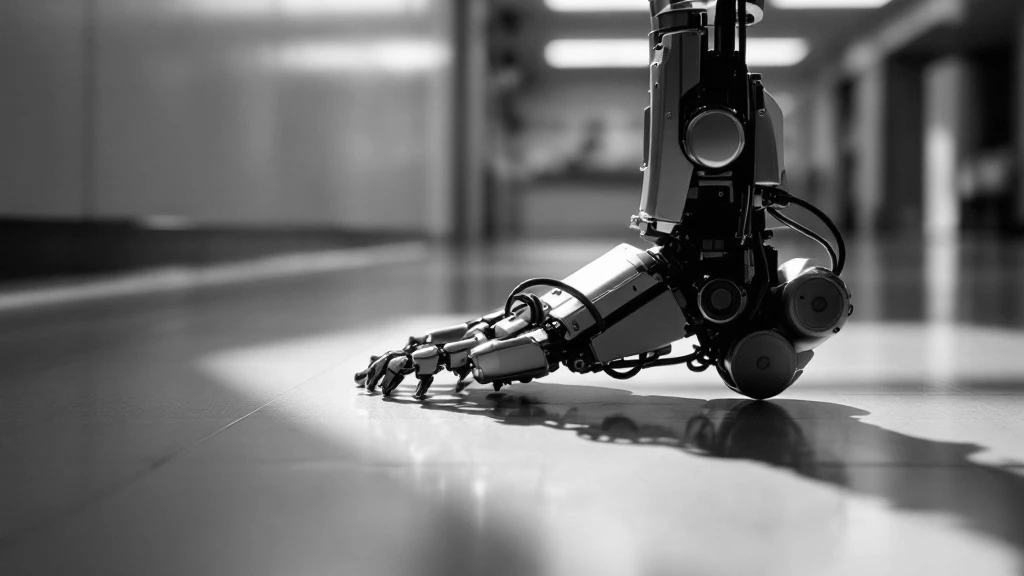
The Magnetic Guardrail: How a 1977 Soviet Math Paper Keeps Rockets and Drones on Track
Standard automated flight and robotic controllers crash when unexpected external winds alter machine parameters; sliding mode control clamps the system’s behavior onto an unshakeable mathematical guardrail that ignores external disturbances. Developed in the Soviet Union and translated in 1977 by Vadim Utkin, this robust control architecture is the mathematical backbone steering rocket thrusters, robot arms, and industrial electric motors worldwide.

In automatic control engineering, programming an autopilot for a missile or a flight controller for a drone works great in calm laboratory air. However, in real-world turbulence, sudden crosswinds or unexpected payload weights alter the machine's physical properties, causing standard control algorithms to wobble and spin out of control. Soviet mathematician Vadim Utkin invented an unyielding mathematical guardrail called Sliding Mode Control. Instead of trying to calculate every tiny wind gust, the controller switches high-speed electrical signals back and forth like a magnetic track, forcing the machine to slide along a desired flight path regardless of how violent the storm gets. Utkin’s work became the gold standard of robust engineering control. By steering spacecraft during violent atmospheric reentry, by stabilizing industrial robotic welding arms, and by controlling electric car motor drives with microsecond precision, sliding mode control provides absolute mechanical stability.

Early roboticists spent millions programming complex supercomputers to calculate every single joint angle in robot legs; Tad McGeer proved that a mechanical pair of legs can walk smoothly down a gentle hill powered by gravity alone with zero motors or computers. Published in 1990, this revolutionary paper shifted robotics from brute-force mathematical computation to natural mechanical resonance, inspiring modern bipedal humanoid robots like Boston Dynamics’ Atlas.

Walking on Gravity: How a 1990 Paper Taught Stiff Robots to Walk Like Humans
Early roboticists spent millions programming complex supercomputers to calculate every single joint angle in robot legs; Tad McGeer proved that a mechanical pair of legs can walk smoothly down a gentle hill powered by gravity alone with zero motors or computers. Published in 1990, this revolutionary paper shifted robotics from brute-force mathematical computation to natural mechanical resonance, inspiring modern bipedal humanoid robots like Boston Dynamics’ Atlas.
In early humanoid robotics, walking robots walked with rigid, stiff-legged steps, consuming massive electrical battery power because onboard computers were constantly forcing electric motors to calculate and correct every joint movement sixty times a second. Canadian aerospace engineer Tad McGeer realized that human legs are natural pendulums. By designing a purely mechanical set of hinged metal legs with no motors, no batteries, and no microchips, he demonstrated that the machine walked down a gentle slope with human-like graceful strides using only gravity and momentum. McGeer’s paper revolutionized the philosophy of robotics design. By teaching roboticists to work with gravity instead of fighting it, by slashing the battery consumption of prosthetic legs, and by enabling agile bipedal humanoid robots, passive dynamic mechanics humanized robotics.

Most fast-conducting solid electrolytes corrode into useless sludge when they touch pure metallic lithium; garnet-type ceramic crystals conduct lithium ions rapidly while remaining completely impervious to corrosive lithium metal. Discovered in 2003 by Thangadurai and Weppner, this sleeping beauty crystal is now the foundational solid electrolyte behind multi-billion-dollar solid-state battery startups like QuantumScape.

The Indestructible Rock: How a 2003 German Discovery Unlocked 600-Mile EV Batteries
Most fast-conducting solid electrolytes corrode into useless sludge when they touch pure metallic lithium; garnet-type ceramic crystals conduct lithium ions rapidly while remaining completely impervious to corrosive lithium metal. Discovered in 2003 by Thangadurai and Weppner, this sleeping beauty crystal is now the foundational solid electrolyte behind multi-billion-dollar solid-state battery startups like QuantumScape.
For decades, battery scientists knew that replacing graphite anodes with pure metallic lithium could double electric car range overnight. However, pure metallic lithium is chemically violent: it instantly corrodes and destroys almost every known solid ceramic electrolyte on contact. Two German materials scientists discovered an indestructible mineral fortress: garnet-type lithium ceramics. The garnet crystal lattice contains interconnected 3D tunnels where lithium ions slide effortlessly, while the surrounding lanthanum and tantalum atoms form a rock-hard shield that ignores corrosive lithium metal completely. This 2003 discovery ignited the global solid-state battery boom. By enabling safe pure lithium metal anodes, by eliminating flammable battery solvents, and by promising electric vehicle ranges exceeding six hundred miles, garnet ceramics drive the clean transport future.

Rigid solid battery electrodes lose contact with solid electrolytes as materials expand and shrink during charging; Michel Armand blended conductive polymers directly into the electrode to maintain seamless atomic contact. Published in 1980, this pioneer composite architecture solved the interfacial resistance bottleneck that makes modern solid-state electric vehicle batteries possible.

The Dual-Lane Highway: How a 1980 Chemistry Paper Solved Solid-State Battery Wear
Rigid solid battery electrodes lose contact with solid electrolytes as materials expand and shrink during charging; Michel Armand blended conductive polymers directly into the electrode to maintain seamless atomic contact. Published in 1980, this pioneer composite architecture solved the interfacial resistance bottleneck that makes modern solid-state electric vehicle batteries possible.
In early solid-state battery experiments, pressing two rigid solid materials together worked for a few minutes, but failed quickly during charging. As battery particles expanded and contracted, microscopic air gaps opened between the solid surfaces, breaking electrical contact and stopping power flow. French electrochemist Michel Armand designed a composite electrode that acts like a flexible dual-lane highway. By blending an elastic, conductive polymer throughout the electrode, electrons and lithium ions can flow smoothly through flexible molecular bridges that stay glued to the battery particles even as they swell. This 1980 composite concept is the standard manufacturing recipe for commercial solid-state batteries. By eliminating dangerous liquid solvents, by preventing battery swelling failures, and by ensuring long cycle life for electric cars, polymer composite electrodes power clean transport.

Traditional optical chipmaking lenses become completely opaque to deep ultraviolet wavelengths; Hiroo Kinoshita carved microchip circuits using extreme ultraviolet soft X-rays reflected off atomic-precision multilayer mirrors. Published in 1989 when the industry deemed X-ray lithography an impossible fantasy, Kinoshita’s experimental setup became the physical foundation of the multi-billion-dollar ASML EUV machines that print the world's most advanced computer chips.

The Atomic Mirror Telescope: How a 1989 Japanese Paper Made Modern Microchips Possible
Traditional optical chipmaking lenses become completely opaque to deep ultraviolet wavelengths; Hiroo Kinoshita carved microchip circuits using extreme ultraviolet soft X-rays reflected off atomic-precision multilayer mirrors. Published in 1989 when the industry deemed X-ray lithography an impossible fantasy, Kinoshita’s experimental setup became the physical foundation of the multi-billion-dollar ASML EUV machines that print the world's most advanced computer chips.
In semiconductor fabrication, printing smaller transistors requires shining light with smaller wavelengths through glass lenses. However, as wavelengths approached extreme ultraviolet, a physical wall was hit: glass lenses absorbed the light like concrete, making traditional camera optics useless. Japanese physicist Hiroo Kinoshita realized that instead of shining light through glass lenses, chipmakers had to bounce soft X-rays off ultra-smooth atomic mirrors in a total vacuum. By coating mirrors with alternating layers of molybdenum and silicon, his team created an atomic telescope capable of focusing 13.5-nanometer light onto silicon. Dormant for three decades while the industry stretched immersion lithography to its limits, Kinoshita's mirror design now powers the global microchip supply chain. By printing the world's fastest two-nanometer AI processors, by enabling ASML’s $300-million lithography machines, and by driving global technology geopolitics, EUV mirror physics shapes human civilization.

Flat two-dimensional transistors leaked electrical current uncontrollably when shrunk down to nanoscale sizes; Digh Hisamoto stood the silicon channel up vertically into a three-dimensional fin wrapped on three sides by the gate. Published in 1989 and ignored for two decades while planar chips dominated, this Japanese invention gave birth to the 3D FinFET transistor powering every modern smartphone and AI processor.

The 3D Shark Fin: How a 1989 Japanese Invention Rescued the Future of Microchips
Flat two-dimensional transistors leaked electrical current uncontrollably when shrunk down to nanoscale sizes; Digh Hisamoto stood the silicon channel up vertically into a three-dimensional fin wrapped on three sides by the gate. Published in 1989 and ignored for two decades while planar chips dominated, this Japanese invention gave birth to the 3D FinFET transistor powering every modern smartphone and AI processor.
In the late 1980s, computer chip manufacturing was strictly two-dimensional: transistors were printed flat on silicon wafers like ink on paper. However, physics warned that when flat transistors shrunk below one hundred nanometers, electrical current would leak right through the gate, overheating chips and ending Moore's Law. Japanese engineer Digh Hisamoto solved this by turning the transistor into a 3D shark fin. Instead of laying the channel flat, he stood it up on its side and wrapped the electrical gate around three sides of the fin—like gripping a garden hose with both hands to shut off a leak completely. Overlooked for twenty years until flat chips hit a physical wall in 2011, FinFET saved modern computing. By slashing electrical power leakage by ninety percent, by enabling sub-five-nanometer smartphone processors, and by powering modern artificial intelligence supercomputers, 3D transistors keep the digital revolution alive.

Storing millions of search queries in computer memory wastes vast amounts of expensive hardware; Bloom filters verify whether a record exists using a tiny fraction of a single bit per item. Published in 1970 to speed up hyphenation in typesetting machines, Burton Bloom’s compact data structure now speeds up every Google search query and Bitcoin transaction on Earth.

The Lightning Bouncer: How a 1970 Math Trick Speeds Up Every Search on Earth
Storing millions of search queries in computer memory wastes vast amounts of expensive hardware; Bloom filters verify whether a record exists using a tiny fraction of a single bit per item. Published in 1970 to speed up hyphenation in typesetting machines, Burton Bloom’s compact data structure now speeds up every Google search query and Bitcoin transaction on Earth.
In massive planetary databases and web search engines, checking whether a specific user or malicious web link exists across billions of stored records requires reading slow computer hard drives, creating massive bottlenecks when millions of people search simultaneously. In 1970, computer pioneer Burton Bloom designed a lightning-fast bouncer that fits in microscopic computer memory. By running an item through several mathematical formulas to flip tiny digital switches in a tiny bit array, the filter can instantly tell you if an item is definitely NOT in the database without reading a single disk. This fifty-year-old discovery is the silent engine of modern internet speed. By preventing millions of unnecessary database disk reads every second, by speeding up cryptocurrency blockchain syncs, and by blocking malicious websites in web browsers, Bloom filters keep the internet fast.

Early distributed consensus protocols assumed network computers were honest; Practical Byzantine Fault Tolerance proved that computer clusters can reach mathematical agreement even when one-third of the servers are actively malicious traitors. Developed in 1999 by Turing Award laureate Barbara Liskov, this sleeping giant became the consensus engine behind modern enterprise blockchains.

The Traitor-Proof Network: How a 1999 Paper Taught Computers to Agree in the Fog of War
Early distributed consensus protocols assumed network computers were honest; Practical Byzantine Fault Tolerance proved that computer clusters can reach mathematical agreement even when one-third of the servers are actively malicious traitors. Developed in 1999 by Turing Award laureate Barbara Liskov, this sleeping giant became the consensus engine behind modern enterprise blockchains.
In distributed computing, keeping thousands of banking servers in perfect sync is easy if every computer tells the truth. However, if a sophisticated hacker compromises several servers and commands them to send conflicting financial numbers to their peers, traditional distributed networks collapse into chaos. MIT computer scientists created a mathematical voting system designed to defeat traitors. Operating like a courtroom of skeptical judges, servers cross-verify every proposed transaction in a three-stage voting round, ensuring that the network agrees on the exact truth even if one out of every three servers is lying. Overlooked for a decade before the cryptocurrency revolution, PBFT is the foundation of high-speed consensus. By processing thousands of financial transactions per second, by eliminating energy-wasting mining rigs, and by defending enterprise blockchains against rogue actors, traitor-proof consensus protects global digital ledgers.

Computer scientists spent decades defending software from malicious executable code; Battista Biggio proved that artificial intelligence can be corrupted by quietly spiking its training data. Published in 2012 when machine learning was still a niche academic field, this foundational paper founded the modern discipline of AI data security and model supply-chain defense.

Spiking the Data Well: How a 2012 Paper Showed Hackers Could Poison AI Brains
Computer scientists spent decades defending software from malicious executable code; Battista Biggio proved that artificial intelligence can be corrupted by quietly spiking its training data. Published in 2012 when machine learning was still a niche academic field, this foundational paper founded the modern discipline of AI data security and model supply-chain defense.
In cybersecurity, firewalls and antivirus scanners were built to stop hackers from executing unauthorized software code on computer servers. When the world switched to artificial intelligence, developers naively assumed that feeding computers vast amounts of public web data was completely harmless. Researchers proved that hackers could poison an AI without writing a single line of malicious code. By injecting a tiny handful of carefully crafted fake data points into the training dataset—like dropping an invisible drop of toxin into a municipal reservoir—an attacker can secretly blind the AI to specific threats. Ignored before the deep learning boom, this paper founded the field of AI supply-chain security. By teaching engineers to sanitize training datasets, by defending autonomous vehicle vision systems from sabotage, and by protecting enterprise AI from backdoors, data poisoning defense safeguards artificial intelligence.

Dense neural networks waste massive electrical power by firing every single artificial neuron for every simple word; Mixture-of-Experts routes specific questions only to the specialized sub-networks that understand them. Published in 2017 when hardware was too immature to run it, this paper is now the core architectural engine powering leading trillion-parameter models like Mixtral and GPT-4.

The Panel of Specialists: How a 2017 Paper Made Trillion-Parameter AI Run on Normal Servers
Dense neural networks waste massive electrical power by firing every single artificial neuron for every simple word; Mixture-of-Experts routes specific questions only to the specialized sub-networks that understand them. Published in 2017 when hardware was too immature to run it, this paper is now the core architectural engine powering leading trillion-parameter models like Mixtral and GPT-4.
In generative AI scaling, making neural networks smarter historically meant making them denser—forcing the computer to calculate hundreds of billions of math equations just to generate the word "the." This computational brute force caused AI training costs and energy bills to explode. Google researchers designed a smarter architecture called Mixture of Experts. Instead of waking up an entire office building to answer a simple question, a smart triage receptionist routes the user's query only to the two or three specialists in the building who are experts on that specific topic. Overlooked for years until memory architectures caught up, MoE is now the gold standard of high-efficiency AI. By slashing electrical power consumption by eighty percent, by enabling trillion-parameter reasoning models on consumer servers, and by democratizing open-weights AI, sparse mixture routing powers the frontier.

Early neural networks were blind to complex real-world relationships because they could only process flat grids of pixels and linear lines of text; Graph Neural Networks allow AI to navigate interconnected networks of molecules, social circles, and traffic maps. Ignored for over a decade during the computer vision boom, this 2005 architecture is now the computational engine behind AI drug discovery and AlphaFold.

Thinking in Webs: How a 2005 Paper Taught AI to Design Medicines and Map the World
Early neural networks were blind to complex real-world relationships because they could only process flat grids of pixels and linear lines of text; Graph Neural Networks allow AI to navigate interconnected networks of molecules, social circles, and traffic maps. Ignored for over a decade during the computer vision boom, this 2005 architecture is now the computational engine behind AI drug discovery and AlphaFold.
In early deep learning, computers were brilliant at analyzing flat photo grids and sentences of text, but completely helpless when trying to understand the real world. Complex systems like human social networks, electrical power grids, and chemical molecules do not fit onto flat grids. Italian researchers invented a way to teach AI to think in webs and networks: Graph Neural Networks. By allowing connected nodes in a web to pass information back and forth like neighbors whispering over a garden fence, the AI learns how individual parts influence the whole system. Dormant until computational chemistry boomed, GNNs revolutionized modern science. By discovering new life-saving antibiotic drugs, by predicting how complex proteins fold in 3D biology, and by routing global shipping logistics, graph neural networks model the interconnected universe.

In the mid-1990s, computer security viewed cryptography exclusively as a defensive shield for privacy; Adam Young and Moti Yung proved that public-key mathematics could be weaponized into an unstoppable digital hostage weapon. Ignored for nearly two decades as an academic thought experiment, this 1996 paper laid the exact technical blueprint for modern ransomware epidemics like WannaCry.

The Digital Hostage: How a Ignored 1996 Paper Predicted the Ransomware Epidemic
In the mid-1990s, computer security viewed cryptography exclusively as a defensive shield for privacy; Adam Young and Moti Yung proved that public-key mathematics could be weaponized into an unstoppable digital hostage weapon. Ignored for nearly two decades as an academic thought experiment, this 1996 paper laid the exact technical blueprint for modern ransomware epidemics like WannaCry.
In 1996, computer viruses were largely treated as annoying digital vandalism that displayed prank messages or wiped hard drives clean. The cybersecurity world believed that public-key encryption was a purely defensive tool designed to protect passwords and secure online banking. Two cryptographers demonstrated that encryption could be turned into an offensive weapon: digital extortion. By using a one-way mathematical padlock, malicious software could secretly lock a victim’s personal files, making it mathematically impossible to recover the data without paying a ransom for the decryption key. Dismissed for years until anonymous cryptocurrency gave hackers a payment mechanism, this dormant paper predicted modern cyberwarfare. By exposing how one-way encryption could paralyze global hospitals, by teaching defenders how to build immutable offline backups, and by founding defensive cryptovirology, this 1996 warning reshaped global cybersecurity.

Layered cobalt cathodes suffer from severe supply-chain bottlenecks and thermal instability; spinel manganese dioxide provides a three-dimensional cubic lattice that shuttles lithium ions safely without cobalt. Discovered as a novel synthetic method in 1981, Hunter’s spinel crystal is now the ethical foundation of low-cost electric vehicle and grid batteries.

The 3D Atomic Lattice: How a 1981 Chemistry Paper Freed Batteries from Toxic Cobalt
Layered cobalt cathodes suffer from severe supply-chain bottlenecks and thermal instability; spinel manganese dioxide provides a three-dimensional cubic lattice that shuttles lithium ions safely without cobalt. Discovered as a novel synthetic method in 1981, Hunter’s spinel crystal is now the ethical foundation of low-cost electric vehicle and grid batteries.
As the world transitions toward electric transport and large-scale renewable power grids, the battery industry is constrained by the extreme financial and human costs of mined cobalt. Standard layered batteries remain vulnerable to thermal fires when pushed to fast-charging limits. In 1981, solid-state chemist J.C. Hunter discovered how to hollow out abundant manganese ore into a three-dimensional atomic jungle gym. Instead of flat layers that collapse under stress, the manganese crystal creates a rigid 3D framework that allows lithium ions to sprint in all directions simultaneously during fast charging. This dormant crystal blueprint provides an ethical, fire-safe battery cathode. By eliminating reliance on scarce cobalt mines, by slashing battery cathode costs by seventy percent, and by delivering exceptional thermal safety, spinel manganese powers sustainable electric transport.

Standard carbon filtration only transfers toxic PFAS from groundwater into solid waste; anodic electrochemical oxidation tears the fluorocarbon spine apart at the electrode surface. Published in 2008 before federal drinking-water standards existed, this paper established the electrochemical blueprint for total forever-chemical destruction.

Stripping the Shield: How a 2008 Electrochemical Setup Cracks Forever Chemicals
Standard carbon filtration only transfers toxic PFAS from groundwater into solid waste; anodic electrochemical oxidation tears the fluorocarbon spine apart at the electrode surface. Published in 2008 before federal drinking-water standards existed, this paper established the electrochemical blueprint for total forever-chemical destruction.
Long before governments established strict parts-per-trillion drinking water limits on toxic forever chemicals, environmental engineers lacked any non-thermal method to destroy fluorinated pollutants on-site. Traditional methods simply trapped the poison in charcoal filters, leaving a hazardous waste problem behind. In 2008, Caltech chemists introduced an electrified diamond electrode that acts as an atomic guillotine. By running electricity through lab-grown synthetic diamond plates, the extreme electrical charge pulls electrons directly out of the chemical’s protective head-group, causing the entire fluorocarbon spine to unravel instantly. This early electrochemical study is now the engineering blueprint for modern water treatment plants. By destroying concentrated chemicals directly on-site, by eliminating high-temperature incinerators, and by purifying contaminated municipal groundwater, diamond electrochemical reactors provide absolute water safety.

Thermal melting degrades recycled plastics into brittle, low-value textiles; bacterial cutinases disassemble rigid synthetic polymers back into pure, virgin-grade chemical building blocks. Initially overlooked as a slow academic oddity in 2005, this enzymatic breakdown process now powers commercial bio-recycling plants that digest plastic waste in hours.

The Plastic-Eating Enzyme: How a Forgotten 2005 Bacterium Solved the Polyester Waste Crisis
Thermal melting degrades recycled plastics into brittle, low-value textiles; bacterial cutinases disassemble rigid synthetic polymers back into pure, virgin-grade chemical building blocks. Initially overlooked as a slow academic oddity in 2005, this enzymatic breakdown process now powers commercial bio-recycling plants that digest plastic waste in hours.
Every year, hundreds of millions of tons of plastic water bottles and polyester fabrics end up in landfills because traditional mechanical recycling degrades plastic quality with every melt cycle. Clear plastic bottles could only be downcycled once or twice before turning into useless, brittle waste. In 2005, microbiologists discovered that soil bacteria from compost heaps possessed a natural protein capable of cutting plastic. The bacterial enzyme behaves like a pair of molecular scissors, selectively snipping synthetic polyester bonds and disassembling complex plastics into pristine liquid chemical ingredients. This dormant biological discovery enables infinitely circular recycling. By digesting mixed colored fabrics without manual sorting, by producing virgin-grade plastic bottles from landfill waste, and by operating in room-temperature water baths, enzyme bio-recycling eliminates plastic pollution.

Mechanical scotch-tape peeling produces only microscopic flakes of pristine graphene; William Hummers’ 1958 chemical recipe exfoliates bulk graphite into tons of water-dispersible two-dimensional sheets. Dormant for nearly half a century, "Hummers' Method" is now the indispensable global manufacturing route for 2D water-purification membranes and conductive composites.

The 1958 Acid Bath Recipe that Built the Wonder Material Age
Mechanical scotch-tape peeling produces only microscopic flakes of pristine graphene; William Hummers’ 1958 chemical recipe exfoliates bulk graphite into tons of water-dispersible two-dimensional sheets. Dormant for nearly half a century, "Hummers' Method" is now the indispensable global manufacturing route for 2D water-purification membranes and conductive composites.
When physicists discovered that single-atom-thick graphene was the strongest and most conductive material in the world, the global manufacturing sector faced an embarrassing roadblock. The only way to make it was peeling graphite with adhesive tape—yielding microscopic flakes barely visible under a microscope. The scalable solution had been written in 1958 by William Hummers: an aggressive chemical oxidation bath of sulfuric acid and permanganate. The chemicals act like microscopic crowbars, jamming oxygen wedges between tightly stacked carbon sheets and forcing them to peel apart into liquid suspensions of single-atom layers. This fifty-year-old recipe unlocked mass-produced nanomaterials. By filtering salt from ocean water with atomic membranes, by creating ultra-fast conductive inks for flexible circuits, and by reinforcing lightweight aerospace plastics, chemical exfoliation powers the nanomaterial revolution.

Heavy nickel and cobalt cathodes limit the flight range of electric aircraft; abundant elemental sulfur offers five times the theoretical energy storage capacity at a fraction of the cost. Ignored for three decades due to rapid polysulfide dissolution, this 1979 paper laid the electrochemical blueprint for lightweight aviation batteries.

The Yellow Powder Miracle: How a 1979 Battery Paper Holds the Key to Electric Flight
Heavy nickel and cobalt cathodes limit the flight range of electric aircraft; abundant elemental sulfur offers five times the theoretical energy storage capacity at a fraction of the cost. Ignored for three decades due to rapid polysulfide dissolution, this 1979 paper laid the electrochemical blueprint for lightweight aviation batteries.
In the quest to build electric regional airplanes and long-haul trucks, battery packs are weighed down by heavy, mined metals like cobalt and nickel. Lithium-ion batteries are simply too heavy to get passenger planes off the ground for long journeys. In 1979, battery researchers discovered that abundant, lightweight yellow sulfur could store five times more electrical energy than cobalt. The early challenge was that sulfur dissolved into battery fluids like sugar in tea, but this paper laid out the exact chemical ether solvents needed to stabilize sulfur ions. Awakened by the electric flight race, sulfur electrochemistry is making zero-emission flight a reality. By eliminating reliance on scarce cobalt mines, by slashing battery manufacturing costs by half, and by cutting battery weight by sixty percent, lithium-sulfur chemistry unlocks electric aviation.

Electrochemical reduction of carbon dioxide typically produced only simple toxic carbon monoxide; Yoshio Hori discovered that plain metallic copper possessed the unique ability to forge multi-carbon hydrocarbons at room temperature. Dormant for a quarter century when oil was cheap, this 1985 breakthrough is now the foundational engine of the synthetic e-fuel industry.

The Copper Catalyst Miracle: How a 1985 Japanese Paper Turned Greenhouse Gas into Fuel
Electrochemical reduction of carbon dioxide typically produced only simple toxic carbon monoxide; Yoshio Hori discovered that plain metallic copper possessed the unique ability to forge multi-carbon hydrocarbons at room temperature. Dormant for a quarter century when oil was cheap, this 1985 breakthrough is now the foundational engine of the synthetic e-fuel industry.
In an era when factory exhaust was treated as an unfixable waste product, and clean synthetic fuels seemed chemically impossible, chemistry lacked a way to recycle carbon dioxide back into useful industrial energy. Petroleum was cheap, and carbon recycling research was dismissed. In 1985, Japanese electrochemist Yoshio Hori discovered a catalytic secret hidden in ordinary copper wire. When electricity was run through copper immersed in water and carbon dioxide, the metal acted like a molecular tuning fork, holding carbon fragments at the exact atomic spacing needed to stitch them into methane and ethylene fuels. This dormant discovery is now the engine of clean aviation fuels and net-zero plastics. By pairing copper reactors with renewable wind energy, by turning industrial smokestacks into fuel factories, and by eliminating fossil crude oil, copper electrocatalysis closes the global carbon loop.

Traditional porous minerals like zeolites were limited by rigid silicon geometries; Bernard Hoskins and Richard Robson envisioned infinite crystalline lattices built from modular metal nodes and organic struts. Ignored for a decade as an impractical chemical oddity, this 1990 paper provided the structural foundation for modern metal-organic frameworks that trap carbon directly from thin air.

The Empty Crystal: How a Forgotten 1990 Paper Built the Scaffolding for Carbon Traps
Traditional porous minerals like zeolites were limited by rigid silicon geometries; Bernard Hoskins and Richard Robson envisioned infinite crystalline lattices built from modular metal nodes and organic struts. Ignored for a decade as an impractical chemical oddity, this 1990 paper provided the structural foundation for modern metal-organic frameworks that trap carbon directly from thin air.
For decades, scientists assumed that porous crystals could only exist as naturally occurring, heavy volcanic rocks with fixed microscopic hole sizes. Industrial gas separation and moisture harvesting remained limited by the rigid molecular shapes of natural minerals. In 1990, two Australian chemists introduced a radical concept: building crystals like molecular Tinkertoys. By using metal ions as corner joints and linking them with rigid organic rods, they constructed infinite three-dimensional scaffolds that were mostly empty space inside. Ignored for a decade, this dormant blueprint became the basis for metal-organic frameworks (MOFs). By capturing carbon dioxide at smokestacks, by pulling drinking water from desert air, and by storing explosive hydrogen fuel safely, modular framework crystals protect our planet.

Psychologists assumed that violent mob riots were caused by crowds filled with violent individuals; Mark Granovetter proved that peaceful citizens will join a riot if each person’s individual threshold triggers the next person like falling dominoes. Published in 1978, Granovetter’s "Threshold Model" founded the mathematics of social contagion, explaining how viral internet memes, financial bank runs, and sudden political revolutions explode into reality.

The Social Domino: How Mark Granovetter Decoded Riots and Viral Trends
Psychologists assumed that violent mob riots were caused by crowds filled with violent individuals; Mark Granovetter proved that peaceful citizens will join a riot if each person’s individual threshold triggers the next person like falling dominoes. Published in 1978, Granovetter’s "Threshold Model" founded the mathematics of social contagion, explaining how viral internet memes, financial bank runs, and sudden political revolutions explode into reality.
In crowd psychology, when a peaceful street protest suddenly turns into a riot or a new fashion trend goes viral overnight, observers assume the entire crowd suddenly went crazy or shared identical extreme desires. Stanford sociologist Mark Granovetter proved that collective actions are like falling dominoes: everyone has a different personal "threshold"—the number of people who must act before they join in. An agitator needs zero followers (threshold 0); a radical needs one follower (threshold 1); an ordinary citizen needs twenty followers. If there is a clean chain (0, 1, 2, 3...), a single rock thrown by one person cascades into a 100-person riot. If just one person in the chain is missing (e.g., no one with threshold 2), nothing happens. By explaining viral social media adoption, by modeling sudden panic bank runs on Wall Street, and by mapping viral crowd dynamics, threshold sociology decodes collective human behavior.

People assumed that a hyper-connected global village would naturally blend humanity into a single unified culture; Robert Axelrod proved with computer simulations that local harmony inevitably fractures societies into isolated polarized tribes. Published in 1997 before the rise of social media, Axelrod’s Culture Model predicted the algorithmic echo chambers dividing modern political life today.

The Echo Chamber Paradox: How Friendly Chats Divide the World into Tribes
People assumed that a hyper-connected global village would naturally blend humanity into a single unified culture; Robert Axelrod proved with computer simulations that local harmony inevitably fractures societies into isolated polarized tribes. Published in 1997 before the rise of social media, Axelrod’s Culture Model predicted the algorithmic echo chambers dividing modern political life today.
In the 1990s, the dawn of the internet sparked idealistic predictions: tech visionaries promised that global communication would break down cultural barriers, allowing people across the world to share ideas and blend into a harmonious global village. Political scientist Robert Axelrod built a computer simulation of human socializing based on a simple rule: people prefer to talk to neighbors who share their existing interests. To everyone's shock, the simulation showed that as neighbors slowly agree with each other, they cut off contact with slightly different neighbors—freezing the digital world into deeply divided cultural islands. Axelrod’s model predicted modern algorithmic echo chambers and political polarization. By explaining why social media naturally divides users into ideological bubbles, by guiding recommender algorithm design, and by advancing computational social science, Axelrod’s model decoded cultural drift.

City planners claimed that toxic garbage landfills were placed in low-income neighborhoods purely by accident based on cheap land prices; Robert Bullard proved that Houston intentionally dumped 100% of its municipal trash dumps into Black neighborhoods. Published in 1983, Bullard’s historic study founded the Environmental Justice movement, establishing that clean air, clean water, and toxic waste zoning are fundamental civil rights issues.

The Toxic Backyard: How Robert Bullard Founded the Environmental Justice Movement
City planners claimed that toxic garbage landfills were placed in low-income neighborhoods purely by accident based on cheap land prices; Robert Bullard proved that Houston intentionally dumped 100% of its municipal trash dumps into Black neighborhoods. Published in 1983, Bullard’s historic study founded the Environmental Justice movement, establishing that clean air, clean water, and toxic waste zoning are fundamental civil rights issues.
In the 1970s, mainstream environmentalism focused almost exclusively on saving whales, protecting wilderness forests, and preserving national parks. No one was paying attention to where toxic chemical plants, garbage incinerators, and city dumps were actually being built in human cities. Sociologist Robert Bullard mapped every municipal landfill in Houston, Texas, over a fifty-year period. The data revealed a shocking pattern of deliberate environmental racism: while Black residents made up only a quarter of Houston's population, every single city-owned garbage dump and eighty-two percent of all commercial waste incinerators were placed directly next to Black homes and elementary schools. Known as the "Father of Environmental Justice," Bullard’s work forced the White House to issue the historic 1994 Environmental Justice Executive Order. By proving that pollution follows racial lines, by integrating civil rights with ecological protection, and by protecting vulnerable communities from toxic dumping, environmental sociology defends human dignity.

Ancient proverbs declared that "the enemy of my enemy is my friend"; Fritz Heider proved mathematically that all human social networks naturally rearrange themselves into harmonious balanced triangles to avoid psychological tension. Published in 1946, Heider’s Structural Balance Theory founded modern social network analysis, providing the underlying graph mathematics that explains global geopolitical alliances, corporate office politics, and social media polarization algorithms today.

The Friend of My Friend: How Fritz Heider Decoded the Mathematics of Alliances
Ancient proverbs declared that "the enemy of my enemy is my friend"; Fritz Heider proved mathematically that all human social networks naturally rearrange themselves into harmonious balanced triangles to avoid psychological tension. Published in 1946, Heider’s Structural Balance Theory founded modern social network analysis, providing the underlying graph mathematics that explains global geopolitical alliances, corporate office politics, and social media polarization algorithms today.
In human relationships, we all know the awkward tension when your two best friends suddenly have a bitter falling out: you are caught in the middle of an uncomfortable social triangle, and the situation feels mentally unstable until something changes. Austrian psychologist Fritz Heider turned social triangles into exact mathematics: "The P-O-X Model." He proved that human minds cannot tolerate unbalanced triangles (where you like two people who hate each other). To eliminate mental stress, people naturally adjust their feelings—either convincing the two friends to make up, or taking a side and ending one friendship. Heider’s balance rules govern entire societies. By explaining why world nations form binary military alliances like NATO, by predicting how social media users divide into polarized echo chambers, and by anchoring complex graph theory, structural balance maps the human social web.

People routinely lie when asked sensitive questions about tax cheating, drug use, or criminal behavior; Stanley Warner invented a private coin-flipping technique that gives every survey respondent total legal plausible deniability while allowing pollsters to measure the exact truth. Published in 1965, Warner’s "Randomized Response" became the foundational mathematical ancestor of modern Differential Privacy—the core algorithm protecting data privacy in Apple iPhones, Google search, and the US Census.

The Secret Coin Flip: How a 1965 Math Trick Invented Modern Data Privacy
People routinely lie when asked sensitive questions about tax cheating, drug use, or criminal behavior; Stanley Warner invented a private coin-flipping technique that gives every survey respondent total legal plausible deniability while allowing pollsters to measure the exact truth. Published in 1965, Warner’s "Randomized Response" became the foundational mathematical ancestor of modern Differential Privacy—the core algorithm protecting data privacy in Apple iPhones, Google search, and the US Census.
In polling and social science, getting honest answers about sensitive topics—like tax fraud, illegal drug use, or marital infidelity—was historically impossible: respondents either refuse to answer or lie to protect their privacy and avoid legal trouble. Statistician Stanley Warner designed an ingenious privacy shield. Before answering "Yes" or "No", the respondent secretly flips a coin that the surveyor cannot see: if it lands Heads, they tell the absolute truth; if it lands Tails, they simply answer "Yes." Because no one knows whether a "Yes" was forced by the coin or represents the truth, the respondent has total plausible deniability, while simple probability math allows the researcher to subtract the coin flips and calculate the true population percentage. Warner’s method unlocked honest social polling and founded modern cybersecurity. By protecting survey respondents from legal exposure, by inspiring differential privacy in tech giants like Apple and Google, and by securing the US Census, randomized response protects digital privacy.

Digital data is inherently easy to copy, clone, and counterfeit with perfect fidelity; Stephen Wiesner proved that storing information in polarized photons makes it physically impossible to counterfeit banknotes without destroying the quantum evidence. Rejected by academic journals for fifteen years, Wiesner’s 1968 paper on "Conjugate Coding" founded quantum cryptography, directly inspiring the famous BB84 quantum encryption protocol protecting modern government communications.

The Uncopyable Dollar: How Stephen Wiesner Invented Quantum Cryptography
Digital data is inherently easy to copy, clone, and counterfeit with perfect fidelity; Stephen Wiesner proved that storing information in polarized photons makes it physically impossible to counterfeit banknotes without destroying the quantum evidence. Rejected by academic journals for fifteen years, Wiesner’s 1968 paper on "Conjugate Coding" founded quantum cryptography, directly inspiring the famous BB84 quantum encryption protocol protecting modern government communications.
In the digital world, every string of 1s and 0s can be duplicated endlessly: whether it is a digital dollar, an encrypted password, or a computer file, hackers can copy the data without leaving a single trace. Columbia University graduate student Stephen Wiesner realized that quantum mechanics has a built-in anti-counterfeiting shield. By storing secret serial numbers inside isolated polarized photons, Heisenberg’s uncertainty principle guarantees that anyone who tries to read or photocopy the quantum banknote will inevitably scramble the photon’s polarization, exposing the counterfeiter instantly. Wiesner’s paper was rejected everywhere until published in a computer newsletter in 1983. By inspiring Charles Bennett and Gilles Brassard to create BB84 quantum key distribution, by proving that quantum states cannot be cloned, and by launching quantum cryptography, conjugate coding defends digital security.

Niels Bohr taught that observing a quantum particle mysteriously collapses all alternate possibilities out of existence; Hugh Everett III proved that the mathematical equations of quantum physics never collapse at all, meaning every possible outcome actually happens in a branching parallel universe. Published in 1957 to career-ending ridicule, Everett’s "Many-Worlds Interpretation" is now one of the dominant frameworks of theoretical physics, driving modern quantum cosmology and quantum computing theory.

The Infinite Tree: How Hugh Everett Invented the Quantum Multiverse
Niels Bohr taught that observing a quantum particle mysteriously collapses all alternate possibilities out of existence; Hugh Everett III proved that the mathematical equations of quantum physics never collapse at all, meaning every possible outcome actually happens in a branching parallel universe. Published in 1957 to career-ending ridicule, Everett’s "Many-Worlds Interpretation" is now one of the dominant frameworks of theoretical physics, driving modern quantum cosmology and quantum computing theory.
In standard quantum mechanics, a subatomic particle can exist in multiple places at once, like a spinning coin in mid-air. The traditional Copenhagen interpretation said that the instant a human looks at the particle, the wave function magically "collapses" into a single reality—an unscientific rule that treated human observers like magic wizards. Princeton graduate student Hugh Everett III looked at the raw mathematics of the Schrödinger equation and asked: what if the wave function never collapses? He showed that when a measurement happens, the universe splits in two: in one branch, the coin lands heads, and in an equally real parallel branch, the coin lands tails. Ostracized by Niels Bohr, Everett left academic physics, but his idea conquered theoretical physics decades later. By eliminating magical wave function collapse, by enabling modern quantum decoherence theory, and by anchoring quantum cosmology, the Many-Worlds interpretation decoded quantum reality.

Computer engineers thought that data was an abstract mathematical concept with zero physical weight; Rolf Landauer proved that erasing a single bit of digital memory produces an unavoidable puff of physical heat. Published in 1961 in an IBM research bulletin, Landauer’s Principle united information theory with the laws of thermodynamics, slaying the 100-year-old "Maxwell’s Demon" paradox and defining the ultimate physical speed and energy limits of modern microchips.

The Cost of Deleting: How Rolf Landauer Proved Information is Physical
Computer engineers thought that data was an abstract mathematical concept with zero physical weight; Rolf Landauer proved that erasing a single bit of digital memory produces an unavoidable puff of physical heat. Published in 1961 in an IBM research bulletin, Landauer’s Principle united information theory with the laws of thermodynamics, slaying the 100-year-old "Maxwell’s Demon" paradox and defining the ultimate physical speed and energy limits of modern microchips.
In early computing, software code was treated like pure abstract thought: whether a computer calculates 2+2 or deletes a document, engineers assumed the calculation had no direct physical connection to heat, believing microchip heating was merely an engineering flaw of copper wires. IBM physicist Rolf Landauer proved the famous slogan: "Information is Physical." When a computer deletes a bit—compressing two possible memory states (0 or 1) down into a single reset state—that lost entropy must go somewhere, forcing the computer to release an exact, irreducible puff of heat into the room: k_B * T * ln(2). Landauer's paper resolved the famous Maxwell's Demon paradox by showing the demon generates heat when erasing its memory. By inspiring reversible adiabatic computing architectures, by establishing the energy limits of supercomputers, and by anchoring quantum computation, Landauer’s principle underpins information physics.

Albert Einstein spent his final decades insisting that quantum entanglement was an incomplete illusion masking hidden common-sense variables; John Stewart Bell devised a single mathematical inequality that allowed laboratory experiments to test whether Einstein or quantum mechanics was right. Published in an obscure, short-lived journal in 1964, Bell’s Theorem proved that the physical universe is fundamentally non-local—founding modern quantum computing, quantum cryptography, and quantum teleportation.

Einstein Was Wrong: How John Bell Proved Quantum Spooky Action is Real
Albert Einstein spent his final decades insisting that quantum entanglement was an incomplete illusion masking hidden common-sense variables; John Stewart Bell devised a single mathematical inequality that allowed laboratory experiments to test whether Einstein or quantum mechanics was right. Published in an obscure, short-lived journal in 1964, Bell’s Theorem proved that the physical universe is fundamentally non-local—founding modern quantum computing, quantum cryptography, and quantum teleportation.

In 1935, Albert Einstein mocked quantum mechanics for predicting "spooky action at a distance"—the idea that measuring one particle instantly dictates the state of another entangled particle across the universe. Einstein argued that particles must carry secret internal instructions (local hidden variables), like a pair of matching shoes packed into two boxes. Northern Irish physicist John Stewart Bell realized this philosophical debate could be settled with pure mathematics. He proved that if Einstein was right and particles had hidden pre-set properties, the statistical correlation between measurements could never exceed a strict mathematical limit: Bell's Inequality. Laboratory experiments smashed Bell's limit, proving Einstein was wrong and quantum entanglement is real. By earning the 2022 Nobel Prize in Physics for Aspect, Clauser, and Zeilinger, by enabling unhackable quantum satellite encryption, and by launching the quantum computer race, Bell's theorem created quantum technology.

Mainstream astronomy invented invisible dark matter particles to explain why outer galaxy stars spin faster than Newton’s laws allow; Mordehai Milgrom proposed that gravity simply gets stronger when accelerations drop to an ultra-slow crawl. Published in 1983 to intense academic skepticism, Modified Newtonian Dynamics (MOND) predicted the exact flat rotation curves and gas fractions of thousands of spiral galaxies, remaining the most resilient theoretical challenge to the dark matter paradigm.

Gravity in the Slow Lane: How a 1983 Theory Challenged the Need for Dark Matter
Mainstream astronomy invented invisible dark matter particles to explain why outer galaxy stars spin faster than Newton’s laws allow; Mordehai Milgrom proposed that gravity simply gets stronger when accelerations drop to an ultra-slow crawl. Published in 1983 to intense academic skepticism, Modified Newtonian Dynamics (MOND) predicted the exact flat rotation curves and gas fractions of thousands of spiral galaxies, remaining the most resilient theoretical challenge to the dark matter paradigm.
When Vera Rubin measured the rotation speeds of spiral galaxies in the 1970s, she discovered that stars on the outer rims were spinning so fast they should fly off into space. Mainstream astrophysics assumed galaxies must be packed with invisible "Dark Matter" that creates extra gravitational glue. Israeli physicist Mordehai Milgrom asked a bold alternative question: what if gravity itself changes? He proposed that when acceleration drops below a tiny cosmic threshold—one ten-billionth of a meter per second squared—gravity stops fading by the square of distance and instead drops much more slowly, holding spinning galaxies together without needing a single gram of dark matter. MOND accurately predicted the exact rotation speeds of thousands of galaxies from their visible stars alone. By challenging the cosmological dogma of invisible matter, by explaining the tight Baryonic Tully-Fisher relation, and by inspiring modified relativistic gravity theories, MOND enriches fundamental physics.

Astrophysicists believed that black holes could only be created by the collapse of giant dying stars; Stephen Hawking proved that the violent pressure cooker of the Big Bang could crush tiny pockets of matter into microscopic black holes the size of an atom. Published in 1971, Hawking’s primordial black hole paper lay dormant for decades until modern gravitational wave detectors and dark matter searches awakened it as one of the leading explanations for the missing mass of our universe.

The Big Bang's Fossils: How Stephen Hawking Predicted Microscopic Black Holes
Astrophysicists believed that black holes could only be created by the collapse of giant dying stars; Stephen Hawking proved that the violent pressure cooker of the Big Bang could crush tiny pockets of matter into microscopic black holes the size of an atom. Published in 1971, Hawking’s primordial black hole paper lay dormant for decades until modern gravitational wave detectors and dark matter searches awakened it as one of the leading explanations for the missing mass of our universe.
In the early 1970s, astronomers believed that black holes were exclusively giant monsters—weighing at least three times the mass of the Sun—formed only when massive stars run out of fuel and collapse. The idea that small, lightweight black holes could exist was dismissed as science fiction. Twenty-nine-year-old British physicist Stephen Hawking calculated that during the first chaotic fraction of a second after the Big Bang, the universe was so dense and violent that sound waves squeezed random pockets of hot radiation, instantly collapsing them into tiny, ancient black holes ranging from the mass of a mountain to the weight of a planet. Hawking's paper led directly to his famous discovery of Hawking Radiation. By providing a natural explanation for cosmic dark matter, by predicting subsolar gravitational wave mergers, and by unifying quantum mechanics with general relativity, primordial black hole physics remains a cornerstone of cosmology.

Young patients with sudden racing heart rates upon standing were routinely misdiagnosed with hysteria and panic attacks; Mayo Clinic neurologist Phillip Low proved that a damaged autonomic nervous system allows blood to pool in the legs, forcing the heart into frantic tachycardia. Published in Neurology in 1993, this landmark paper formally defined Postural Orthostatic Tachycardia Syndrome (POTS), providing the diagnostic foundation for millions of patients battling post-viral autonomic conditions and Long COVID today.

The Standing Reflex: How a 1993 Mayo Clinic Paper Solved the Mystery of POTS
Young patients with sudden racing heart rates upon standing were routinely misdiagnosed with hysteria and panic attacks; Mayo Clinic neurologist Phillip Low proved that a damaged autonomic nervous system allows blood to pool in the legs, forcing the heart into frantic tachycardia. Published in Neurology in 1993, this landmark paper formally defined Postural Orthostatic Tachycardia Syndrome (POTS), providing the diagnostic foundation for millions of patients battling post-viral autonomic conditions and Long COVID today.
For decades, hundreds of thousands of young, previously athletic patients—predominantly young women—experienced debilitating dizziness, brain fog, and fainting whenever they stood up. Medical doctors repeatedly dismissed their symptoms as anxiety, panic disorders, or chronic hyperventilation. Mayo Clinic neurologist Phillip Low discovered a clear physical neurological disorder: POTS. When a healthy person stands up, the autonomic nervous system automatically squeezes blood vessels in the legs to push blood up to the brain. In POTS patients, this reflex fails, allowing blood to pool in the lower body and forcing the heart to race by thirty to fifty beats a minute just to prevent the brain from fainting. Low established the first objective tilt-table diagnostic criteria for autonomic dysfunction. By giving millions of dismissed patients a biological diagnosis, by guiding modern autonomic rehabilitation protocols, and by serving as the clinical foundation for post-viral Long COVID research, POTS neurology validates autonomic medicine.

When financial analysts analyze thousands of stocks with limited historical data, pure random noise masquerades as fake trading patterns; Vladimir Marchenko and Leonid Pastur calculated the exact mathematical boundary where random noise stops and true signal begins. Published in Soviet mathematics in 1967, the Marchenko-Pastur Law is now the universal filter used by quantitative hedge funds, telecommunication engineers, and neural network researchers to purge noise from high-dimensional datasets.

The Noise Filter: How a 1967 Soviet Paper Separates Real Signals from Big Data Chaos
When financial analysts analyze thousands of stocks with limited historical data, pure random noise masquerades as fake trading patterns; Vladimir Marchenko and Leonid Pastur calculated the exact mathematical boundary where random noise stops and true signal begins. Published in Soviet mathematics in 1967, the Marchenko-Pastur Law is now the universal filter used by quantitative hedge funds, telecommunication engineers, and neural network researchers to purge noise from high-dimensional datasets.
In modern quantitative finance and wireless communications, computers analyze thousands of variables simultaneously—like tracking stock price fluctuations across global markets. However, when the number of variables exceeds the number of data samples, random chance creates hundreds of fake correlations that fool standard algorithms. Soviet mathematicians Vladimir Marchenko and Leonid Pastur derived an exact equation for pure random noise. Their law acts like an acoustic noise filter: it calculates an exact spectral shape that contains 100% of meaningless random noise, proving that any data point lying outside this curve is a genuine real-world signal. Dormant for decades until big data arrived, the Marchenko-Pastur law revolutionized modern analytics. By cleaning noise from quantitative hedge fund portfolios, by optimizing 5G wireless antenna arrays, and by explaining how deep neural networks generalize, random matrix theory extracts truth from data.

Simple machine learning algorithms can only draw straight lines to separate data; Nachman Aronszajn proved that positive-definite kernels calculate complex relationships in infinite-dimensional space without ever computing higher dimensions directly. Published in 1950 as pure functional analysis, Aronszajn’s reproducing kernel theory became the "kernel trick" that powered Support Vector Machines and modern non-linear machine learning.

The Lifting Trick: How a 1950 Math Paper Taught AI to Untangle Complex Data
Simple machine learning algorithms can only draw straight lines to separate data; Nachman Aronszajn proved that positive-definite kernels calculate complex relationships in infinite-dimensional space without ever computing higher dimensions directly. Published in 1950 as pure functional analysis, Aronszajn’s reproducing kernel theory became the "kernel trick" that powered Support Vector Machines and modern non-linear machine learning.
In early artificial intelligence, linear computer algorithms were blind to complex patterns because they could only draw straight lines. If data points formed concentric circles—like a bullseye on a target—a straight ruler could never separate the inner circle from the outer ring. Polish mathematician Nachman Aronszajn provided the mathematical magic wand: Reproducing Kernel Hilbert Spaces. By using a simple kernel formula, data points on flat paper are implicitly lifted into infinite-dimensional space—like popping a flat sheet of rubber into a 3D bowl—where a straight plane can slice the bullseye in half. Dormant for forty years until machine learning adopted it in the 1990s, the "kernel trick" transformed AI. By enabling Support Vector Machines to classify handwriting, by powering Gaussian process optimization in robotics, and by separating complex genetic data, kernel mathematics is foundational to data science.

Most cryptographic systems only guarantee that a mathematical lock is hard to pick on average; Miklós Ajtai proved that breaking a random lattice lock requires an algorithm capable of solving the hardest geometric problem in the entire universe. Published in 1996, Ajtai’s worst-case to average-case reduction is the foundational mathematical theorem behind all post-quantum cryptography protecting global cybersecurity from quantum computers.

The Master Safe: How a 1996 Math Proof Built Quantum-Proof Encryption
Most cryptographic systems only guarantee that a mathematical lock is hard to pick on average; Miklós Ajtai proved that breaking a random lattice lock requires an algorithm capable of solving the hardest geometric problem in the entire universe. Published in 1996, Ajtai’s worst-case to average-case reduction is the foundational mathematical theorem behind all post-quantum cryptography protecting global cybersecurity from quantum computers.
In classical cryptography, algorithms like RSA rely on factoring prime numbers, but mathematicians could never prove that every single RSA key was hard to crack—some randomly generated keys might secretly contain easy shortcuts that hackers could exploit. Hungarian mathematician Miklós Ajtai constructed a mathematical fortress based on high-dimensional lattices. He proved a theorem: if a hacker invents an algorithm that cracks even a random, everyday lattice lock, that exact same algorithm can be used to solve the single most difficult geometric puzzle in the universe. Ajtai’s reduction became the foundation for post-quantum security. By guaranteeing that lattice encryption contains no easy backdoor shortcuts, by resisting Shor’s quantum factoring algorithms, and by anchoring the new NIST post-quantum encryption standards (ML-KEM and Dilithium), Ajtai’s proof defends the future internet.

Error-correcting codes were invented to clean static noise from radio broadcasts; Elwyn Berlekamp and Robert McEliece proved that deliberately scrambling error-correcting codes creates an NP-complete cryptographic lock. Published in 1978 and sidelined for decades due to large key sizes, the McEliece code-based cryptosystem has never been broken in nearly fifty years, standing today as NIST’s premier quantum-resistant encryption standard (Classic McEliece).

The Unbroken Code: How a 1978 Paper Built the 50-Year Unhackable Quantum Vault
Error-correcting codes were invented to clean static noise from radio broadcasts; Elwyn Berlekamp and Robert McEliece proved that deliberately scrambling error-correcting codes creates an NP-complete cryptographic lock. Published in 1978 and sidelined for decades due to large key sizes, the McEliece code-based cryptosystem has never been broken in nearly fifty years, standing today as NIST’s premier quantum-resistant encryption standard (Classic McEliece).
In 1978, when public-key cryptography was born, every system relied on prime number mathematics that could theoretically be reversed by quantum computers. Cryptographers needed a totally different branch of mathematics with proven, unbreakable computational hardness. Information theorists realized that the math used to clean static noise from satellite radio could be turned into a lock. They proved that decoding a scrambled linear radio code is mathematically NP-complete—creating a system where the receiver can effortlessly remove injected noise using a private mathematical secret, while eavesdroppers face an impossible static maze. While RSA dominated the commercial web, McEliece's code-based cipher quietly survived five decades of attacks. By resisting Shor’s quantum algorithm completely, by offering sub-microsecond decryption speeds, and by anchoring NIST’s post-quantum security suite, code-based cryptography protects government and financial networks.

Injecting synthetic mRNA was thought to trigger lethal immune inflammation that killed the host before making any medicine; Katalin Karikó and Drew Weissman swapped a single chemical letter to camouflage mRNA so it slipped past cellular alarms undetected. Published in 2005 after facing career demotions and grant rejections, this discovery won the 2023 Nobel Prize in Medicine and saved tens of millions of lives during the COVID-19 pandemic.

The Camouflage Jacket: How a Rejected 2005 Paper Made mRNA Vaccines Possible
Injecting synthetic mRNA was thought to trigger lethal immune inflammation that killed the host before making any medicine; Katalin Karikó and Drew Weissman swapped a single chemical letter to camouflage mRNA so it slipped past cellular alarms undetected. Published in 2005 after facing career demotions and grant rejections, this discovery won the 2023 Nobel Prize in Medicine and saved tens of millions of lives during the COVID-19 pandemic.
For decades, Hungarian biochemist Katalin Karikó believed that synthetic mRNA could be injected into the human body to teach cells to produce their own customized vaccines and cancer medicines. However, the scientific establishment rejected her work: whenever synthetic RNA entered a living cell, immune alarm sensors went off, triggering violent fever reactions and destroying the RNA. Karikó and immunologist Drew Weissman discovered that natural human RNA contains subtle chemical modifications that synthetic lab RNA lacked. By swapping standard uridine for a modified version called pseudouridine, they gave the synthetic mRNA an invisible camouflage jacket—slipping it past the cell's tripwires and allowing the cell to churn out therapeutic proteins in peace. This 2005 breakthrough became the foundation for the Pfizer-BioNTech and Moderna COVID-19 vaccines. By enabling the fastest vaccine development in human history, by powering personalized mRNA cancer vaccines, and by launching modern genetic medicine, modified mRNA revolutionized human health.

Mysterious repeating DNA sequences in bacteria were dismissed for decades as useless junk DNA; Francisco Mojica discovered that bacteria store stolen snippets of viral DNA like a "Most Wanted" gallery to recognize and destroy invading viruses. Published in 2005 after being rejected by four leading journals, Mojica’s paper unlocked the biological secret of CRISPR, unleashing the greatest gene-editing revolution in human history.

The Bacterial Mugshot Gallery: How a Rejected 2005 Paper Discovered CRISPR
Mysterious repeating DNA sequences in bacteria were dismissed for decades as useless junk DNA; Francisco Mojica discovered that bacteria store stolen snippets of viral DNA like a "Most Wanted" gallery to recognize and destroy invading viruses. Published in 2005 after being rejected by four leading journals, Mojica’s paper unlocked the biological secret of CRISPR, unleashing the greatest gene-editing revolution in human history.
In the 1990s, microbiologists studying the genomes of salt-marsh microbes noticed strange palindromic DNA patterns that repeated over and over with random mystery spacers in between. For years, the scientific establishment ignored these repeats, assuming they were meaningless evolutionary junk. Spanish microbiologist Francisco Mojica typed the mystery spacer sequences into a global DNA database and discovered an astonishing pattern: every single spacer matched the DNA of viruses that attack bacteria. Bacteria were keeping a biological "Most Wanted" photo gallery—storing snippets of past viral invaders so RNA-guided molecular scissors could chop them up upon reinfection. Mojica coined the term CRISPR and proved it was a bacterial immune system. By inspiring Doudna and Charpentier to turn CRISPR into a programmable gene-editing tool, by curing hereditary sickle cell anemia, and by rewriting the code of life, Mojica’s discovery transformed biology.

Newborn babies are naturally protected from sickle cell anemia because they produce healthy fetal hemoglobin; an obscure genetic repressor called BCL11A shuts off this baby blood switch a few months after birth. Discovered in 2008 by Stuart Orkin and Swee Lay Thein, BCL11A became the exact genetic target for Casgevy—the world’s first FDA-approved CRISPR gene-editing medicine that cures sickle cell disease.
Turning the Baby Blood Switch Back On: The Discovery Behind the First CRISPR Cure
Newborn babies are naturally protected from sickle cell anemia because they produce healthy fetal hemoglobin; an obscure genetic repressor called BCL11A shuts off this baby blood switch a few months after birth. Discovered in 2008 by Stuart Orkin and Swee Lay Thein, BCL11A became the exact genetic target for Casgevy—the world’s first FDA-approved CRISPR gene-editing medicine that cures sickle cell disease.
Sickle cell disease causes red blood cells to deform into stiff, sickle-shaped crescents that block blood vessels, causing excruciating pain crises and early organ failure. For a century, doctors noticed a curious medical miracle: newborn infants with the sickle mutation show zero symptoms because their bodies are still making fetal hemoglobin, which never sickles. Geneticists hunted for the biological off-switch that shuts down fetal hemoglobin after birth. They discovered a master repressor gene called BCL11A. Acting like a genetic dimmer switch, BCL11A turns off healthy fetal blood production at six months of age, forcing the body to produce defective adult sickle cells. By disabling the BCL11A switch with CRISPR gene-editing scissors, doctors turn fetal blood production back on permanently. By eliminating excruciating pain crises in sickle cell patients, by freeing patients from lifelong blood transfusions, and by delivering the first commercial CRISPR cure in history (Casgevy), BCL11A biology cures genetic disease.
81430-8/v1.webp)
Full-length gut peptides showed zero effect on pancreatic insulin; Svetlana Mojsov discovered that chopping off the first six amino acids produces the active GLP-1 hormone that powers human metabolism. Sidelined for decades in public credit battles, Mojsov’s 1987 discovery of the active GLP-1(7-37) peptide is the direct biochemical foundation for Ozempic, Wegovy, and Mounjaro—the multi-billion-dollar drugs transforming global diabetes and obesity care.

The Master Key: How Svetlana Mojsov Discovered the Molecule Behind Ozempic
Full-length gut peptides showed zero effect on pancreatic insulin; Svetlana Mojsov discovered that chopping off the first six amino acids produces the active GLP-1 hormone that powers human metabolism. Sidelined for decades in public credit battles, Mojsov’s 1987 discovery of the active GLP-1(7-37) peptide is the direct biochemical foundation for Ozempic, Wegovy, and Mounjaro—the multi-billion-dollar drugs transforming global diabetes and obesity care.
In the 1980s, diabetes researchers knew that eating food triggered a mysterious gut hormone that stimulated the pancreas to produce insulin, but when scientists tested the full-length GLP-1 protein in laboratories, nothing happened. Researchers concluded that GLP-1 was a useless biological dud. Yugoslav-American chemist Svetlana Mojsov realized that the body chops the protein down before using it. She chemically synthesized a shortened fragment missing the first six amino acids—GLP-1(7-37)—and proved that this exact truncated molecule acted like a master key, triggering instant insulin release whenever blood sugar was high. Mojsov’s discovery laid the chemical blueprint for modern GLP-1 medicines. By controlling type 2 diabetes safely without causing dangerous low blood sugar, by suppressing brain appetite to reverse severe obesity, and by reducing cardiovascular heart failure, GLP-1 biology transforms modern healthcare.

Winter flu outbreaks were historically blamed on cold outdoor air and indoor school crowding; John Cannell proved that the seasonal crash in winter sunlight lowers Vitamin D, disabling the lung’s natural production of virus-destroying antimicrobial peptides. Published in 2006, this epidemiological synthesis solved the fifty-year-old riddle of seasonal influenza waves, establishing Vitamin D as a vital endocrine regulator of innate human antiviral immunity.

The Winter Immune Sunset: Why the Lack of Sun Makes Us Vulnerable to Winter Flu
Winter flu outbreaks were historically blamed on cold outdoor air and indoor school crowding; John Cannell proved that the seasonal crash in winter sunlight lowers Vitamin D, disabling the lung’s natural production of virus-destroying antimicrobial peptides. Published in 2006, this epidemiological synthesis solved the fifty-year-old riddle of seasonal influenza waves, establishing Vitamin D as a vital endocrine regulator of innate human antiviral immunity.
Every winter, respiratory viruses strike northern populations like clockwork, yet scientists struggled to explain why flu epidemics explode simultaneously across entire continents every winter, even in heated homes and offices. Physician John Cannell synthesized molecular biology to solve the riddle. Sunlight triggers the skin to manufacture Vitamin D, which commands the lungs to produce cathelicidins—natural biological bleach molecules that puncture and destroy viral membranes on contact. When winter sets in and sunlight fades, Vitamin D levels crash, disarming the lungs' front-line defenses. This paper transformed public health understanding of seasonal respiratory infections. By validating affordable Vitamin D supplementation for winter immune support, by explaining seasonal viral surges, and by guiding respiratory infection prevention, sunlight immunology protects public health.

The medical establishment spent a decade convinced that Herpes Simplex Virus was the cause of cervical cancer; Harald zur Hausen proved that a common wart virus—Human Papillomavirus type 16—was the true oncogenic culprit. Awarded the 2008 Nobel Prize in Medicine, this discovery led directly to the Gardasil HPV vaccine, putting humanity on track to eradicate cervical cancer entirely.

The Cancer Vaccine: How Harald zur Hausen Discovered HPV and Won the Nobel Prize
The medical establishment spent a decade convinced that Herpes Simplex Virus was the cause of cervical cancer; Harald zur Hausen proved that a common wart virus—Human Papillomavirus type 16—was the true oncogenic culprit. Awarded the 2008 Nobel Prize in Medicine, this discovery led directly to the Gardasil HPV vaccine, putting humanity on track to eradicate cervical cancer entirely.
In the 1970s, cervical cancer was one of the leading causes of cancer death in women worldwide. Medical orthodoxy insisted that Herpes Simplex Virus caused the disease, leading researchers down a dead-end street for over a decade while millions of cancer patients died. German virologist Harald zur Hausen looked at the DNA of common papillomaviruses that cause skin warts. In 1983, his team isolated and cloned a new viral strain—HPV 16—and discovered its genetic fingerprints embedded inside more than sixty percent of all malignant cervical tumors worldwide. Zur Hausen’s discovery earned him the 2008 Nobel Prize in Medicine. By proving that cervical cancer was an infectious disease, by inspiring the development of the Gardasil vaccine that prevents over ninety percent of cervical cancers, and by saving hundreds of thousands of lives annually, HPV virology is on track to eliminate a major human cancer.

Classical physics predicted that messy defects in a crystal would merely scatter moving electrons like pinballs; Philip Anderson proved that quantum wave interference traps electrons in place, freezing electrical currents completely. Awarded the 1977 Nobel Prize in Physics, Anderson Localization unlocked the physics of disordered materials, topological insulators, and light-trapping photonic metamaterials.

The Frozen Electron: How Philip Anderson Proved Waves Can Get Trapped in Chaos
Classical physics predicted that messy defects in a crystal would merely scatter moving electrons like pinballs; Philip Anderson proved that quantum wave interference traps electrons in place, freezing electrical currents completely. Awarded the 1977 Nobel Prize in Physics, Anderson Localization unlocked the physics of disordered materials, topological insulators, and light-trapping photonic metamaterials.
In classical electrical physics, if a metal crystal has random impurities and defects, moving electrons are expected to bounce off them like pinballs in an obstacle course, slowing down the electrical current into electrical resistance. No one imagined that adding defects could stop electricity from moving entirely. Bell Labs theoretical physicist Philip Anderson treated electrons as quantum waves. He proved that when waves travel through a disordered maze of random atomic defects, their reflections interfere destructively with each other—canceling out all forward motion and trapping the electron frozen in a tiny pocket of space. Anderson's paper founded the modern quantum physics of disordered systems. By explaining how semiconductors turn from metals into insulators, by enabling optical fibers that trap and guide light pulses with disorder, and by guiding quantum computing circuits, Anderson localization reshaped condensed matter physics.

Western intelligence agencies and political scientists believed the Soviet bloc was permanently stable right up until the day the Berlin Wall fell; Timur Kuran proved that citizens living under authoritarian regimes publicly praise governments they privately despise until a single spark triggers an unstoppable social avalanche. Published in World Politics in 1991, this masterpiece of political sociology explained the mystery of "preference falsification"—revealing why oppressive regimes appear invincible right up to the second they collapse.

The Social Avalanche: Why Powerful Dictatorships Collapse Overnight
Western intelligence agencies and political scientists believed the Soviet bloc was permanently stable right up until the day the Berlin Wall fell; Timur Kuran proved that citizens living under authoritarian regimes publicly praise governments they privately despise until a single spark triggers an unstoppable social avalanche. Published in World Politics in 1991, this masterpiece of political sociology explained the mystery of "preference falsification"—revealing why oppressive regimes appear invincible right up to the second they collapse.
In 1989, the world watched in utter shock as communist regimes across Eastern Europe collapsed like dominoes in weeks, catching every CIA analyst, KGB officer, and academic political scientist completely unprepared. Why did nobody see the greatest political revolution of the twentieth century coming? Turkish-American economist Timur Kuran solved the puzzle with the concept of "Preference Falsification." In police states, citizens hide their real beliefs to keep their jobs and stay out of prison, publicly cheering the government while privately praying for its downfall—meaning society looks ninety-nine percent loyal until a tiny protest lowers the fear threshold, causing millions to suddenly join the avalanche in hours. Kuran’s theory explained the Arab Spring, viral social media rebellions, and sudden corporate culture shifts. By showing how hidden dissent accumulates silently under pressure, by explaining the element of surprise in human history, and by championing free expression, political sociology decodes social revolutions.

Advertisers and politicians believed that television broadcasts injected ideas directly into the brains of passive audiences like a hypodermic needle; Elihu Katz proved that people only change their minds when trusted local "opinion leaders" vouch for the message. Published in 1957, the "Two-Step Flow of Communication" founded modern media sociology, predicting the multi-billion-dollar influencer marketing economy and social media word-of-mouth algorithms decades before the internet existed.

The Human Megaphone: How a 1957 Study Predicted the Social Media Influencer
Advertisers and politicians believed that television broadcasts injected ideas directly into the brains of passive audiences like a hypodermic needle; Elihu Katz proved that people only change their minds when trusted local "opinion leaders" vouch for the message. Published in 1957, the "Two-Step Flow of Communication" founded modern media sociology, predicting the multi-billion-dollar influencer marketing economy and social media word-of-mouth algorithms decades before the internet existed.
In the mid-twentieth century, early communications experts feared that mass television and radio were all-powerful propaganda tools that brainwashed citizens directly, treating audiences like passive sheep injected with media messages. Sociologist Elihu Katz and Paul Lazarsfeld proved that media influence happens in two steps: television news and advertisements do not persuade regular citizens directly—instead, they reach trusted "opinion leaders" in the community (the popular neighbor, the knowledgeable coworker, the local doctor), who filter the news and persuade their own friend circles through personal word-of-mouth. This paper founded modern advertising and political campaign strategy. By explaining why trusted peer recommendations beat million-dollar television ads, by launching the creator influencer economy, and by mapping information diffusion, two-step communication theory anchors media studies.

Executives assumed that corporate email would simply act like a faster digital typewriter for formal memos; Lee Sproull and Sara Kiesler discovered that communicating through computer screens strips away human social cues, unleashing aggressive flame wars and flattening corporate hierarchies. Published in Management Science in 1986, this landmark study founded the psychology of computer-mediated communication, predicting online toxicity, internet trolling, and remote work culture decades before the web existed.

Talking Through a Blindfold: How a 1986 Study Predicted Internet Flame Wars
Executives assumed that corporate email would simply act like a faster digital typewriter for formal memos; Lee Sproull and Sara Kiesler discovered that communicating through computer screens strips away human social cues, unleashing aggressive flame wars and flattening corporate hierarchies. Published in Management Science in 1986, this landmark study founded the psychology of computer-mediated communication, predicting online toxicity, internet trolling, and remote work culture decades before the web existed.
In the mid-1980s, when Fortune 500 corporations first connected employees via text-only computer electronic mail, managers expected workers to write the exact same formal letters they used to dictate to secretaries. Instead, corporate email networks erupted in shocking shouting matches and blunt insults. Carnegie Mellon sociologists Lee Sproull and Sara Kiesler discovered the psychological mechanism: "Reduced Social Cues." When you cannot see someone's facial expressions, hear their tone of voice, or see their corner office, your brain acts as if normal social rules do not exist—leading to "flaming" (aggressive outbursts) while simultaneously empowering junior workers to speak directly to the CEO without fear. This paper predicted internet culture and remote work dynamics. By explaining why social media comment sections descend into toxic vitriol, by guiding digital workplace communication etiquette (Slack and Teams), and by decoding online disinhibition, cyber-psychology shapes the digital workplace.

Economics viewed labor as physical muscle and technical brainpower; Arlie Hochschild proved that millions of service workers are paid to manage and fake their inner human emotions for corporate profit. Published in 1979, Hochschild’s concept of "Emotional Labor" transformed workplace sociology, defining the invisible psychological exhaustion experienced by flight attendants, retail workers, and healthcare professionals in the modern service economy.

The Price of a Smile: How Arlie Hochschild Discovered Emotional Labor
Economics viewed labor as physical muscle and technical brainpower; Arlie Hochschild proved that millions of service workers are paid to manage and fake their inner human emotions for corporate profit. Published in 1979, Hochschild’s concept of "Emotional Labor" transformed workplace sociology, defining the invisible psychological exhaustion experienced by flight attendants, retail workers, and healthcare professionals in the modern service economy.
For centuries, industrial economics measured work by physical labor (lifting boxes) or mental labor (crunching numbers). When millions of workers transitioned into customer service, airlines, and hospitality, economists were blind to the hidden physical toll of constantly smiling at difficult customers. Sociologist Arlie Hochschild interviewed airline flight attendants and bill collectors. She identified "Emotional Labor"—the exhausting process of inducing or suppressing your real feelings to produce a corporately mandated cheerful smile. Workers are forced into "deep acting," altering their authentic inner emotions to match corporate "feeling rules," leading to severe occupational burnout and emotional detachment. Hochschild’s paper founded the sociology of emotions and revolutionized workplace labor rights. By validating the invisible toll of customer service work, by protecting nurses and hospitality staff from emotional burnout, and by reforming modern service management, emotional labor theory honors human dignity.

Silicon solar panels require expensive, energy-intensive cleanrooms and high-temperature furnaces; hybrid organic-inorganic perovskites absorb light across the entire solar spectrum and can be printed like ink. Published in 1978 as a basic crystallographic record, Dieter Weber’s hybrid crystal is now the fastest-advancing solar technology in history.

The 1978 Crystal that Conquered Solar: How Obscure German Crystallography Revolutionized Clean Energy
Silicon solar panels require expensive, energy-intensive cleanrooms and high-temperature furnaces; hybrid organic-inorganic perovskites absorb light across the entire solar spectrum and can be printed like ink. Published in 1978 as a basic crystallographic record, Dieter Weber’s hybrid crystal is now the fastest-advancing solar technology in history.
For fifty years, solar energy was chained to heavy, brittle silicon panels that required multi-million-dollar cleanrooms and extreme furnace heat to manufacture. The renewable energy sector desperately needed a semiconductor that could absorb sunlight with atomic efficiency yet be manufactured cheaply. The wonder crystal was hidden in a 1978 German chemistry journal: hybrid methylammonium lead halides. The crystal forms a hybrid cage where inorganic lead atoms build rigid electrical highways while organic molecules keep the structure flexible, creating an atomic lattice that absorbs light like a sponge and tolerates physical defects. Dormant for thirty years, this crystal sparked the modern solar revolution. By printing flexible solar cells onto building windows, by boosting commercial silicon panel efficiency past thirty percent, and by powering everyday devices with indoor ambient light, hybrid perovskites democratize clean power.

Antibodies are engineered by the immune system to neutralize and destroy invading viruses; weak pre-existing dengue antibodies paradoxically act like a Trojan horse, helping the virus enter and destroy immune cells from the inside. Discovered in 1977 by Scott Halstead after years of medical skepticism, Antibody-Dependent Enhancement explained why secondary dengue infections turn deadly and is the central safety principle guiding global viral vaccine engineering.

The Trojan Horse Antibody: How a 1977 Discovery Explained Deadly Dengue Infections
Antibodies are engineered by the immune system to neutralize and destroy invading viruses; weak pre-existing dengue antibodies paradoxically act like a Trojan horse, helping the virus enter and destroy immune cells from the inside. Discovered in 1977 by Scott Halstead after years of medical skepticism, Antibody-Dependent Enhancement explained why secondary dengue infections turn deadly and is the central safety principle guiding global viral vaccine engineering.
In tropical medicine, doctors were terrified by a medical paradox: when children were infected with Dengue fever a second time by a different strain, they did not have mild immunity—instead, their blood pressure collapsed into lethal Dengue Hemorrhagic Shock. Infectious disease pioneer Scott Halstead discovered the Trojan horse mechanism: Antibody-Dependent Enhancement (ADE). Weak antibodies left over from the first infection bind to the new virus but fail to kill it—instead, the antibody acts like a VIP backstage pass, escorting the live virus straight into white blood cells where it multiplies millions of times faster. Halstead’s discovery reshaped virology and vaccine safety. By explaining severe secondary dengue mortality, by preventing flawed viral vaccines (like Dengvaxia) from endangering seronegative children, and by guiding coronavirus vaccine safety, ADE immunology protects global health.

Medical vision algorithms frequently focused on irrelevant image artifacts to classify lung pathologies; GazeGNN guides graph neural networks by modeling the eye-tracking fixation scanpaths of expert radiologists.
Looking Where Doctors Look: Gaze-Guided Graph Neural Networks for Chest X-Ray Diagnosis
Medical vision algorithms frequently focused on irrelevant image artifacts to classify lung pathologies; GazeGNN guides graph neural networks by modeling the eye-tracking fixation scanpaths of expert radiologists.
Deep learning models excel at classifying chest radiographs, but their black-box nature often conceals dangerous diagnostic shortcuts: algorithms frequently latch onto hospital bed markers, tube artifacts, or rib shadows rather than actual pulmonary lesions. Radiologists do not scan X-rays uniformly; their eyes jump between anatomically meaningful landmarks in structured clinical scanpaths honed by decades of clinical training. GazeGNN introduces a graph neural network that explicitly incorporates expert radiologists' eye-tracking gaze data as a topological attention prior. By modeling anatomical relationships as nodes and clinical fixation sequences as edges, the model forces the vision network to evaluate genuine radiographic pathology. This gaze-anchored graph architecture dramatically boosts diagnostic accuracy for pneumothorax, cardiomegaly, and lung nodules, setting a new standard for interpretable, clinically aligned diagnostic AI in hospital emergency radiology.

Radiation detection crystals historically suffered from sluggish response times and dim light yields; hybrid divalent europium-bromide scintillators achieve ultra-bright, picosecond radiation-to-light conversion through optimized 5d-4f bandgap transitions.
Glowing Under Radiation: High-Efficiency Europium Scintillators for Nuclear Imaging
Radiation detection crystals historically suffered from sluggish response times and dim light yields; hybrid divalent europium-bromide scintillators achieve ultra-bright, picosecond radiation-to-light conversion through optimized 5d-4f bandgap transitions.
Scintillators are the crucial materials inside medical PET scanners, airport security portals, and nuclear radiation detectors that absorb high-energy gamma rays and convert them into visible light pulses for digital sensors. Traditional scintillators forced an unwanted trade-off: high light output materials were slow and hygroscopic (decaying upon exposure to air), while fast materials were too dim to detect faint radiation sources accurately. This breakthrough reports a new class of hybrid zero-dimensional europium(II)-bromide scintillators that harness efficient 5do4f electronic transitions. The crystal architecture achieves an extraordinary light yield of over eighty thousand photons per MeV with sub-nanosecond decay times and exceptional ambient air stability. These ultra-sensitive hybrid scintillators promise to revolutionize low-dose clinical radiation tomography, homeland nuclear material interdiction, and deep-space cosmic ray spectroscopy.

First-order cosmological phase transitions in the early universe expand as seething vacuum bubbles whose speed determines gravitational wave signatures; first-principles hydrodynamic calculations establish exact bubble wall velocity benchmarks without phenomenological friction.
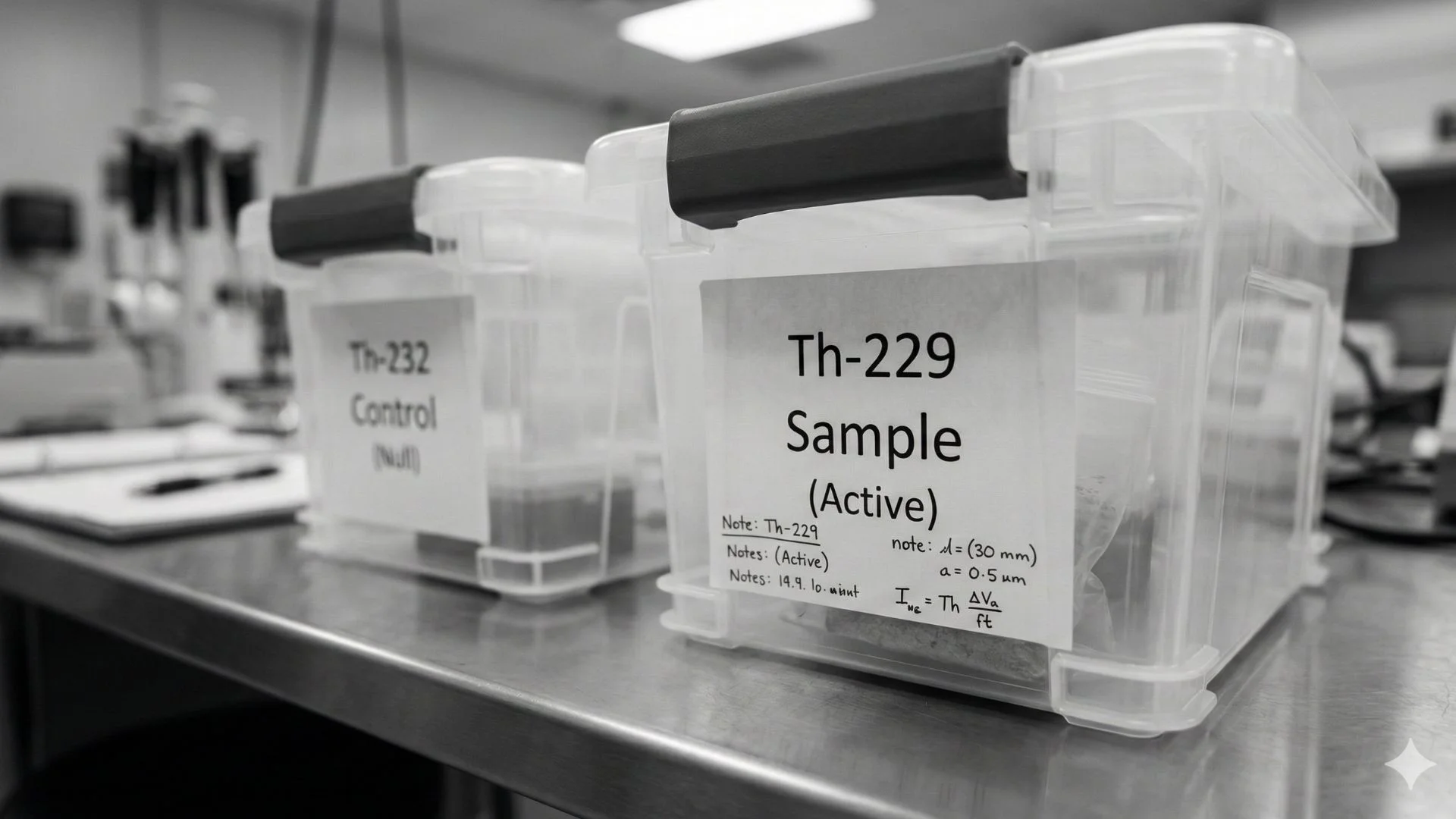
Bubbles in the Primordial Soup: Calculating Bubble Wall Velocity in Cosmic Phase Transitions
First-order cosmological phase transitions in the early universe expand as seething vacuum bubbles whose speed determines gravitational wave signatures; first-principles hydrodynamic calculations establish exact bubble wall velocity benchmarks without phenomenological friction.
Microseconds after the Big Bang, the universe underwent intense phase transitions, shifting from a seething plasma into broken-symmetry vacuum states through the nucleation and violent collision of macroscopic bubbles. The amplitude and frequency spectrum of gravitational waves emitted by these ancient cosmic collisions depend sensitively on the terminal velocity of the expanding bubble walls, but calculating wall friction from microscopic particle collisions long remained an intractable theoretical challenge. This work establishes a rigorous, first-principles field-theoretic framework to determine bubble wall velocity in relativistic thermal plasma, self-consistently solving coupled out-of-equilibrium Boltzmann transport equations and Higgs field profiles without phenomenological fudge factors. These precise terminal velocity benchmarks provide the vital theoretical roadmap required to interpret future gravitational wave discoveries from space-based interferometers like LISA, offering a window into cosmic electroweak symmetry breaking.

Atomic clocks measure electron orbital energy jumps that are vulnerable to external electromagnetic interference; directly exciting the ultralow-energy nuclear isomer of Thorium-229 with vacuum ultraviolet lasers paves the way for nuclear clocks of unprecedented stability.
Ticking with Nuclei: Direct Laser Excitation of the Thorium-229 Nuclear Clock Transition
Atomic clocks measure electron orbital energy jumps that are vulnerable to external electromagnetic interference; directly exciting the ultralow-energy nuclear isomer of Thorium-229 with vacuum ultraviolet lasers paves the way for nuclear clocks of unprecedented stability.
Modern atomic clocks keep time with breathtaking precision by locking laser frequencies to electron transitions in strontium or cesium atoms, powering global GPS navigation and telecommunications. However, electrons orbit on the fragile exterior of atoms, where stray magnetic and electric fields constantly perturb energy levels, placing a hard physical ceiling on long-term timekeeping stability. In a historic Physical Review Letters breakthrough, physicists achieved direct resonant laser excitation of the Thorium-229 nuclear isomer using vacuum ultraviolet laser pulses in a calcium fluoride crystal. By driving a transition inside the tightly shielded atomic nucleus rather than the outer electron cloud, the nuclear transition proves immune to external environmental noise. The realization of the world's first solid-state nuclear clock promises to surpass today's best atomic clocks by orders of magnitude, opening revolutionary probes into fundamental constant drift, dark matter waves, and gravitational redshift on millimeter scales.

Psychometricians long treated Cronbach's alpha of .70 as the golden threshold for psychological test reliability; meta-analytic auditing reveals an anomalous statistical spike precisely at .70, exposing widespread researcher p-hacking.

The Magic Number: Unmasking the Suspicious Abundance of Cronbach's Alpha at .70
Psychometricians long treated Cronbach's alpha of .70 as the golden threshold for psychological test reliability; meta-analytic auditing reveals an anomalous statistical spike precisely at .70, exposing widespread researcher p-hacking.
In psychology, sociology, and educational research, measuring invisible human constructs—anxiety, intelligence, leadership—requires survey scales whose internal reliability is traditionally quantified via Cronbach's alpha. Generations of textbooks codified an informal rule of thumb: an alpha of .70 is 'acceptable,' while .69 is an unpublishable failure. This arbitrary bright line created immense pressure on researchers to massage borderline data. Analyzing thousands of published psychological scales, this forensic meta-analysis uncovers an unnatural, statistically aberrant spike in reported alpha values clustered precisely at .70 to .71, with a conspicuous deficit at .68 and .69. This landmark psychometric exposé lays bare the pervasive practice of post-hoc item deletion to sneak past journal reviewers, demanding a transition toward structural equation modeling, omega coefficients, and preregistered scale development.

Binomial coefficients are among the oldest tools in discrete mathematics; Annamalai's identity introduces an elegant algebraic transformation that simplifies higher-order combinatorial summations.

Combinatorial Horizons: Annamalai's Binomial Identity and Algebraic Extensions
Binomial coefficients are among the oldest tools in discrete mathematics; Annamalai's identity introduces an elegant algebraic transformation that simplifies higher-order combinatorial summations.
For centuries, mathematicians have explored the symmetrical properties of Pascal's triangle and the binomial theorem, utilizing binomial identities as the structural scaffolding for number theory, probability, and calculus. Evaluating complex combinatorial summations involving alternating signs and factorial fractions frequently demands cumbersome generating functions or contour integration, obscuring underlying arithmetic symmetries. This mathematical paper presents Annamalai's binomial identity and theorem, deriving novel algebraic identities that transform nested binomial sums into compact, closed-form polynomial expressions. These combinatorial identities provide powerful analytical shortcuts for algorithm complexity analysis, statistical distribution moments, and discrete algebraic geometry.

Classical fuzzy sets struggled to model real-world problems containing active contradictions and indeterminate information; single-valued neutrosophic relations provide a rigorous mathematical framework to compute truth, indeterminacy, and falsity independently.

Beyond True and False: Algebraic Properties of Single-Valued Neutrosophic Relations
Classical fuzzy sets struggled to model real-world problems containing active contradictions and indeterminate information; single-valued neutrosophic relations provide a rigorous mathematical framework to compute truth, indeterminacy, and falsity independently.

In medical diagnosis, expert systems, and automated decision-making, real-world information is rarely crisp binary truth: observations are frequently incomplete, contradictory, or shrouded in neutral doubt. Classical logic demands that statements are either true or false, while Zadeh's fuzzy logic models degrees of truth but forces truth and falsity into rigid complementary bounds that cannot represent genuine logical indeterminacy. This mathematical treatise investigates single-valued neutrosophic relations (SVNRs), which independently quantify degrees of truth-membership, indeterminacy-membership, and falsity-membership. The author proves fundamental composition theorems, symmetry properties, and transitive closures for relational structures. These neutrosophic relational theorems establish the rigorous mathematical foundation required for next-generation multi-criteria decision support systems, medical diagnostic AI, and automated risk analysis in uncertain environments.

Generative AI tools sparked equal parts utopian excitement and moral panic among educators; empirical analysis demonstrates how structured AI literacy programs empower teachers to leverage automated feedback while safeguarding critical thinking.

The Ethical Tutor: Navigating Opportunities and Risks of AI in Teacher Education
Generative AI tools sparked equal parts utopian excitement and moral panic among educators; empirical analysis demonstrates how structured AI literacy programs empower teachers to leverage automated feedback while safeguarding critical thinking.
The sudden mainstream release of conversational generative AI threw teacher training faculties into disarray, as traditional essay writing and homework grading paradigms were instantly upended. Educational authorities faced a stark binary choice: impose futile campus-wide bans that alienated students from contemporary digital tools, or permit unmonitored AI usage that risked eroding foundational reading and analytical reasoning skills. This study analyzes the integration of AI tools across Spanish and Latin American teacher training programs, identifying high-impact benefits in lesson plan differentiation and automated feedback, alongside critical risks regarding data privacy and cognitive over-reliance. The authors propose a comprehensive teacher AI literacy framework, shifting pedagogical focus from policing student plagiarism to designing reflective, dialogic assessments that prepare learners for an AI-augmented society.

Generative AI swept into university lecture halls with disruptive speed, leaving academic governance struggling to adapt; bibliometric analysis maps global patterns of AI adoption and pedagogical transformation across higher education.

The University of the Algorithm: Mapping AI Adoption Across Higher Education
Generative AI swept into university lecture halls with disruptive speed, leaving academic governance struggling to adapt; bibliometric analysis maps global patterns of AI adoption and pedagogical transformation across higher education.

The sudden mainstream proliferation of large language models and automated coding assistants created an institutional crisis in global higher education, challenging traditional assessment and academic integrity. University administrators and faculty lacked a comprehensive evidence base regarding how AI is actually being deployed across diverse academic disciplines—from the humanities to medical sciences. This study conducts an extensive bibliometric analysis of international scientific literature on AI in higher education. The authors map co-citation networks, research hot spots, and emerging themes, revealing a dramatic shift from initial concerns over plagiarism toward proactive integration in personalized tutoring and curriculum design. This global bibliometric map provides university leaders with a strategic foundation to formulate balanced institutional AI policies that uphold academic integrity while preparing students for an AI-integrated workforce.

Classroom instruction long relied on static physical textbooks and unidirectional lectures; modern educational technology integrates interactive digital repositories, cloud collaboration, and adaptive multimedia tools.

The Digital Blackboard: Emerging Trends in Educational Technology Resources
Classroom instruction long relied on static physical textbooks and unidirectional lectures; modern educational technology integrates interactive digital repositories, cloud collaboration, and adaptive multimedia tools.
For over a century, traditional schooling changed little: students sat in rows listening to teacher monologues and reading dated paper textbooks with limited opportunities for dynamic self-paced discovery. The sudden digital transformation of society exposed rigid pedagogical orthodoxies, leaving educators searching for systematic methodologies to evaluate and implement new digital teaching tools. This empirical survey evaluates emerging trends in educational technology across Latin American schools, assessing the impact of gamified learning platforms, cloud-based collaborative whiteboards, and interactive multimedia repositories on student motivation. The study provides educators and school administrators with a practical framework for adopting modern digital teaching tools that foster collaborative inquiry and digital literacy across diverse student demographics.

Online digital classrooms were accused of isolating learners and degrading human social skills; mining learning management system interactions reveals that big data analytics can actively track and foster student collaborative social competencies.

Connecting the Clicks: How Big Data Analytics Enhance Student Social Competence
Online digital classrooms were accused of isolating learners and degrading human social skills; mining learning management system interactions reveals that big data analytics can actively track and foster student collaborative social competencies.
The widespread adoption of digital learning management systems (LMS) transformed education, but sparked widespread concern that online schooling stunts student emotional development and interpersonal social skills. Educators struggled to observe peer collaboration in digital environments, unable to discern whether silent students were disengaged or learning quietly on their own. Published in PeerJ Computer Science, this study analyzes LMS activity telemetry and collaborative discussion forums using big data analytics. The findings reveal that structured online group problem-solving and automated peer-feedback mechanisms significantly enhance student social competence, empathy, and team communication. Demonstrating that digital learning environments can cultivate social competencies provides instructional designers with an empirical blueprint to engineer collaborative, socially enriching online education platforms.

University educators traditionally identified struggling students only after midterm exams were failed; predictive machine learning models analyze continuous digital engagement to trigger early proactive student counseling.

Early Warning Classrooms: Machine Learning Models for Predicting Academic Risk
University educators traditionally identified struggling students only after midterm exams were failed; predictive machine learning models analyze continuous digital engagement to trigger early proactive student counseling.

College student dropout rates represent a major crisis in higher education, resulting in wasted tuition, diminished economic mobility, and institutional attrition. Academic advisors historically lacked real-time visibility into student performance, relying on sporadic exam grades that revealed learning failures too late in the semester to rescue student GPA. This study develops an explainable machine learning predictive model trained on multi-dimensional learning management system (LMS) interaction metrics, forum participation, and quiz submission regularity across university cohorts. Deploying predictive early-warning systems allows academic institutions to deliver targeted tutoring and psychological support weeks before midterm assessments, significantly boosting course retention and graduation rates.

Modern workforces demand complex, multi-dimensional problem-solving skills that traditional standardized tests fail to quantify; structural equation modeling validates the eComplexity instrument to measure real-world complex thinking competencies.

Measuring the Agile Mind: Structural Validation of the eComplexity Thinking Instrument
Modern workforces demand complex, multi-dimensional problem-solving skills that traditional standardized tests fail to quantify; structural equation modeling validates the eComplexity instrument to measure real-world complex thinking competencies.
The Fourth Industrial Revolution and the rise of automation require professionals who possess 'complex thinking'—the integrative ability to synthesize critical, creative, scientific, and systemic reasoning to solve messy real-world challenges. Higher education institutions lacked reliable, psychometrically validated instruments to assess whether university curricula actually cultivate complex thinking competencies in undergraduate students. This psychometric investigation in Frontiers in Education validates the eComplexity instrument across university student cohorts using structural equation modeling (SEM) and confirmatory factor analysis. The findings confirm high construct validity and internal reliability across four distinct sub-competency dimensions. Validating the eComplexity tool equips educational leaders with an empirical diagnostic instrument to evaluate curricular reforms and ensure university graduates are equipped to navigate global complexity.

Smart city initiatives frequently imported glossy foreign technological blueprints that failed in regional municipal governments; empirical ICT auditing maps local technological capabilities to design realistic e-government roadmaps.

Smart Cities from the Ground Up: ICT Infrastructure in Brazilian Municipalities
Smart city initiatives frequently imported glossy foreign technological blueprints that failed in regional municipal governments; empirical ICT auditing maps local technological capabilities to design realistic e-government roadmaps.

Global urban planning promotes the 'smart city' vision—digitized public services, IoT traffic management, and transparent digital municipal administration. However, developing nations like Brazil exhibit vast regional disparities: while wealthy metropolitan capitals enjoy advanced fiber-optic networks, hundreds of rural municipalities lack basic computing infrastructure and digital public records. Published in the Brazilian Journal of Public Administration, this extensive empirical survey evaluates ICT infrastructure and digital readiness across Brazilian municipalities, classifying local governments into distinct readiness clusters based on connectivity, hardware, and staff training. These empirical classifications provide federal policymakers with an actionable roadmap to tailor digital government investments, ensuring smart city technologies bridge municipal inequalities rather than leaving rural communities behind.

Environmental monitoring produced massive multi-variable water and soil contamination datasets that obscured causal pollution pathways; parametric and non-parametric correlation modeling identifies the statistical fingerprints of industrial pollutants.

Decoding Ecological Clues: Correlation Analysis in Environmental Risk Assessment
Environmental monitoring produced massive multi-variable water and soil contamination datasets that obscured causal pollution pathways; parametric and non-parametric correlation modeling identifies the statistical fingerprints of industrial pollutants.
Industrialization, agricultural runoff, and urban expansion release complex cocktails of heavy metals, microplastics, and chemical nutrients into regional rivers, lakes, and soils. Environmental scientists face a daunting diagnostic puzzle: analyzing dozens of fluctuating water parameters (pH, dissolved oxygen, nitrates, turbidity) to isolate the specific sources of ecological degradation. This study applies Pearson and Spearman correlation coefficients alongside principal component modeling to analyze multivariate environmental contamination datasets. The statistical framework detects subtle non-linear dependencies between industrial discharge points and downstream water quality indicators. Providing clear statistical guidelines for environmental correlation enables environmental protection agencies to pinpoint pollution hotspots rapidly and enforce targeted remediation policies to safeguard public watersheds.

Einstein's theory of relativity abolished universal cosmic simultaneity, relegating the 'present moment' to a subjective human illusion; spatio-temporal indeterminism and branching space-times construct a rigorous, relativity-proof definition of the present.

The Quantum Present: Reconciling the Flow of Time with Einstein's Relativity
Einstein's theory of relativity abolished universal cosmic simultaneity, relegating the 'present moment' to a subjective human illusion; spatio-temporal indeterminism and branching space-times construct a rigorous, relativity-proof definition of the present.

Human beings experience time as an active, unfolding flow: the past is settled, the future is open, and reality happens in the present moment. However, Einstein's special and general relativity showed that the simultaneity of distant events is relative to the observer's motion, leading physicists to embrace the 'block universe' where past, present, and future coexist eternally. This paper in Foundations of Physics introduces an ontologically objective definition of the present through spatio-temporal indeterminism. Utilizing branching space-times and local indeterministic quantum events, the authors prove that an objective frontier of becoming can coexist with the local invariance of relativity. Formulating a relativity-proof notion of time bridges quantum indeterminism with gravitational geometry, offering profound theoretical insights for quantum gravity and the physics of temporal consciousness.

Shor's quantum algorithm threatens to dismantle RSA and elliptic curve public-key cryptography; multivariate quadratic cryptosystems constructed over extremal algebraic graphs provide robust post-quantum security.

Quantum-Resistant Ciphers: Extremal Algebraic Graphs and Multivariate Cryptography
Shor's quantum algorithm threatens to dismantle RSA and elliptic curve public-key cryptography; multivariate quadratic cryptosystems constructed over extremal algebraic graphs provide robust post-quantum security.
The impending arrival of large-scale quantum computers poses an existential threat to modern digital finance and secure web communication by solving integer factorization and discrete logarithms in polynomial time. Multivariate quadratic public-key cryptosystems offer post-quantum resistance, but early designs suffered from massive public key sizes and vulnerability to specialized algebraic Gröbner basis attacks. This mathematical framework constructs multivariate encryption schemes using incidence geometries of extremal algebraic graphs with large girth. The resulting algebraic structures provide provable non-linear complexity while significantly shrinking public key footprints. These graph-based multivariate constructions offer a lightweight, quantum-resistant cryptographic shield for embedded IoT devices, smart cards, and long-term secure archival data storage.

Ontic structural realists claimed modern physics dissolved material objects into pure mathematical relations; rigorous metaphysical analysis proves that physical dispositions and properties require a minimal objecthood foundation to exist.
Do Objects Disappear? Dispositions, Structures, and the Limits of Ontic Reduction
Ontic structural realists claimed modern physics dissolved material objects into pure mathematical relations; rigorous metaphysical analysis proves that physical dispositions and properties require a minimal objecthood foundation to exist.
In modern quantum mechanics and field theory, subatomic particles lose their classical individuality, behaving as excitations of quantum fields rather than miniature billiard balls. Radical ontic structural realists argued that this physics proves 'objects wither away entirely'—that physical reality consists exclusively of abstract mathematical structures and relations without any underlying entities. In this influential Synthese treatise, philosopher Alexander Bird deconstructs this radical claim. Through careful metaphysical analysis of physical dispositions and causal powers, he demonstrates that relational structures logically presuppose minimal ontological particulars to instantiate those relations. Defending a moderate metaphysical realism prevents theoretical physics from collapsing into pure Pythagorean idealism, preserving the essential philosophical bridge connecting physical matter with mathematical theory.

High-power electronic feedback amplifiers burst into ear-splitting shrieks and destroyed equipment when signals looped back out of phase; Hendrik Bode plotted frequency gain and phase on logarithmic charts to show engineers exactly where stability breaks down. Published in 1940 at Bell Labs, Bode plots became the foundational diagnostic tool of electrical and aerospace control systems, ensuring feedback stability in everything from audio amplifiers to jet fighter autopilots.
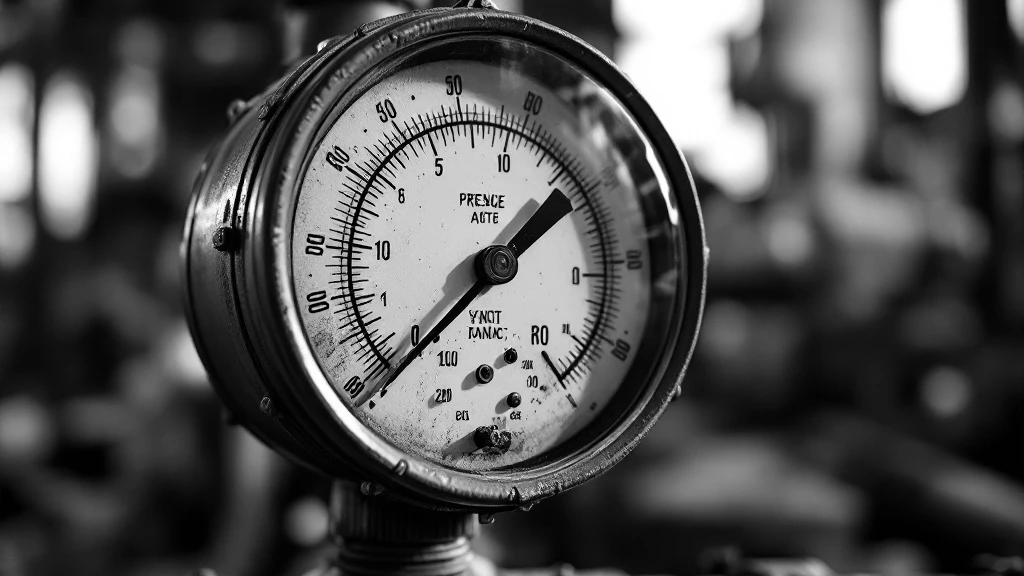
Stopping the Scream: How a 1940 Bell Labs Paper Tamed the Roar of Electronic Feedback
High-power electronic feedback amplifiers burst into ear-splitting shrieks and destroyed equipment when signals looped back out of phase; Hendrik Bode plotted frequency gain and phase on logarithmic charts to show engineers exactly where stability breaks down. Published in 1940 at Bell Labs, Bode plots became the foundational diagnostic tool of electrical and aerospace control systems, ensuring feedback stability in everything from audio amplifiers to jet fighter autopilots.
In the 1930s expansion of long-distance telephone lines, engineers placed feedback amplifiers every few miles to boost audio signals across the continent. However, as amplifiers boosted high frequencies, the electrical feedback constantly flipped out of phase, turning clear telephone conversations into ear-splitting acoustic howls. Bell Labs mathematician Hendrik Bode turned complex electrical math into a clean visual chart: the Bode plot. By graphing signal strength and phase delay on simple logarithmic grid paper, an engineer can see at a single glance the exact "gain and phase safety margins" that prevent an amplifier from turning into a screeching siren. Bode plots became the universal language of control theory. By stabilizing trans-Atlantic telephone cables, by ensuring rock-solid flight stability in modern supersonic fighter jets, and by delivering crystal-clear high-fidelity audio, Bode analysis ensures feedback stability across modern technology.

Factory engineers once tuned automatic industrial valves through stressful trial-and-error that frequently blew out boilers and ruined chemical batches; John Ziegler and Nathaniel Nichols created simple mathematical formulas to tune PID controllers for optimal stability. Published in 1942, the Ziegler-Nichols tuning rules established the operational foundation for modern industrial automation, controlling over ninety percent of all automated factory loops, chemical plants, and thermostats in the world.

The Factory Cruise Control: How a 1942 Paper Taught Industrial Machines Not to Shake
Factory engineers once tuned automatic industrial valves through stressful trial-and-error that frequently blew out boilers and ruined chemical batches; John Ziegler and Nathaniel Nichols created simple mathematical formulas to tune PID controllers for optimal stability. Published in 1942, the Ziegler-Nichols tuning rules established the operational foundation for modern industrial automation, controlling over ninety percent of all automated factory loops, chemical plants, and thermostats in the world.
In the massive factory build-up of World War II, automated pneumatic controllers were introduced to regulate temperatures in oil refineries and steam pressures in chemical reactors. However, setting the knobs on these automatic controllers was pure guesswork—if an engineer turned a knob too far, the boiler went into violent oscillations and exploded. Engineers John Ziegler and Nathaniel Nichols discovered two practical tuning shortcuts. By pushing a controller just to the brink of continuous oscillation and measuring that single critical frequency, their simple table of mathematical formulas instantly tells the engineer the exact knob settings needed to stabilize the machine with a graceful quarter-decay response. Ziegler-Nichols tuning became the most famous rule of thumb in industrial automation. By regulating furnace temperatures in steel mills, by maintaining precise flight speeds in aircraft cruise control, and by controlling life-support systems in hospitals, PID tuning keeps modern industry running smoothly.

Early computer simulations of earthquakes suffered from mathematical rounding errors that caused virtual buildings to blow up on screen; Nathan Newmark developed an unconditionally stable numerical formula that marches through time with absolute accuracy. Published in 1959, the Newmark-beta method is the numerical integration engine powering every modern earthquake simulation, crash test, and explosion defense model engineered today.

The Earthquake Time Machine: How Nathan Newmark Taught Computers to Simulate Disasters
Early computer simulations of earthquakes suffered from mathematical rounding errors that caused virtual buildings to blow up on screen; Nathan Newmark developed an unconditionally stable numerical formula that marches through time with absolute accuracy. Published in 1959, the Newmark-beta method is the numerical integration engine powering every modern earthquake simulation, crash test, and explosion defense model engineered today.
In civil and structural engineering, designing high-rise buildings and nuclear power plants to survive violent earthquakes requires calculating how every floor vibrates during seconds of violent ground shaking. Early computer simulations were mathematically unstable: tiny numerical rounding errors compounded rapidly, causing simulated buildings to explode into infinite values on computers. University of Illinois civil engineer Nathan Newmark formulated an unconditionally stable time integration method. Acting like a mathematically perfect digital time machine, the Newmark-beta equation calculates acceleration, velocity, and displacement step-by-step through an earthquake without ever blowing up or drifting out of control. Newmark’s equation is embedded in every structural dynamics simulation package on Earth. By safeguarding nuclear power plants against catastrophic earthquakes, by protecting towering skyscrapers from hurricane wind gusts, and by saving thousands of lives during major seismic disasters, Newmark time-integration protects global infrastructure.

Calculating the position of complex robotic joints in 3D space once required messy trigonometry that became impossible as mechanical links were added; Jacques Denavit and Richard Hartenberg standardized all mechanical motion into four elegant numbers per joint. Published in 1955 before modern robotics even existed, the Denavit-Hartenberg convention is the universal mathematical grammar controlling every industrial robotic arm, surgical manipulator, and planetary rover in existence.

The Robot's Skeleton Grammar: How a 1955 Paper Controls Every Robotic Arm on Earth
Calculating the position of complex robotic joints in 3D space once required messy trigonometry that became impossible as mechanical links were added; Jacques Denavit and Richard Hartenberg standardized all mechanical motion into four elegant numbers per joint. Published in 1955 before modern robotics even existed, the Denavit-Hartenberg convention is the universal mathematical grammar controlling every industrial robotic arm, surgical manipulator, and planetary rover in existence.
In early mechanical engineering, tracking how a multi-jointed metal arm moved through 3D space was a geometric nightmare. Each rotating joint added complex three-dimensional angles that tangled together, making it nearly impossible for engineers to calculate where the tip of a multi-jointed arm would end up. Jacques Denavit and Richard Hartenberg invented the universal coordinate grammar of robotics. By describing any rotating or sliding mechanical joint using just four simple physical numbers—length, twist, offset, and angle—an engineer can link mathematical matrices together like physical bones to instantly calculate the position of the robot’s fingertip. Denavit-Hartenberg parameters became the bedrock of automated robotics. By guiding welding robots on automotive assembly lines, by steering robotic arms on the International Space Station, and by enabling millimeter-precise robotic brain surgery, D-H kinematics powers modern automation.

Designing industrial chemical distillation towers once required hundreds of pages of tedious algebraic equations; Warren McCabe and Ernest Thiele calculated the exact height of towering distillation columns by drawing a simple staircase on graph paper. Published in 1925, the McCabe-Thiele method founded modern chemical engineering and is the separation design framework behind every petroleum refinery, pharmaceutical plant, and brewery on Earth.

The Distillation Staircase: How a 1925 MIT Paper Built the World's Chemical Refineries
Designing industrial chemical distillation towers once required hundreds of pages of tedious algebraic equations; Warren McCabe and Ernest Thiele calculated the exact height of towering distillation columns by drawing a simple staircase on graph paper. Published in 1925, the McCabe-Thiele method founded modern chemical engineering and is the separation design framework behind every petroleum refinery, pharmaceutical plant, and brewery on Earth.
In the roaring 1920s boom of the automobile and petroleum industries, chemical plants needed giant fractionating towers to separate crude oil into gasoline, kerosene, and diesel. However, calculating how tall a tower needed to be required chemical engineers to spend weeks solving repetitive algebra by hand. MIT researchers Warren McCabe and Ernest Thiele turned complex thermodynamics into a simple visual drawing. By plotting the boiling curve of two liquids on a single chart, an engineer can simply draw a geometric staircase between two lines—where each stair step directly represents one physical distillation tray inside the tower. The McCabe-Thiele method became the most taught technique in chemical engineering history. By optimizing gasoline production during industrialization, by purifying life-saving pharmaceutical drugs, and by designing ultra-efficient chemical processing plants, graphical distillation shaped modern industrial manufacturing.

Physical sensors in rockets and satellites are constantly corrupted by noise, vibration, and sensor drift; Rudolf Kalman developed an optimal mathematical filter that predicts true position by fusing imperfect sensor readings with equations of motion in real time. Published in 1960, the Kalman Filter guided the Apollo spacecraft to the Moon and is the mathematical brain powering every GPS receiver, autonomous drone, and commercial jetliner on Earth.

The Navigator in the Fog: How Rudolf Kalman's Equation Guided Apollo to the Moon
Physical sensors in rockets and satellites are constantly corrupted by noise, vibration, and sensor drift; Rudolf Kalman developed an optimal mathematical filter that predicts true position by fusing imperfect sensor readings with equations of motion in real time. Published in 1960, the Kalman Filter guided the Apollo spacecraft to the Moon and is the mathematical brain powering every GPS receiver, autonomous drone, and commercial jetliner on Earth.
In the dawn of the Space Race, NASA engineers faced an impossible navigation challenge: radar signals and onboard gyroscopes were filled with noisy electronic errors. If an Apollo spacecraft relied on raw sensor readings to land on the Moon, navigational errors would cause it to crash into lunar craters. Hungarian-American mathematician Rudolf Kalman designed an optimal recursive filter. The algorithm acts like an experienced ship captain in a thick fog: by constantly comparing where the spacecraft's physics says it should be against what the noisy sensors are seeing, it computes the mathematically perfect estimate of true position in real time. The Kalman Filter became the most famous algorithm in aerospace history. By guiding the Apollo 11 lunar module safely to the surface, by positioning every smartphone via GPS satellites, and by stabilizing autonomous self-driving cars, Kalman filtering navigates modern aerospace.

Computer scientists believed that mastering the ancient game of Go required human intuition that machines would not achieve for decades; DeepMind’s AlphaGo paired deep neural networks with Monte Carlo tree search to defeat the world champion. Published in 2016, AlphaGo proved that deep reinforcement learning could exhibit genuine creative intuition, sparking the modern Artificial General Intelligence revolution.

Move 37: How DeepMind's AlphaGo Shocked the World and Unlocked Artificial Creativity
Computer scientists believed that mastering the ancient game of Go required human intuition that machines would not achieve for decades; DeepMind’s AlphaGo paired deep neural networks with Monte Carlo tree search to defeat the world champion. Published in 2016, AlphaGo proved that deep reinforcement learning could exhibit genuine creative intuition, sparking the modern Artificial General Intelligence revolution.
In artificial intelligence history, the ancient board game of Go was considered the ultimate grand challenge. With more board configurations than there are atoms in the observable universe, traditional brute-force chess supercomputers like Deep Blue were utterly useless against human masters who relied on aesthetic intuition. Google DeepMind designed an AI that learned through millions of games of self-play. By pairing an intuition network that spots beautiful moves with an evaluation network that calculates long-term win probabilities, AlphaGo played with a mysterious, creative elegance—delivering historic moves that overturned three thousand years of human Go strategy. AlphaGo demonstrated that machines could discover new knowledge beyond human teaching. By laying the algorithmic foundations for AlphaFold to solve the 50-year protein folding challenge, by optimizing global energy grid cooling, and by accelerating modern reasoning AI, deep reinforcement learning opened the path toward Artificial General Intelligence.

Early computer networks were isolated corporate islands that could not speak to one another; Vint Cerf and Bob Kahn designed an open universal protocol that connects any computer on Earth regardless of hardware. Published in 1974, TCP/IP created the architecture of the Internet, allowing billions of devices to communicate seamlessly across a unified global network.

The Universal Postal Service: How Vint Cerf and Bob Kahn Built the Internet
Early computer networks were isolated corporate islands that could not speak to one another; Vint Cerf and Bob Kahn designed an open universal protocol that connects any computer on Earth regardless of hardware. Published in 1974, TCP/IP created the architecture of the Internet, allowing billions of devices to communicate seamlessly across a unified global network.
In the early 1970s, universities and military labs had built several isolated experimental computer networks, but they were completely incompatible. IBM computers could not talk to DEC machines, and satellite networks could not connect to radio networks, leaving computing fragmented into isolated technological silos. Vint Cerf and Bob Kahn invented the universal postal system of the digital world: TCP/IP. Instead of trying to maintain rigid dedicated lines, TCP chops any file—an email, a picture, or a video—into millions of tiny digital postcards that travel independently along any wire before automatically reassembling in perfect order at their destination. This open protocol created the global Internet. By connecting billions of smartphones and supercomputers across every country, by democratizing access to human knowledge, and by powering the modern digital economy, TCP/IP built the connected world.

Early corporate databases were tangled mazes of computer hardware pointers that broke whenever physical storage changed; Edgar Codd organized all human data into clean mathematical tables connected by logical relationships. Published in 1970, Codd’s relational model created SQL and built the multi-trillion-dollar database engine powering every enterprise business on Earth.

The Universal Spreadsheet: How Edgar Codd Organized All the World's Data in 1970
Early corporate databases were tangled mazes of computer hardware pointers that broke whenever physical storage changed; Edgar Codd organized all human data into clean mathematical tables connected by logical relationships. Published in 1970, Codd’s relational model created SQL and built the multi-trillion-dollar database engine powering every enterprise business on Earth.
In the 1960s, corporate computer databases were tangled digital mazes. If a company changed its hard drives or reorganized its filing system, every single computer program in the company broke because software was hard-coded to the exact physical storage addresses on magnetic tapes. IBM computer scientist Edgar Codd introduced a brilliant separation: the Relational Model. Instead of navigating physical pointers, data is organized into clean, interlocking tables of rows and columns, allowing users to query data in simple logical English without worrying about how disks are arranged. Codd’s paper gave birth to SQL and modern database infrastructure. By powering global banking ledgers, by organizing inventory for airline reservations, and by enabling corporate enterprise software worldwide, relational databases built the modern data economy.

For thousands of years, secret communication required sending a physical key via a trusted courier before a message could be sent; Whitfield Diffie and Martin Hellman proved that two total strangers can agree on a shared secret over a compromised public channel. Published in 1976, this mathematical breakthrough invented public-key cryptography and made secure global e-commerce possible.

Mixing Paint in Public: How Diffie and Hellman Made Secret Messages on the Web Possible
For thousands of years, secret communication required sending a physical key via a trusted courier before a message could be sent; Whitfield Diffie and Martin Hellman proved that two total strangers can agree on a shared secret over a compromised public channel. Published in 1976, this mathematical breakthrough invented public-key cryptography and made secure global e-commerce possible.
From the military codes of Julius Caesar to the secret radios of the Cold War, cryptography suffered from an insurmountable logistical bottleneck: you could never send an encrypted message to someone without first secretly handing them a physical key. This meant global online banking and private internet commerce were impossible. Two Stanford researchers solved this using the mathematics of one-way trapdoors. Much like two people mixing cans of paint in front of a crowd—where anyone can see the mixed color but no spy can unmix the paint to recover the secret ingredients—strangers can agree on a shared secret key across public radio wires. Diffie and Hellman’s discovery made the modern commercial internet possible. By enabling secure credit card transactions over open Wi-Fi, by creating digital signatures that verify identity, and by protecting private end-to-end messaging for billions of people, public-key cryptography created the secure digital economy.

Telecommunication engineers believed that static noise permanently corrupted electrical signals; Claude Shannon proved that information can be transmitted with zero errors across noisy channels by converting meaning into binary bits. Published in 1948, Shannon’s masterwork founded information theory and created the digital language of the modern world.

The Man Who Invented the Bit: How Claude Shannon Built the Digital Universe
Telecommunication engineers believed that static noise permanently corrupted electrical signals; Claude Shannon proved that information can be transmitted with zero errors across noisy channels by converting meaning into binary bits. Published in 1948, Shannon’s masterwork founded information theory and created the digital language of the modern world.
In the mid-twentieth century, as telephone lines stretched across oceans and radio signals beamed across continents, engineers faced a physical barrier: background electrical static always scrambled transmissions. Telecommunications experts believed that sending perfect messages across long distances was physically impossible. Bell Labs mathematician Claude Shannon stripped human communication down to pure mathematics. By inventing the "bit"—the basic binary choice between 0 and 1—he proved that any message, from a Shakespeare sonnet to a television video, can be sent with perfect fidelity through roaring static by using smart mathematical error-correcting codes. Shannon’s 1948 paper built the entire digital universe. By enabling fiber-optic internet cables to carry petabytes of data, by allowing deep-space probes to beam crisp photos from Jupiter, and by founding computer science, information theory powers modern civilization.

Early carbon-carbon double-bond metathesis catalysts were notoriously sensitive to moisture and air, catching fire upon the slightest atmospheric contact; Robert Grubbs engineered a stable ruthenium carbene catalyst that performs bond-swapping reactions smoothly on the open benchtop. This Nobel Prize-winning catalyst transformed green polymer manufacturing and pharmaceutical synthesis of Hepatitis C antiviral therapies.

The Molecular Square Dance: How Grubbs Catalysts Swapped Carbon Bonds with Surgical Precision
Early carbon-carbon double-bond metathesis catalysts were notoriously sensitive to moisture and air, catching fire upon the slightest atmospheric contact; Robert Grubbs engineered a stable ruthenium carbene catalyst that performs bond-swapping reactions smoothly on the open benchtop. This Nobel Prize-winning catalyst transformed green polymer manufacturing and pharmaceutical synthesis of Hepatitis C antiviral therapies.
In industrial plastic synthesis and pharmaceutical manufacturing, stitching carbon-carbon double bonds together required harsh, dangerous chemicals that destroyed delicate therapeutic molecules. Early catalysts were so violently sensitive to air and water that they burst into flames outside specialized vacuum boxes. Robert Grubbs engineered an air-stable ruthenium catalyst that works like a molecular square dance caller. When added to a reaction flask on an open laboratory bench, the catalyst coordinates reacting carbon molecules, breaks their double bonds, and swaps their partners smoothly without producing toxic chemical waste. Grubbs catalysts became a cornerstone of green, sustainable chemistry. By enabling commercial self-healing materials, by synthesizing life-saving antiviral medicines for Hepatitis C, and by manufacturing bio-based plastics from vegetable oils, ruthenium metathesis reshaped industrial chemistry.

Continuous-wave nuclear magnetic resonance required hours of sluggish radiofrequency tuning to obtain noisy, low-resolution spectra; Richard Ernst hit atomic nuclei with a single broadband radio pulse and used Fourier mathematics to decode all resonances simultaneously. This sensitivity leap revolutionized structural biology and created the physical foundations of clinical MRI medical scanners.

Listening to the Atomic Symphony: How Fourier Transform Chemistry Built the MRI Scanner
Continuous-wave nuclear magnetic resonance required hours of sluggish radiofrequency tuning to obtain noisy, low-resolution spectra; Richard Ernst hit atomic nuclei with a single broadband radio pulse and used Fourier mathematics to decode all resonances simultaneously. This sensitivity leap revolutionized structural biology and created the physical foundations of clinical MRI medical scanners.
In early chemistry labs, determining the 3D shape of an organic molecule using magnetic resonance required slowly sweeping radio dials for hours to measure one atomic frequency at a time. The resulting data signal was so faint that complex biological molecules and carbon atoms were completely invisible. Richard Ernst realized that instead of plucking one piano key at a time, he could hit all keys simultaneously with a single microsecond radio pulse. By recording the complex acoustic echo and running it through Fourier mathematics, computers instantly untangled every atomic frequency in a single burst. Fourier transform NMR transformed chemistry and medicine. By unlocking high-resolution 3D structures of enzymes in liquid water, by cutting measurement times from days to seconds, and by powering magnetic resonance imaging (MRI) machines in hospitals worldwide, Fourier spectroscopy revolutionized non-invasive imaging.

Traditional mass spectrometry used harsh electron beams that shattered delicate biological proteins into unrecognizable debris; John Fenn used an electrified mist to gently levitate giant biomolecules intact into the vacuum chamber. By generating multiply charged ions from liquid droplets, Electrospray Ionization enabled precision mass spectrometry of entire intact proteins and founded modern proteomics.

Giving Elephants Wings: How Electrospray Mass Spectrometry Weighed Intact Proteins
Traditional mass spectrometry used harsh electron beams that shattered delicate biological proteins into unrecognizable debris; John Fenn used an electrified mist to gently levitate giant biomolecules intact into the vacuum chamber. By generating multiply charged ions from liquid droplets, Electrospray Ionization enabled precision mass spectrometry of entire intact proteins and founded modern proteomics.
For decades, analytical chemistry had perfected scales to weigh small chemical molecules with single-atom precision, but the giant protein machines that drive human health and disease remained completely unmeasurable. Blasting proteins with high heat or electron beams shredded them into useless microscopic dust. John Fenn achieved what he called "giving wings to molecular elephants." By spraying a liquid solution of proteins from an electrified needle, the charged droplets evaporate gently, leaving massive intact proteins floating in a vacuum chamber without a single broken molecular bond. Electrospray mass spectrometry became the bedrock of modern biopharmaceuticals and cancer proteomics. By identifying disease biomarkers from a single drop of blood, by ensuring the purity of monoclonal antibody therapies, and by mapping the complete human proteome, soft ionization mass spectrometry transformed clinical science.

Standard chemical synthesis produced equal mixtures of left-handed and right-handed molecular twins, where one enantiomer healed while the mirror image caused severe side effects; Sharpless epoxidation selectively synthesizes pure, single-handed chiral molecules using catalytic titanium complexes. This monumental catalytic breakthrough unlocked the safe, industrial manufacturing of single-enantiomer pharmaceuticals.

Handed Molecules: How Sharpless Asymmetric Synthesis Eliminated Toxic Mirror Drugs
Standard chemical synthesis produced equal mixtures of left-handed and right-handed molecular twins, where one enantiomer healed while the mirror image caused severe side effects; Sharpless epoxidation selectively synthesizes pure, single-handed chiral molecules using catalytic titanium complexes. This monumental catalytic breakthrough unlocked the safe, industrial manufacturing of single-enantiomer pharmaceuticals.
Following the mid-century thalidomide disaster, where a left-handed drug cured morning sickness while its right-handed twin caused catastrophic birth defects, chemistry faced an urgent moral challenge. Chemical synthesis naturally created 50:50 mixtures of both mirror twins, and separating them in factories was brutally inefficient. Barry Sharpless and Tsutomu Katsuki created a catalytic template that functions like a left-handed baseball glove. By binding titanium to natural wine tartrate molecules, the catalyst only allows one face of a reacting chemical to receive an oxygen atom, delivering pure single-handed drugs with over ninety percent precision. Asymmetric catalysis revolutionized global pharmaceutical manufacturing. By eliminating dangerous mirror-image drug side effects, by reducing chemical manufacturing waste, and by opening scalable routes to complex life-saving therapies, single-handed chemistry protects human health.

Detecting a single viral gene or defective hereditary mutation in a blood sample was like finding a single needle in an ocean of biological noise; the Polymerase Chain Reaction amplifies a specific target DNA sequence into billions of identical copies in just a few hours. This thermal cycling discovery became the bedrock of modern medical diagnostics, forensic crime analysis, and pandemic response.

The Molecular Xerox Machine: How PCR Multiplied Single DNA Strands into Billions
Detecting a single viral gene or defective hereditary mutation in a blood sample was like finding a single needle in an ocean of biological noise; the Polymerase Chain Reaction amplifies a specific target DNA sequence into billions of identical copies in just a few hours. This thermal cycling discovery became the bedrock of modern medical diagnostics, forensic crime analysis, and pandemic response.
In medical diagnostics and forensic science, testing for hereditary diseases or identifying microscopic drops of blood at crime scenes required large biological tissue samples. A single viral gene or a trace drop of blood was impossible to analyze because there simply were not enough DNA molecules to measure. Kary Mullis and colleagues turned natural DNA replication into an exponential chain reaction. Operating like a molecular Xerox machine, PCR heats DNA to unzip the double strands, latches targeted synthetic bookmarks onto the edges, and triggers enzymes to double the copies with every heating and cooling cycle. Within hours, a single DNA strand multiplies into billions of identical copies. By detecting dangerous viral pathogens during global pandemics, by solving cold criminal cases from thirty-year-old microscopic evidence, and by guiding prenatal genetic screening, PCR transformed human medicine.

Building peptides in liquid solution required painstaking, months-long crystallization after every single amino acid addition; Bruce Merrifield anchored growing peptide chains to insoluble plastic beads, allowing unreacted chemicals to be washed away in seconds. This ingenious solid-phase paradigm automated the chemical assembly of proteins and laid the foundation for modern peptide therapeutics like GLP-1 weight-loss drugs.

The Bead Machine: How Anchoring Molecules to Plastic Beads Automated the Synthesis of Life
Building peptides in liquid solution required painstaking, months-long crystallization after every single amino acid addition; Bruce Merrifield anchored growing peptide chains to insoluble plastic beads, allowing unreacted chemicals to be washed away in seconds. This ingenious solid-phase paradigm automated the chemical assembly of proteins and laid the foundation for modern peptide therapeutics like GLP-1 weight-loss drugs.
In the mid-twentieth century, medical researchers knew that short protein chains called peptides controlled human hormones and metabolism, but synthesizing even a tiny peptide in liquid flasks required a team of chemists working for an entire year. Every single amino acid addition required weeks of slow crystallization and suffered catastrophic yield loss. Bruce Merrifield solved this with a brilliantly simple idea: tie the growing peptide chain to an insoluble microscopic plastic bead. The plastic bead acts like a secure molecular anchor, holding the protein in place while excess reagents are flushed down a drain with a quick wash, allowing automated assembly line manufacturing. Solid-phase synthesis completely automated modern biotechnology. By slashing protein manufacturing from years to hours, by enabling the industrial production of life-saving insulin and modern GLP-1 medicines, and by paving the way for automated DNA synthesizers, Merrifield's bead method mechanized molecular medicine.

Organic ring-closing reactions often yielded baffling mixtures of chemical isomers that defied classical thermodynamic rules; Robert Woodward and Roald Hoffmann proved that orbital symmetry dictates exactly which molecular shapes can form. By tracking how electron phases overlap during thermal and photochemical reactions, the Woodward-Hoffmann rules gave chemists complete geometric control over complex molecular synthesis.

The Symmetry Secret: How Woodward and Hoffmann Cracked the Hidden Geometry of Chemical Reactions
Organic ring-closing reactions often yielded baffling mixtures of chemical isomers that defied classical thermodynamic rules; Robert Woodward and Roald Hoffmann proved that orbital symmetry dictates exactly which molecular shapes can form. By tracking how electron phases overlap during thermal and photochemical reactions, the Woodward-Hoffmann rules gave chemists complete geometric control over complex molecular synthesis.
During the golden age of synthetic medicine, when chemists attempted to synthesize complex antibiotics and anticancer compounds, chemical reactions produced bizarre, unpredictable mixtures of mirror-image molecules. Heating a flask produced one shape, while shining ultraviolet light produced the exact opposite, baffling synthetic chemists for decades. Woodward and Hoffmann proved that electron clouds have distinct mathematical wave phases that must stay aligned during a reaction. Like interlocking gears that can only rotate in coordinated directions to keep their teeth aligned, reacting atoms must twist together to keep positive and negative electron waves smoothly connected. These orbital symmetry rules gave chemists complete control over the geometry of matter. By eliminating trial-and-error in life-saving drug synthesis, by enabling the total synthesis of Vitamin B12 and cancer drugs, and by unlocking the geometry of complex organic molecules, orbital symmetry transformed chemistry.

Nineteenth-century chemistry viewed molecular bonds as rigid mechanical hooks; Linus Pauling revealed that chemical bonds are dynamic quantum mechanical resonance clouds. By introducing orbital hybridization and electronegativity scales, Pauling transformed chemistry from an empirical guesswork craft into a predictive mathematical science.

The Quantum Handshake: How Linus Pauling Decoded the Rules of Every Molecule in the Universe
Nineteenth-century chemistry viewed molecular bonds as rigid mechanical hooks; Linus Pauling revealed that chemical bonds are dynamic quantum mechanical resonance clouds. By introducing orbital hybridization and electronegativity scales, Pauling transformed chemistry from an empirical guesswork craft into a predictive mathematical science.
In the early twentieth century, physicists were unraveling the mysterious quantum behavior of isolated subatomic particles, but chemists were still depicting molecules with rigid wooden sticks and ball models. Science could not explain why a single carbon atom formed four identical, directional bonds in diamonds and living tissue. Linus Pauling bridged physics and chemistry by proving that electron waves blend together inside molecules. Like musical notes harmonizing into a rich chord, different atomic electron orbitals blend into hybridized shapes that reach outward in perfect three-dimensional tetrahedral geometry. This foundational theory turned chemistry into an exact predictive science. By enabling the structural discovery of DNA and proteins, by predicting chemical reactions before mixing beakers, and by guiding computer-aided drug design, Pauling’s quantum rules built modern molecular medicine.

Astronomers believed that every dying star would peacefully cool down into a permanent white dwarf crystal; nineteen-year-old Subrahmanyan Chandrasekhar calculated on a steamship voyage that any star heavier than 1.44 Suns must catastrophically collapse into a neutron star or black hole. Awarded the 1983 Nobel Prize in Physics, the Chandrasekhar Limit established the theoretical foundation of modern stellar death, supernovae, and black holes.

The Cosmic Weight Limit: How a 19-Year-Old Predicted Black Holes on a Boat
Astronomers believed that every dying star would peacefully cool down into a permanent white dwarf crystal; nineteen-year-old Subrahmanyan Chandrasekhar calculated on a steamship voyage that any star heavier than 1.44 Suns must catastrophically collapse into a neutron star or black hole. Awarded the 1983 Nobel Prize in Physics, the Chandrasekhar Limit established the theoretical foundation of modern stellar death, supernovae, and black holes.
In 1930, astronomy taught that white dwarf stars—dense stellar corpses where atoms are packed so tightly that quantum mechanics prevents further collapse—were the eternal resting place of all dying stars. The greatest astrophysicist of the era, Sir Arthur Eddington, insisted that gravity could never crush a dead star any further. Nineteen-year-old Indian prodigy Subrahmanyan Chandrasekhar combined Einstein’s special relativity with quantum mechanics. He proved that in heavy stars, electrons are squeezed so hard they move at near light-speed, causing their quantum "elbow room" to collapse under gravity—meaning any dead star weighing more than 1.44 times the Sun cannot survive and must collapse forever. Publicly mocked by Eddington for years, Chandrasekhar was ultimately vindicated and awarded the 1983 Nobel Prize. By predicting the existence of black holes and neutron stars, by explaining Type Ia supernova explosions used to discover dark energy, and by founding relativistic astrophysics, the Chandrasekhar limit guides stellar astronomy.

Calculating the number of ways to break large numbers into smaller pieces once required weeks of grueling manual additions; G. H. Hardy and Srinivasa Ramanujan invented the Circle Method to calculate exact partitions in fractions of a second. Published in 1918 from their legendary Cambridge collaboration, this masterwork founded analytic additive number theory and is the mathematical engine calculating black hole entropy in modern quantum string theory.

Plucking Trillions from Thin Air: How Hardy and Ramanujan Cracked Number Partitions
Calculating the number of ways to break large numbers into smaller pieces once required weeks of grueling manual additions; G. H. Hardy and Srinivasa Ramanujan invented the Circle Method to calculate exact partitions in fractions of a second. Published in 1918 from their legendary Cambridge collaboration, this masterwork founded analytic additive number theory and is the mathematical engine calculating black hole entropy in modern quantum string theory.

The number of ways to write an integer as a sum of smaller numbers (partitions) explodes into trillions at blistering speed. For centuries, calculating the partitions of a number like 200 was a grueling nightmare that took human calculators months of hand calculations. Self-taught Indian mathematical genius Srinivasa Ramanujan and Cambridge professor G. H. Hardy invented the "Circle Method." By integrating complex numbers along a mathematical circle, they harvested energy spikes near roots of unity—calculating that the number 200 can be partitioned in exactly 3,972,999,029,388 ways with zero manual addition. The Circle Method became the most powerful tool in additive number theory. By solving Waring’s problem on sums of powers, by proving Goldbach-type prime sum theorems, and by calculating black hole quantum microstates in string theory, Ramanujan’s formula enriches pure mathematics and physics.

For over three hundred and fifty years, Fermat’s Last Theorem stood as the most tantalizing unsolved riddle in human history; Andrew Wiles conquered the mystery by proving that every geometric donut-shaped elliptic curve mirrors a symmetric modular clock form. Working in complete isolation for seven years, Wiles unified arithmetic geometry with modular forms, slaying Fermat’s dragon and delivering the greatest mathematical triumph of the twentieth century.

The 350-Year Riddle: How Andrew Wiles Proved Fermat's Last Theorem
For over three hundred and fifty years, Fermat’s Last Theorem stood as the most tantalizing unsolved riddle in human history; Andrew Wiles conquered the mystery by proving that every geometric donut-shaped elliptic curve mirrors a symmetric modular clock form. Working in complete isolation for seven years, Wiles unified arithmetic geometry with modular forms, slaying Fermat’s dragon and delivering the greatest mathematical triumph of the twentieth century.
In 1637, French mathematician Pierre de Fermat scribbled a famous note in the margin of a book: x^n + y^n = z^n has no positive whole-number solutions for n greater than 2, adding that the margin was too narrow to contain his proof. For 350 years, the greatest minds in mathematics failed to prove it. British mathematician Andrew Wiles solved Fermat by proving the Taniyama-Shimura conjecture. By constructing an unshakeable mathematical mirror connecting doughnut-shaped geometric elliptic curves to symmetric modular forms, Wiles proved that if a counterexample to Fermat existed, its corresponding geometric curve would be mathematically impossible. Published in a special 1995 volume of the Annals of Mathematics, Wiles’s proof made global headlines. By creating the machinery of modern modularity lifting, by advancing the grand Langlands program, and by inspiring generations of young mathematicians, Wiles proved Fermat’s Last Theorem.

Topologists struggled for a century to prove whether every simply connected three-dimensional space was equivalent to a round hypersphere; Grigori Perelman treated the universe like a wrinkled sheet of metal, using heat diffusion equations to smooth out wrinkled geometric singularities. Posted quietly to the arXiv in 2002, Perelman’s proof solved the Poincaré Conjecture—becoming the first and only Millennium Prize Problem ever conquered.

Ironing the Universe: How Grigori Perelman Solved the 100-Year Poincaré Mystery
Topologists struggled for a century to prove whether every simply connected three-dimensional space was equivalent to a round hypersphere; Grigori Perelman treated the universe like a wrinkled sheet of metal, using heat diffusion equations to smooth out wrinkled geometric singularities. Posted quietly to the arXiv in 2002, Perelman’s proof solved the Poincaré Conjecture—becoming the first and only Millennium Prize Problem ever conquered.
In 1904, French genius Henri Poincaré asked if a loop of string wrapped around any closed three-dimensional space could be pulled tight to a single point, does that space have to be a standard round 3D sphere? For a century, topologists proved it true for every higher dimension (4D, 5D, 6D), but three dimensions remained stubbornly unsolved. Russian mathematical recluse Grigori Perelman solved it by treating space like an expanding ball of heat. Using "Ricci flow," he flowed heat across wrinkled 3D geometry to smooth out rough spots, performing delicate mathematical surgery with scissors to snip off pinching necks before they blew up into singularities. Perelman proved that every 3-dimensional universe must round out into a sphere. By solving the 100-year-old Poincaré Conjecture, by proving Thurston’s Geometrization of all 3-manifolds, and by famously declining the $1 million Clay Millennium Prize, Perelman conquered modern topology.

Economists once believed that human competition was a pure zero-sum fight where one person’s win required another’s total loss; John Nash proved in a single page of mathematics that all competing systems reach a stable state of mutual balance. Published in 1950 when Nash was just twenty-one, the Nash Equilibrium earned him the Nobel Prize and created the strategic grammar governing global economics, geopolitics, and evolutionary biology.

The Cosmic Stalemate: How a One-Page 1950 Paper Rewrote Global Economics
Economists once believed that human competition was a pure zero-sum fight where one person’s win required another’s total loss; John Nash proved in a single page of mathematics that all competing systems reach a stable state of mutual balance. Published in 1950 when Nash was just twenty-one, the Nash Equilibrium earned him the Nobel Prize and created the strategic grammar governing global economics, geopolitics, and evolutionary biology.
In early economics, Adam Smith taught that societies thrive when everyone acts purely in their own self-interest. However, when competitors make decisions simultaneously—such as two superpowers building nuclear missiles or two gas stations setting prices—pure self-interest often leads to disastrous lose-lose outcomes. Princeton graduate student John Nash derived an elegant one-page proof. Using a mathematical theorem about stirring liquids, he proved that in any game with any number of players, there is always at least one "equilibrium point"—a sweet spot where every player has picked their best move given what everyone else is doing, so no one has an incentive to switch. Nash's one-page paper transformed human social science. By designing multi-billion-dollar government 5G radio spectrum auctions, by preventing nuclear wars through strategic game theory, and by explaining evolutionary biology, the Nash equilibrium underpins modern society.

Measuring microscopic hormones in human blood was once like trying to find a single grain of sand on a vast beach; Rosalyn Yalow and Solomon Berson used radioactive isotope tags to measure microscopic hormone molecules at parts-per-trillion sensitivity. Awarded the 1977 Nobel Prize in Medicine, Radioimmunoassay founded modern endocrinology and is the analytical foundation behind blood bank screening, thyroid testing, and home pregnancy kits worldwide.

The Atomic Scale: How Rosalyn Yalow Measured the Invisible Hormones in Our Blood
Measuring microscopic hormones in human blood was once like trying to find a single grain of sand on a vast beach; Rosalyn Yalow and Solomon Berson used radioactive isotope tags to measure microscopic hormone molecules at parts-per-trillion sensitivity. Awarded the 1977 Nobel Prize in Medicine, Radioimmunoassay founded modern endocrinology and is the analytical foundation behind blood bank screening, thyroid testing, and home pregnancy kits worldwide.
In mid-twentieth-century medicine, doctors were blind to the endocrine system: vital hormones like insulin, thyroid hormones, and human growth hormones exist in human blood at microscopic concentrations—equivalent to a single drop of water in an Olympic swimming pool. Scientists had no physical lab test sensitive enough to measure them. Medical physicist Rosalyn Yalow designed an atomic scale using radioactive isotopes. In a game of microscopic musical chairs, radioactive hormone tags compete with natural hormones in a patient’s blood to bind to specific antibodies—allowing a simple radiation counter to measure exact hormone concentrations in minutes. Yalow became the second woman in history to win the Nobel Prize in Medicine. By proving that Type 2 diabetes is caused by insulin resistance rather than a lack of insulin, by securing the global blood supply against hepatitis and HIV, and by enabling modern diagnostic medicine, RIA transformed healthcare.

In the 1940s, lung cancer was widely blamed on automobile exhaust and asphalt road tar while doctors smoked in hospital hallways; Richard Doll and Austin Bradford Hill proved mathematically that smoking cigarettes multiplied lung cancer risk twenty-fold. Published in the British Medical Journal in 1950, this landmark study established modern epidemiology and launched the global public health war against tobacco, saving tens of millions of lives.
The Deadly Habit: How a 1950 British Study Proved Cigarettes Cause Lung Cancer
In the 1940s, lung cancer was widely blamed on automobile exhaust and asphalt road tar while doctors smoked in hospital hallways; Richard Doll and Austin Bradford Hill proved mathematically that smoking cigarettes multiplied lung cancer risk twenty-fold. Published in the British Medical Journal in 1950, this landmark study established modern epidemiology and launched the global public health war against tobacco, saving tens of millions of lives.
In the first half of the twentieth century, lung cancer exploded from a rare medical curiosity into a global epidemic, yet tobacco companies and public health authorities blamed asphalt road fumes, industrial coal smog, and the 1918 flu pandemic. Smoking was considered harmless, and eighty percent of British doctors smoked daily. British epidemiologists Richard Doll and Austin Bradford Hill interviewed hundreds of lung cancer patients in London hospitals. Their data revealed a clear mathematical staircase: as daily cigarette consumption increased, lung cancer risk rose in direct proportion, showing heavy smokers were twenty times more likely to develop lung tumors. Doll immediately quit smoking while analyzing his own data. By pioneering modern statistical epidemiology (the Bradford Hill criteria), by forcing governments to place warning labels on tobacco, and by reducing global smoking rates to save over fifty million lives, this study created modern public health.
91816-6/v1.webp)
Doctors spent a century insisting that painful stomach ulcers were caused by spicy food, nervous stress, and excess stomach acid; Barry Marshall and Robin Warren proved that ulcers are caused by a resilient spiral bacterium living in the stomach lining. Awarded the 2005 Nobel Prize in Medicine after Marshall drank a beaker of bacterial culture to prove the medical establishment wrong, this discovery turned stomach ulcers from a chronic lifelong surgery into a simple two-week antibiotic cure.

The Bug in the Acid: How a Rebellious Australian Doctor Proved Ulcers Are an Infection
Doctors spent a century insisting that painful stomach ulcers were caused by spicy food, nervous stress, and excess stomach acid; Barry Marshall and Robin Warren proved that ulcers are caused by a resilient spiral bacterium living in the stomach lining. Awarded the 2005 Nobel Prize in Medicine after Marshall drank a beaker of bacterial culture to prove the medical establishment wrong, this discovery turned stomach ulcers from a chronic lifelong surgery into a simple two-week antibiotic cure.
For generations, patients suffering from burning stomach ulcers were told by doctors that their stress, lifestyle, and spicy food were causing excess stomach acid to burn holes in their stomachs. Millions of patients underwent life-altering stomach surgeries and took antacids for decades with frequent painful relapses. Australian pathologist Robin Warren and young physician Barry Marshall discovered curved spiral bacteria happily thriving in the stomach’s acidic furnace. When the medical establishment mocked their claim that bacteria could survive in acid, Marshall famously drank a beaker of cloudy bacteria, developed acute gastritis and ulcers, and cured himself with standard antibiotics. Their discovery earned the 2005 Nobel Prize in Medicine and cured peptic ulcers. By replacing invasive stomach surgeries with a two-week course of antibiotics, by preventing gastric stomach cancers, and by transforming gastroenterology, H. pylori microbiology freed humanity from ulcer pain.

Central biological dogma dictated that every infectious disease on Earth must carry genetic DNA or RNA to reproduce; Stanley Prusiner proved that a misfolded shape of a normal human protein can act like an infectious zombie, converting healthy brain proteins into lethal brain-destroying amyloids. Awarded the 1997 Nobel Prize in Medicine after enduring a decade of intense scientific ridicule, Prusiner’s discovery of "prions" solved Mad Cow disease and unlocked the unified protein-folding mechanism behind Alzheimer’s and Parkinson’s diseases.

The Zombie Protein: How Stanley Prusiner Discovered Prions and Rewrote Biology
Central biological dogma dictated that every infectious disease on Earth must carry genetic DNA or RNA to reproduce; Stanley Prusiner proved that a misfolded shape of a normal human protein can act like an infectious zombie, converting healthy brain proteins into lethal brain-destroying amyloids. Awarded the 1997 Nobel Prize in Medicine after enduring a decade of intense scientific ridicule, Prusiner’s discovery of "prions" solved Mad Cow disease and unlocked the unified protein-folding mechanism behind Alzheimer’s and Parkinson’s diseases.
In biology, the central rule of life was absolute: every virus, bacterium, fungus, and parasite requires genetic material (DNA or RNA) to multiply and cause disease. When mysterious fatal brain diseases like Mad Cow and Creutzfeldt-Jakob destroyed brains into spongy swiss cheese, scientists searched desperately for a hidden "slow virus" that never existed. Neurologist Stanley Prusiner subjected the infectious brain material to intense ultraviolet radiation and acid baths that destroyed all genetic material, yet the sample remained fully infectious. He proved that the killer was a "prion"—a single misfolded rogue protein that acts like a zombie, tapping healthy brain proteins on the shoulder and forcing them to flip into indestructible toxic clumps. Prusiner’s paper earned the 1997 Nobel Prize and transformed neuroscience. By containing the global Mad Cow epidemic, by securing surgical tools and the beef food supply against heat-proof prions, and by explaining protein misfolding in Alzheimer's and ALS, prion biology revolutionized medical science.

AIDS erupted in the early 1980s as a terrifying medical mystery that baffled doctors and decimated young populations; Françoise Barré-Sinoussi and Luc Montagnier isolated the novel retrovirus that selectively destroys the body’s master immune cells. Awarded the 2008 Nobel Prize in Medicine, the discovery of HIV enabled blood-bank screening tests, prevented millions of infant infections, and guided the development of life-saving antiretroviral therapy.
Unmasking the Ghost: How Pasteur Institute Scientists Discovered HIV
AIDS erupted in the early 1980s as a terrifying medical mystery that baffled doctors and decimated young populations; Françoise Barré-Sinoussi and Luc Montagnier isolated the novel retrovirus that selectively destroys the body’s master immune cells. Awarded the 2008 Nobel Prize in Medicine, the discovery of HIV enabled blood-bank screening tests, prevented millions of infant infections, and guided the development of life-saving antiretroviral therapy.
In 1981, hospitals in New York, San Francisco, and Paris began admitting young, healthy patients whose immune systems were mysteriously vanishing, leaving them dying from rare fungal pneumonias and aggressive cancers. Medical panic spread globally as public health officials had no idea whether the killer was an airborne chemical, a lifestyle toxin, or a mystery pathogen. At the Pasteur Institute in Paris, virologists Françoise Barré-Sinoussi and Luc Montagnier examined lymph node tissue from an infected patient. They detected reverse transcriptase enzyme activity and isolated a completely new human retrovirus—HIV—that specifically targets and kills CD4 helper T-cells, the commanding generals of the human immune system. Their discovery earned the 2008 Nobel Prize and saved tens of millions of lives. By enabling diagnostic blood tests that secured the global blood supply, by guiding combination antiretroviral cocktails (ART) that turn HIV into an undetectable chronic condition, and by preventing mother-to-child transmission, HIV virology conquered modern medicine’s greatest epidemic.

Two radio astronomers thought an annoying persistent microwave hiss in their antenna was caused by pigeon droppings; Arno Penzias and Robert Wilson were actually listening to the dying thermal echo of the Big Bang. Awarded the 1978 Nobel Prize in Physics, this discovery of the Cosmic Microwave Background proved that our universe was born in a fiery cosmic explosion fourteen billion years ago.

The Echo of the Big Bang: How Two Astronomers Heard the Birth of the Universe
Two radio astronomers thought an annoying persistent microwave hiss in their antenna was caused by pigeon droppings; Arno Penzias and Robert Wilson were actually listening to the dying thermal echo of the Big Bang. Awarded the 1978 Nobel Prize in Physics, this discovery of the Cosmic Microwave Background proved that our universe was born in a fiery cosmic explosion fourteen billion years ago.
In the 1960s, astronomy was deadlocked in a fierce cosmological war between two theories: the "Steady State" model (which said the universe was eternal and changeless) and the "Big Bang" model (which said the cosmos erupted from a single hot explosion). Science lacked physical proof to decide between them. Bell Labs radio astronomers Arno Penzias and Robert Wilson pointed a giant 20-foot horn antenna at the sky. No matter where they aimed, they heard a steady, uniform microwave hiss at 3.5 Kelvin—a background noise so uniform they scrubbed the antenna clean of pigeon nests, only to realize the noise was the 13.8-billion-year-old afterglow of the Big Bang itself. Their discovery definitively settled the origin of the cosmos. By proving the Big Bang theory, by providing the cosmic microwave background map that reveals the seeds of all galaxies, and by founding modern precision cosmology, this radio hiss changed human history.

Albert Einstein predicted in 1916 that massive orbiting bodies shed energy by rippling the fabric of spacetime, yet gravitational waves were considered too faint to ever detect; Russell Hulse and Joseph Taylor tracked two dead stars locked in a furious orbital waltz and watched them spiral inward at the exact rate predicted by Einstein’s equations. Awarded the 1993 Nobel Prize in Physics, the Hulse-Taylor binary pulsar provided the historic first proof that gravitational waves are real.

The Dancing Dead Stars: How Two Neutron Stars Proved Einstein's Waves Are Real
Albert Einstein predicted in 1916 that massive orbiting bodies shed energy by rippling the fabric of spacetime, yet gravitational waves were considered too faint to ever detect; Russell Hulse and Joseph Taylor tracked two dead stars locked in a furious orbital waltz and watched them spiral inward at the exact rate predicted by Einstein’s equations. Awarded the 1993 Nobel Prize in Physics, the Hulse-Taylor binary pulsar provided the historic first proof that gravitational waves are real.
In 1916, Albert Einstein predicted that when massive objects orbit each other, they generate invisible ripples in space called gravitational waves. However, because gravity is the weakest force in nature, Einstein himself believed gravitational waves were so unimaginably faint that humanity would never be able to measure them. Using the giant Arecibo radio telescope in Puerto Rico, Russell Hulse and Joseph Taylor discovered PSR B1913+16: two neutron stars orbiting each other every eight hours at three hundred miles per second. By timing the pulsar's pulses over thirty years, they proved the two stars were spiraling toward each other by a fraction of an inch per orbit because they were radiating energy into gravitational waves. The observed orbital decay matched Einstein's mathematical formula with 99.8% precision. By proving gravitational waves exist, by earning the 1993 Nobel Prize, and by inspiring the construction of the multi-billion-dollar LIGO laser observatories, the binary pulsar validated general relativity.

Cosmologists spent a century assuming that the mutual gravitational pull of galaxies was slowing down the expansion of the universe; two competing teams measuring exploding white dwarf stars discovered that cosmic expansion is speeding up faster and faster. Awarded the 2011 Nobel Prize in Physics, this discovery of Dark Energy proved that empty space contains a repulsive anti-gravity energy that makes up seventy percent of our universe.

The Accelerating Universe: How Exploding Stars Revealed Dark Energy
Cosmologists spent a century assuming that the mutual gravitational pull of galaxies was slowing down the expansion of the universe; two competing teams measuring exploding white dwarf stars discovered that cosmic expansion is speeding up faster and faster. Awarded the 2011 Nobel Prize in Physics, this discovery of Dark Energy proved that empty space contains a repulsive anti-gravity energy that makes up seventy percent of our universe.
For decades after Edwin Hubble discovered the expanding universe, every astrophysicist believed that the expansion was gradually slowing down, pulled inward by the gravitational tug of billions of galaxies—much like a baseball thrown into the air slows down as Earth's gravity pulls it back. Two rival astronomy teams (led by Saul Perlmutter, Brian Schmidt, and Adam Riess) used exploding white dwarf stars (Type Ia supernovae) as standard 100-watt lightbulbs to measure cosmic distances. To their absolute shock, distant supernovae were dimmer than expected—proving that the cosmic car is not braking; it is stepping on the gas pedal. The accelerating universe earned the 2011 Nobel Prize in Physics. By discovering that invisible Dark Energy makes up seventy percent of the universe, by confirming Einstein's once-abandoned Cosmological Constant, and by predicting that our cosmos will expand forever into a cold, dark freeze, Dark Energy rewrote cosmology.

Physicists universally believed that the laws of nature look completely identical when viewed in a mirror; Chien-Shiung Wu proved that radioactive atoms preferentially shoot electrons in only one direction, proving that nature has an intrinsic left-handed bias. Executed at cryogenic temperatures in 1957, the "Wu Experiment" shattered the sacred law of Parity Conservation, revolutionizing particle physics and laying the foundation for the electroweak Standard Model.

The Left-Handed Universe: How Madame Wu Shattered the Sacred Law of Symmetry
Physicists universally believed that the laws of nature look completely identical when viewed in a mirror; Chien-Shiung Wu proved that radioactive atoms preferentially shoot electrons in only one direction, proving that nature has an intrinsic left-handed bias. Executed at cryogenic temperatures in 1957, the "Wu Experiment" shattered the sacred law of Parity Conservation, revolutionizing particle physics and laying the foundation for the electroweak Standard Model.
In 1950s physics, symmetry was considered the sacred law of the universe: whether a physical reaction happens right-handed or left-handed, looking in a mirror should produce an identical, valid physical process. No physicist imagined nature would have a built-in preference for one hand over the other. Experimental physicist Chien-Shiung Wu designed a masterwork experiment. She froze radioactive Cobalt-60 atoms down to near absolute zero and aligned their magnetic spins with a strong magnet. When the cobalt atoms decayed, they shot electrons almost exclusively downward out the south pole—proving that the weak nuclear force violates mirror symmetry completely. The result stunned the world and earned theorists Lee and Yang the Nobel Prize. By proving that our universe is fundamentally left-handed, by establishing the V-A theory of weak interactions, and by anchoring the Standard Model of subatomic particles, the Wu experiment changed fundamental physics.

Albert Einstein and Satyendra Nath Bose predicted in 1924 that freezing atoms to near absolute zero would cause them to lose their individual identities and merge into a single giant quantum wave; Eric Cornell and Carl Wieman cooled rubidium gas to one-billionth of a degree above absolute zero to create the first Bose-Einstein Condensate. Awarded the 2001 Nobel Prize in Physics, this creation of the "fifth state of matter" opened the field of macroscopic quantum engineering, atom lasers, and quantum simulation.

The Super-Atom: How Physicists Reached Absolute Zero to Create the 5th State of Matter
Albert Einstein and Satyendra Nath Bose predicted in 1924 that freezing atoms to near absolute zero would cause them to lose their individual identities and merge into a single giant quantum wave; Eric Cornell and Carl Wieman cooled rubidium gas to one-billionth of a degree above absolute zero to create the first Bose-Einstein Condensate. Awarded the 2001 Nobel Prize in Physics, this creation of the "fifth state of matter" opened the field of macroscopic quantum engineering, atom lasers, and quantum simulation.
In 1924, Albert Einstein predicted that if you cool a cloud of gas atoms close enough to absolute zero, their individual quantum wavelengths expand until they overlap—forcing thousands of individual atoms to lose their separate identities and collapse into a single giant "super-atom." For seventy years, physicists tried and failed to reach the ultra-cold temperatures needed to prove Einstein right. At JILA in Boulder, Colorado, Eric Cornell and Carl Wieman combined laser beams with magnetic evaporative cooling. By skimming the hottest atoms off the top of a magnetic trap like steam rising from a cup of coffee, they chilled two thousand rubidium atoms down to 170 nanokelvin—less than one-millionth of a degree above absolute zero—watching the atoms suddenly freeze into a single macroscopic quantum wave. Earning the 2001 Nobel Prize alongside Wolfgang Ketterle, BEC created the fifth state of matter. By enabling atom lasers that print microchips with atomic precision, by powering ultra-sensitive quantum gravity sensors, and by simulating complex quantum materials, Bose-Einstein condensates revolutionized quantum physics.

Neoclassical economists spent two centuries assuming that humans calculate money like rational, emotionless computing robots; Daniel Kahneman and Amos Tversky proved that the human brain feels the pain of losing 100twiceasintenselyasthejoyofwinning100. Awarded the 2002 Nobel Prize in Economics, Prospect Theory shattered rational-choice theory and founded Behavioral Economics, revolutionizing financial markets, consumer design, and government policy worldwide.

The Pain of Loss: How Kahneman and Tversky Proved Humans Aren't Rational Robots
Neoclassical economists spent two centuries assuming that humans calculate money like rational, emotionless computing robots; Daniel Kahneman and Amos Tversky proved that the human brain feels the pain of losing 100twiceasintenselyasthejoyofwinning100. Awarded the 2002 Nobel Prize in Economics, Prospect Theory shattered rational-choice theory and founded Behavioral Economics, revolutionizing financial markets, consumer design, and government policy worldwide.
In standard economic textbooks, "Homo Economicus" was a mythical creature: a completely rational human who calculates probabilities perfectly and feels the exact same emotional weight whether winning or losing ten dollars. For two centuries, economic policies were built on this unrealistic robotic assumption. Israeli psychologists Daniel Kahneman and Amos Tversky proved that human psychology has an asymmetric S-shaped curve: losses loom twice as large as gains. Losing a thousand dollars stings twice as hard as the happiness of gaining a thousand dollars, causing people to make irrational bets, hold onto losing stocks too long, and overpay for extended insurance warranties. Prospect Theory became the most cited paper in economics history, earning Kahneman the 2002 Nobel Prize. By predicting stock market panic bubbles, by designing automatic retirement savings nudges for workers, and by founding behavioral economics, Kahneman and Tversky humanized the science of money.

Free-market theory assumed that supply and demand would always find a fair price for any product; George Akerlof proved that when sellers know more about a product’s flaws than buyers, low-quality defective goods will drive high-quality goods completely out of the market. Awarded the 2001 Nobel Prize in Economics, "The Market for Lemons" founded the economics of Information Asymmetry, explaining why health insurance markets fail, why warranties exist, and why buyer review platforms like eBay and Airbnb are essential.

The Lemon Trap: How George Akerlof Discovered the Economics of Information
Free-market theory assumed that supply and demand would always find a fair price for any product; George Akerlof proved that when sellers know more about a product’s flaws than buyers, low-quality defective goods will drive high-quality goods completely out of the market. Awarded the 2001 Nobel Prize in Economics, "The Market for Lemons" founded the economics of Information Asymmetry, explaining why health insurance markets fail, why warranties exist, and why buyer review platforms like eBay and Airbnb are essential.
In classical economics, the "invisible hand" promised that free markets would always work smoothly to balance buyers and sellers. However, in real life, used car lots, health insurance markets, and freelance hiring platforms were plagued by distrust and collapsing sales that economists could not explain. MIT economist George Akerlof looked at used cars: sellers know if a car is a well-maintained "peach" or a broken "lemon," but buyers cannot tell the difference. Because buyers fear getting ripped off, they only offer an average low price—causing sellers with pristine cars to pull out of the market, leaving behind only the junk cars in a self-reinforcing death spiral that destroys the market entirely. Akerlof won the 2001 Nobel Prize and explained why trust mechanisms are mandatory. By proving why health insurance mandates are needed to prevent adverse selection, by inspiring certified pre-owned warranties, and by anchoring online reputation ratings, lemons economics safeguards global commerce.

People assumed that close friends and family members were the most important allies for finding a new job and getting ahead in life; Mark Granovetter proved that casual acquaintances you barely talk to are the single most valuable source of new career opportunities and fresh ideas. Published in 1973, "The Strength of Weak Ties" is one of the most influential sociology papers in history, providing the network blueprint that built LinkedIn and modern professional networking.

The Power of Acquaintances: Why Weak Ties Are the Secret to Finding a Great Job
People assumed that close friends and family members were the most important allies for finding a new job and getting ahead in life; Mark Granovetter proved that casual acquaintances you barely talk to are the single most valuable source of new career opportunities and fresh ideas. Published in 1973, "The Strength of Weak Ties" is one of the most influential sociology papers in history, providing the network blueprint that built LinkedIn and modern professional networking.
When job seekers are hunting for a new career move, they instinctively turn to their closest friends and family members for help. However, because your close friends travel in the exact same social circles as you, they usually know the exact same people and have the exact same stale information. Sociologist Mark Granovetter studied how professionals found jobs in Boston. He proved that nearly sixty percent of jobs were found through "weak ties"—casual acquaintances, former coworkers, and distant friends. Your close friends form an isolated island, but your casual acquaintances act like suspension bridges to entirely new worlds, exposing you to job openings you would never hear about otherwise. Granovetter’s paper founded modern social network analysis. By providing the structural logic behind professional platforms like LinkedIn, by explaining how innovations spread across corporate industries, and by empowering job seekers worldwide, weak tie theory revolutionized human networking.

Philosophy taught that human reason was an immaculate engine of pure logic and objective truth; Amos Tversky and Daniel Kahneman proved that our daily decisions are run by quick mental shortcuts that systematically trick our brains into predictable cognitive illusions. Published in Science in 1974, "Judgment under Uncertainty" mapped the universal cognitive biases governing the human mind, revolutionizing behavioral psychology, courtroom legal jury decisions, and medical diagnostics.

The Brain's Shortcuts: How Kahneman and Tversky Mapped the Flaws in Human Logic
Philosophy taught that human reason was an immaculate engine of pure logic and objective truth; Amos Tversky and Daniel Kahneman proved that our daily decisions are run by quick mental shortcuts that systematically trick our brains into predictable cognitive illusions. Published in Science in 1974, "Judgment under Uncertainty" mapped the universal cognitive biases governing the human mind, revolutionizing behavioral psychology, courtroom legal jury decisions, and medical diagnostics.
In classical philosophy and cognitive science, humans were considered logical beings who make decisions by calmly weighing statistical odds. When people made bad choices, experts assumed they were simply uneducated or lacked sufficient data. Amos Tversky and Daniel Kahneman identified three powerful mental shortcuts: Representativeness, Availability, and Anchoring. When judging probability, the brain does not calculate math; it relies on vivid memory shortcuts—fearing shark attacks more than car crashes because shark attacks make splashy headlines, and getting trapped by the first "anchor" price seen on a store tag. Their paper became the founding bible of cognitive psychology. By helping doctors avoid misdiagnosing rare diseases, by training courtroom juries to evaluate forensic evidence objectively, and by illuminating human intuition, Kahneman and Tversky decoded human thought.

Psychologists predicted that less than one percent of ordinary citizens would ever administer a lethal electric shock to a screaming stranger; Stanley Milgram proved that two-thirds of everyday adults will flip the final 450-volt shock switch simply because a man in a gray lab coat calmly tells them to proceed. Conducted at Yale University in 1963, the Milgram Obedience Experiment remains the most chilling and famous social psychology experiment in history, exposing the terrifying vulnerability of human conscience to authority figures.

The Shock Machine: How Stanley Milgram Revealed the Terrifying Power of Authority
Psychologists predicted that less than one percent of ordinary citizens would ever administer a lethal electric shock to a screaming stranger; Stanley Milgram proved that two-thirds of everyday adults will flip the final 450-volt shock switch simply because a man in a gray lab coat calmly tells them to proceed. Conducted at Yale University in 1963, the Milgram Obedience Experiment remains the most chilling and famous social psychology experiment in history, exposing the terrifying vulnerability of human conscience to authority figures.
In the aftermath of World War II and the Nuremberg trials, psychiatrists wondered whether the perpetrators of war crimes were sadistic monsters with deranged brains, or whether ordinary human beings in structured hierarchies could be compelled to commit atrocities simply by following orders. Yale psychologist Stanley Milgram seated ordinary citizens in front of an authentic-looking electric shock generator with switches labeled up to 450 volts ("Danger: Severe Shock"). When an actor screamed in agony from the other room, an experimenter in a lab coat simply insisted: "The experiment requires that you continue." Sixty-five percent of participants went all the way to the lethal maximum switch. Milgram identified the "Agentic State"—where individuals surrender their personal moral responsibility and view themselves as mere instruments executing authority. By transforming institutional ethics, by establishing mandatory human research protections (IRBs), and by warning societies against blind obedience, Milgram’s experiment protects democratic conscience.

Behaviorist psychologists treated humans as passive organisms conditioned purely by external rewards and punishments; Albert Bandura proved that an individual’s internal belief in their own capability is the single greatest predictor of human success, perseverance, and emotional recovery. Published in Psychological Review in 1977, Bandura’s Self-Efficacy Theory revolutionized cognitive psychology, athletic coaching, addiction recovery, and modern educational pedagogy.

The Power of "I Can": How Albert Bandura Discovered the Science of Self-Efficacy
Behaviorist psychologists treated humans as passive organisms conditioned purely by external rewards and punishments; Albert Bandura proved that an individual’s internal belief in their own capability is the single greatest predictor of human success, perseverance, and emotional recovery. Published in Psychological Review in 1977, Bandura’s Self-Efficacy Theory revolutionized cognitive psychology, athletic coaching, addiction recovery, and modern educational pedagogy.
In mid-20th-century psychology, B.F. Skinner’s strict behaviorism taught that humans were like laboratory pigeons, shaped entirely by external treats and shocks. Psychology lacked a scientific model to explain why two people with identical skills handle failure in completely opposite ways—one giving up immediately, while the other fights through adversity to triumph. Stanford psychologist Albert Bandura discovered "Self-Efficacy"—the personal conviction that you have the power to overcome obstacles and accomplish a goal. Bandura showed that confidence is built through "enactive mastery": by stacking small, concrete real-world victories, the brain rewires its perception of fear, transforming self-doubt into persistent grit. Self-efficacy became the cornerstone of modern cognitive behavioral therapy. By powering public health addiction interventions, by boosting math and science confidence in young students, and by elevating human agency, Bandura’s theory champions human potential.

Economists measured a nation’s strength strictly by GDP growth, stock prices, and industrial output; Robert Putnam proved that a democracy’s true wealth lies in "Social Capital"—the invisible web of neighborhood trust, bowling leagues, and community clubs binding citizens together. Published in 1995, "Bowling Alone" became a global political sensation, warning that the collapse of local civic clubs was eroding social trust and fraying the foundations of modern democracy.

Bowling Alone: How the Disappearance of Local Clubs Frayed Modern Democracy
Economists measured a nation’s strength strictly by GDP growth, stock prices, and industrial output; Robert Putnam proved that a democracy’s true wealth lies in "Social Capital"—the invisible web of neighborhood trust, bowling leagues, and community clubs binding citizens together. Published in 1995, "Bowling Alone" became a global political sensation, warning that the collapse of local civic clubs was eroding social trust and fraying the foundations of modern democracy.
In 1990s political science, Western democracies were richer and more technologically advanced than ever before. Yet, despite soaring economic wealth, citizens were feeling increasingly isolated, lonely, and politically cynical, leaving sociologists searching for what was draining community spirit. Harvard political scientist Robert Putnam identified the culprit: the collapse of "Social Capital." Tracking fifty years of civic data, he discovered that Americans were pulling out of community life: attendance at town meetings had dropped by a third, church picnics were vanishing, and while more people were bowling than ever, they were bowling alone rather than in neighborhood leagues where people made friends and discussed local issues. Putnam’s essay ignited a worldwide debate over community revival. By proving that social trust is as vital to an economy as physical factories, by inspiring urban community centers and park design, and by revitalizing civic organizations, social capital theory strengthens democratic society.

People assumed that segregated cities were created solely by extreme racial hatred and overt bigotry; Thomas Schelling proved on a simple checkerboard that mild personal preferences for having just a few similar neighbors inevitably divide entire cities into segregated racial islands. Awarded the 2005 Nobel Prize in Economics, Schelling’s Segregation Model revolutionized urban economics, game theory, and agent-based computer modeling, showing why integrated communities unravel without active policy integration.

The Checkerboard City: How Mild Preferences Create Segregated Worlds
People assumed that segregated cities were created solely by extreme racial hatred and overt bigotry; Thomas Schelling proved on a simple checkerboard that mild personal preferences for having just a few similar neighbors inevitably divide entire cities into segregated racial islands. Awarded the 2005 Nobel Prize in Economics, Schelling’s Segregation Model revolutionized urban economics, game theory, and agent-based computer modeling, showing why integrated communities unravel without active policy integration.
In American cities, residential neighborhood segregation was severe and persistent: Black and white families lived in completely divided neighborhoods. Sociologists assumed that this total spatial divide was driven exclusively by extreme racial animosity among all residents. Harvard economist Thomas Schelling set up pennies and dimes on a simple checkerboard. He gave each coin a mild, tolerant rule: a coin is happy as long as at least one-third of its neighbors are the same coin type. As coins that feel slightly outnumbered move to new squares, they trigger a chain reaction—causing the checkerboard to sort itself into one hundred percent segregated blocks. Schelling won the 2005 Nobel Prize and established the law of "Micro-Motives and Macrobehavior." By proving that individual good intentions are not enough to keep cities integrated, by inspiring affirmative fair housing incentives, and by founding agent-based computational economics, Schelling’s model transforms urban policy.

Early nucleotide analysis relied on slow radioactive degradation techniques that could only decipher a dozen genetic letters per year; Fred Sanger designed chemical "terminator" nucleotides that freeze DNA replication at precise atomic coordinates. By sorting the resulting fragments by length on a gel, Sanger sequencing allowed scientists to read the exact chemical sequence of entire genomes.

The Genetic Speed-Trap: How Poisoning DNA Replication Decoded the Book of Life
Early nucleotide analysis relied on slow radioactive degradation techniques that could only decipher a dozen genetic letters per year; Fred Sanger designed chemical "terminator" nucleotides that freeze DNA replication at precise atomic coordinates. By sorting the resulting fragments by length on a gel, Sanger sequencing allowed scientists to read the exact chemical sequence of entire genomes.
Following the discovery of the DNA double helix, scientists were completely blind to the actual order of the billions of chemical letters inside living genes. Deciphering even a short viral gene required years of dangerous radioactive degradation that destroyed DNA samples. Fred Sanger solved this by designing defective DNA building blocks that acted like molecular roadblocks. By lacking a chemical hook, these terminator bases freeze DNA copying the moment they are incorporated, creating a complete ladder of genetic fragments sorted letter by letter. Sanger sequencing catalyzed the modern genomic age and the Human Genome Project. By decoding the genetic roots of hereditary illnesses, by empowering personalized cancer oncology, and by enabling modern forensic DNA testing, chemical sequencing transformed human medicine.

Multiplying two massive prime numbers takes a fraction of a second on a computer; factoring that product back into its original primes takes millions of years. By anchoring asymmetric encryption to the asymmetry of prime numbers, Ron Rivest, Adi Shamir, and Leonard Adleman created RSA—the cryptographic algorithm that encrypts every browser connection, banking transfer, and software update on Earth.

The Prime Number Vault: How Three MIT Scientists Built the Lock on the Modern Internet
Multiplying two massive prime numbers takes a fraction of a second on a computer; factoring that product back into its original primes takes millions of years. By anchoring asymmetric encryption to the asymmetry of prime numbers, Ron Rivest, Adi Shamir, and Leonard Adleman created RSA—the cryptographic algorithm that encrypts every browser connection, banking transfer, and software update on Earth.
Following Diffie and Hellman's theoretical concept of public-key cryptography, the computer science community lacked a practical mathematical function to build a working system. The world needed an elegant mathematical one-way street: an operation that is trivial to perform in one direction but impossible to reverse. Three MIT researchers discovered the answer in ancient prime number arithmetic: the RSA algorithm. Multiplying two giant 300-digit prime numbers together takes a computer a millisecond, but taking the resulting product and figuring out which two primes created it would take all the supercomputers on Earth millions of years. RSA became the most widely deployed security algorithm in human history. By securing the green padlock in every web browser, by preventing identity fraud through unforgeable digital signatures, and by protecting trillions of dollars in daily electronic commerce, RSA underpins the security of modern civilization.

Physical clocks drift out of sync across distributed computer networks because electrical signals cannot travel faster than the speed of light; Leslie Lamport defined time through cause-and-effect causality rather than ticking seconds. Published in 1978, Lamport’s logical clock paper is the most cited work in distributed systems, establishing the foundational physics of cloud computing.

The Domino Clock: How Leslie Lamport Taught Distributed Computers the True Meaning of Time
Physical clocks drift out of sync across distributed computer networks because electrical signals cannot travel faster than the speed of light; Leslie Lamport defined time through cause-and-effect causality rather than ticking seconds. Published in 1978, Lamport’s logical clock paper is the most cited work in distributed systems, establishing the foundational physics of cloud computing.
In distributed computing, when thousands of servers across different continents manage financial trades or multiplayer video games, wall clocks on individual servers constantly drift apart by milliseconds. If two users click a button at the exact same moment, computers cannot agree on who went first. Leslie Lamport realized that physical wall clocks are meaningless across distributed networks. Instead of measuring seconds, Lamport created "logical clocks" based on causality: like falling dominoes, an event only happens after the message that caused it was sent, creating an unshakeable order of cause and effect. Lamport's paper became the theoretical cornerstone of cloud computing. By keeping global database clusters in sync, by powering distributed cloud giants like AWS and Google Cloud, and by enabling decentralized blockchains, logical clocks keep the distributed internet orderly.

Theoretical physics predicted that glass and steel should withstand millions of pounds of pressure; Alan Arnold Griffith proved that microscopic surface scratches focus mechanical stress into catastrophic fractures. Published in 1921, Griffith’s energy balance theorem founded the discipline of fracture mechanics, explaining why Liberty Ships snapped in half during World War II and teaching modern engineers how to build shatter-proof materials.
The Invisible Scratch: How a 1921 Paper Explained Why Glass and Ships Shatter
Theoretical physics predicted that glass and steel should withstand millions of pounds of pressure; Alan Arnold Griffith proved that microscopic surface scratches focus mechanical stress into catastrophic fractures. Published in 1921, Griffith’s energy balance theorem founded the discipline of fracture mechanics, explaining why Liberty Ships snapped in half during World War II and teaching modern engineers how to build shatter-proof materials.
In early twentieth-century materials science, physicists were baffled by a massive calculation error: according to atomic physics, a rod of solid glass or steel should be strong enough to lift a skyscraper, yet in the real world, glass bottles shattered when dropped on carpet, and welded steel ships broke in half in cold waters. British aeronautical engineer A. A. Griffith discovered the secret: microscopic flaws. He proved that an invisible scratch on a material’s surface acts like a wedge, focusing stress at the razor-sharp crack tip. When the energy released by the stretching material exceeds the energy needed to tear atomic bonds, the crack rips through the entire object at the speed of sound. Griffith’s discovery founded modern fracture mechanics and structural safety. By inspiring the development of shatter-resistant Gorilla Glass for smartphones, by ensuring carbon-fiber airplane wings do not tear under turbulence, and by preventing catastrophic failures in nuclear reactors, fracture mechanics protects modern materials.

Obtaining versatile human stem cells once required the destruction of human embryos and was locked in fierce ethical battles; Shinya Yamanaka discovered that injecting just four genetic factors can turn ordinary adult skin cells into embryonic-like stem cells. Awarded the 2012 Nobel Prize in Medicine just six years after publication, Yamanaka’s discovery of "induced pluripotent stem cells" created a cellular time machine, revolutionizing regenerative medicine, drug testing, and personalized organ generation.

The Cellular Time Machine: How Shinya Yamanaka Turned Skin into Stem Cells
Obtaining versatile human stem cells once required the destruction of human embryos and was locked in fierce ethical battles; Shinya Yamanaka discovered that injecting just four genetic factors can turn ordinary adult skin cells into embryonic-like stem cells. Awarded the 2012 Nobel Prize in Medicine just six years after publication, Yamanaka’s discovery of "induced pluripotent stem cells" created a cellular time machine, revolutionizing regenerative medicine, drug testing, and personalized organ generation.
In early 2000s biology, stem cells were viewed as the holy grail of medicine—capable of turning into heart, brain, or liver tissue to cure blindness and paralysis. However, harvesting them required destroying human embryos, sparking fierce political controversies and strict government funding bans that paralyzed research worldwide. Japanese stem cell biologist Shinya Yamanaka tested twenty-four candidate genes and discovered a four-factor formula: Oct4, Sox2, Klf4, and c-Myc. Injected into an ordinary adult skin cell, these four genetic keys act like a cellular time machine, winding back the biological clock to reset the skin cell into a blank-slate "embryonic-like" stem cell. Yamanaka won the 2012 Nobel Prize and liberated regenerative biology from ethical dilemmas. By enabling scientists to grow patient-matched heart patches and brain organoids from skin biopsies, by testing new pharmaceutical drugs on live human tissues in dish cultures, and by reversing cellular aging, iPSC biotechnology builds future medicine.

For a century, humanity looked at the universe exclusively through telescopes that capture light; Advanced LIGO used four-kilometer laser beams to directly feel the physical vibration of two black holes colliding 1.3 billion light-years away. Awarded the 2017 Nobel Prize in Physics, the detection of GW150914 confirmed Einstein’s final prediction and gave human science ears to hear the sound of the cosmos.

The Sound of Spacetime: How LIGO Caught Two Black Holes Merging in Deep Space
For a century, humanity looked at the universe exclusively through telescopes that capture light; Advanced LIGO used four-kilometer laser beams to directly feel the physical vibration of two black holes colliding 1.3 billion light-years away. Awarded the 2017 Nobel Prize in Physics, the detection of GW150914 confirmed Einstein’s final prediction and gave human science ears to hear the sound of the cosmos.
Ever since Galileo pointed the first telescope at the night sky in 1609, every astronomical discovery in human history relied on light—visible light, radio waves, X-rays, and infrared. However, violent events like the collision of black holes emit zero light, keeping the darkest regions of space completely hidden from view. Physicists built the Advanced LIGO detectors: giant four-kilometer vacuum tunnels in Washington and Louisiana that bounce laser beams back and forth to measure changes in distance smaller than one ten-thousandth the diameter of a proton. On September 14, 2015, a 0.2-second "chirp" swept through Earth as two giant black holes collided, converting three solar masses of pure matter into gravitational energy in a fraction of a second. Earning Rainer Weiss, Kip Thorne, and Barry Barish the 2017 Nobel Prize, GW150914 opened a new sense for humanity. By proving stellar-mass black hole pairs exist, by opening gravitational-wave astronomy, and by verifying general relativity in the extreme strong-field regime, LIGO transformed our view of the cosmos.

For nearly fifty years, the greatest minds in quantum mechanics failed to explain why frozen metals lose all electrical resistance; John Bardeen, Leon Cooper, and Robert Schrieffer proved that electrons pair up into synchronized couples gliding through atomic lattices without a single collision. Awarded the 1972 Nobel Prize in Physics (giving Bardeen his historic second Nobel), BCS Theory solved the greatest mystery in solid-state physics, enabling MRI hospital scanners, fusion reactor magnets, and superconducting quantum computers.

The Atomic Dance: How BCS Theory Solved the 50-Year Mystery of Superconductors
For nearly fifty years, the greatest minds in quantum mechanics failed to explain why frozen metals lose all electrical resistance; John Bardeen, Leon Cooper, and Robert Schrieffer proved that electrons pair up into synchronized couples gliding through atomic lattices without a single collision. Awarded the 1972 Nobel Prize in Physics (giving Bardeen his historic second Nobel), BCS Theory solved the greatest mystery in solid-state physics, enabling MRI hospital scanners, fusion reactor magnets, and superconducting quantum computers.
Ever since Heike Kamerlingh Onnes discovered in 1911 that mercury wires cooled to absolute zero conduct electricity with zero resistance, quantum giants like Einstein, Bohr, and Feynman tried and failed for forty-six years to explain the microscopic mechanism of superconductivity. The BCS team proved that normally repelling electrons can attract each other. As an electron moves through a metal crystal, it pulls positive atomic ions inward, creating a brief pocket of positive charge—acting like a dent in a mattress that pulls a second electron behind it. These "Cooper pairs" lock together into a massive, synchronized quantum wave that flows through the metal with zero electrical friction. BCS theory became the gold standard of condensed matter physics. By explaining magnetic levitation (the Meissner effect), by enabling high-field magnets for hospital MRI machines and CERN particle colliders, and by powering superconducting qubits, BCS physics powers modern technology.

Isaac Newton’s classical gravity ruled human science unchallenged for over two hundred years; Arthur Eddington photographed stars during a total solar eclipse and proved that the Sun’s heavy mass bends the path of light itself. Published in the Philosophical Transactions in 1920, this historic eclipse expedition verified General Relativity, overthrowing Newtonian physics and catapulting Albert Einstein into global fame.

Lights All Askew: How a 1919 Solar Eclipse Proved Einstein Right and Made Him Famous
Isaac Newton’s classical gravity ruled human science unchallenged for over two hundred years; Arthur Eddington photographed stars during a total solar eclipse and proved that the Sun’s heavy mass bends the path of light itself. Published in the Philosophical Transactions in 1920, this historic eclipse expedition verified General Relativity, overthrowing Newtonian physics and catapulting Albert Einstein into global fame.
In 1915, Albert Einstein completed his General Theory of Relativity, proposing that gravity is not a Newtonian invisible pulling force, but rather the physical bending and warping of spacetime around massive objects. To prove it, Einstein made a bold prediction: starlight passing close to the Sun during a total solar eclipse would be bent by exactly 1.75 arcseconds—twice what Newton’s theory predicted. British astronomer Arthur Eddington traveled to the island of Príncipe during the May 1919 total eclipse. As the Moon blacked out the Sun's glare, Eddington photographed the stars of the Hyades cluster behind the Sun, confirming that the Sun’s gravitational warp had shifted the apparent position of the stars by the exact angle Einstein predicted. The announcement in London made worldwide headlines: "Lights All Askew in the Heavens." By proving that spacetime is curved, by enabling modern gravitational lensing to map dark matter across the cosmos, and by founding modern cosmology, the 1919 eclipse expedition changed humanity’s picture of the universe.

Adam Smith taught that individuals acting in pure rational self-interest would automatically enrich society; Garrett Hardin proved that when everyone acts in their own self-interest on shared public land, they inevitably destroy the shared resource for everyone. Published in Science in 1968, "The Tragedy of the Commons" became the defining environmental manifesto of the modern era, guiding global ocean fisheries quotas, clean air regulations, and international climate agreements.
The Overgrazed Pasture: How Garrett Hardin Explained Environmental Destruction
Adam Smith taught that individuals acting in pure rational self-interest would automatically enrich society; Garrett Hardin proved that when everyone acts in their own self-interest on shared public land, they inevitably destroy the shared resource for everyone. Published in Science in 1968, "The Tragedy of the Commons" became the defining environmental manifesto of the modern era, guiding global ocean fisheries quotas, clean air regulations, and international climate agreements.
In economics and ecology, society struggled to explain why shared natural treasures—like ocean fish stocks, clean air, and lush public pastures—are constantly overexploited, polluted, and destroyed, even when every individual user knows the destruction will ruin them all in the end. Ecologist Garrett Hardin described an open public pasture: each herdsman gains 100% of the profit from adding one more cow, while the cost of overgrazing is shared among all herdsmen. Because individual self-interest rewards taking more, every herdsman adds more cows until the shared pasture collapses into a barren wasteland of dust. Hardin’s paper revolutionized global environmental governance and inspired Elinor Ostrom’s Nobel Prize-winning work on common pool resources. By justifying international fishing quotas, by framing atmospheric carbon pollution as a global commons crisis, and by protecting shared planet resources, commons economics guides sustainable development.

Medical silos historically trained doctors, nurses, and pharmacists in isolation, leading to preventable clinical communication errors; interprofessional education (IPE) integrates cross-disciplinary teamwork and role clarity into clinical training.

Team-Based Medicine: Mapping Core Competencies in Interprofessional Healthcare Education
Medical silos historically trained doctors, nurses, and pharmacists in isolation, leading to preventable clinical communication errors; interprofessional education (IPE) integrates cross-disciplinary teamwork and role clarity into clinical training.
In traditional healthcare education, medical students, nursing candidates, and pharmacy trainees were educated in rigid professional silos, meeting for the first time in high-pressure emergency rooms and surgical suites. This fragmented training culture bred hierarchical barriers, misaligned communication, and diagnostic handoff errors that medical error studies identify as leading causes of preventable patient harm. This comprehensive scoping review analyzes global interprofessional education (IPE) curricula, identifying shared competency frameworks centered on role clarification, interprofessional communication, conflict resolution, and shared patient-centered care plans. Institutionalizing collaborative clinical simulations and cross-disciplinary team training bridges medical faculties, fostering a cooperative hospital culture that directly improves patient safety, reduces readmission rates, and mitigates clinician burnout.

Legacy networks optimized exclusively for high throughput or low packet delay; the Age of Information (AoI) metric revolutionizes cyberphysical communication by quantifying the timeliness and freshness of data at the destination monitor.

The Currency of Freshness: Designing Autonomous Networks Around Age of Information
Legacy networks optimized exclusively for high throughput or low packet delay; the Age of Information (AoI) metric revolutionizes cyberphysical communication by quantifying the timeliness and freshness of data at the destination monitor.
In classical telecommunications, network engineers designed systems to maximize throughput and minimize transmission delays. However, in autonomous driving, industrial robotics, and drone telemetry, receiving a massive stream of stale, queued data is worse than receiving a tiny update that is freshly minted. Traditional latency measures the time a packet spends in flight, but fails to capture the receiver's perspective: if a sensor sends updates too frequently, packets queue up and become stale by the time they are decoded. The Age of Information (AoI) metric formalizes the time elapsed since the most recently received update was generated at the source. This paradigm proves that optimal data freshness requires deliberately dropping queued packets and balancing sampling rates against transmission intervals. AoI principles are now fundamentally reshaping 6G networks, autonomous vehicular platoons, and remote surgical telemetry, ensuring that robotic decision-makers always operate on fresh, timely situational intelligence.

Confined quarks inside protons and mesons cannot be weighed on physical scales; the Flavour Lattice Averaging Group (FLAG) review establishes global consensus benchmarks for quark masses, decay constants, and CKM matrix parameters from lattice QCD.

The Subatomic Census: Standardizing Light-Quark Masses and Lattice Meson Physics
Confined quarks inside protons and mesons cannot be weighed on physical scales; the Flavour Lattice Averaging Group (FLAG) review establishes global consensus benchmarks for quark masses, decay constants, and CKM matrix parameters from lattice QCD.
Quarks are the fundamental bricks of hadronic matter, yet because of color confinement, an isolated quark can never be observed in a physical laboratory detector. Measuring their fundamental masses and coupling strengths requires simulating the seething quantum chromodynamic vacuum on supercomputers. Dozens of independent lattice QCD collaborations produce conflicting calculations using different fermion actions, lattice spacings, and pion mass extrapolations, creating confusion for experimental particle physicists searching for Standard Model deviations. The Flavour Lattice Averaging Group (FLAG) established rigorous quality criteria—auditing chiral extrapolations, finite-volume errors, and continuum extrapolations—to produce standardized global averages for light-quark masses (u,d,s), heavy-quark parameters (c,b), and leptonic decay constants. These gold-standard lattice benchmarks provide the indispensable baseline needed to test CKM unitarity, search for lepton-flavor universality violations at LHCb and Belle II, and interpret high-energy neutrino collisions across global colliders.

The mystery of why our universe contains matter instead of equal parts antimatter points toward broken fundamental symmetries; precision measurements of ultracold neutrons show the neutron electric dipole moment is zero down to extraordinary decimal places.
The Perfectly Round Particle: Measuring the Neutron's Electric Dipole Moment
The mystery of why our universe contains matter instead of equal parts antimatter points toward broken fundamental symmetries; precision measurements of ultracold neutrons show the neutron electric dipole moment is zero down to extraordinary decimal places.
At the birth of the universe, the Big Bang should have forged equal amounts of matter and antimatter, annihilating everything into pure radiation. The fact that galaxies, stars, and humans exist proves that an unknown fundamental mechanism broke this symmetry. The Standard Model accommodates slight CP violation, but not enough to explain the cosmic matter surplus. If the neutron possesses a non-zero permanent electric dipole moment (EDM), it would provide immediate, incontrovertible proof of new CP-violating physics beyond the Standard Model. At the Paul Scherrer Institute, physicists trapped ultracold neutrons inside vacuum chambers, applying Ramsey's method of separated oscillating magnetic and electric fields to detect any electric-charge-induced spin precession. Their measurement established the most stringent limit in history: the neutron EDM is consistent with zero down to 1.8×10⁻²⁶e⋅cm. This breathtaking precision eliminates entire classes of speculative supersymmetric and grand unified theories, forcing theoretical physicists to construct new models of dark matter and baryogenesis that can explain our matter-dominated cosmos without distorting the neutron's perfect symmetry.

Direct dark matter detection experiments were historically deaf to low-mass particle interactions; XENON1T's ultra-pure liquid xenon time projection chamber uncovered a tantalizing excess of low-energy electronic recoils deep beneath an Italian mountain.

The Dark Matter Whisper: Tracking Low-Energy Electronic Recoils in XENON1T
Direct dark matter detection experiments were historically deaf to low-mass particle interactions; XENON1T's ultra-pure liquid xenon time projection chamber uncovered a tantalizing excess of low-energy electronic recoils deep beneath an Italian mountain.
Deep beneath the Gran Sasso mountain in Italy, shielded from cosmic rays by kilometers of rock, the XENON1T detector deployed over three tons of ultra-purified liquid xenon to capture the faintest collisions between passing dark matter particles and atomic nuclei. While standard WIMP searches focus on nuclear recoils, low-mass dark matter candidates or exotic solar particles produce subtle electronic recoils that are easily drowned out by microscopic radioactive impurities like radon and krypton. With an unprecedentedly low background rate and 0.65 tonne-years of exposure, XENON1T detected a distinct excess of 53 events above expected backgrounds in the 1 to 7 keV energy window. The statistical signal ignited global debates between solar axions, anomalous neutrino magnetic moments, and trace concentrations of tritium atoms. Regardless of whether the signal is new physics or subtle background isotopes, this landmark measurement pushed experimental sensitivity to unprecedented sub-keV frontiers, paving the way for next-generation multi-tonne detectors like XENONnT and LZ to resolve the nature of cosmic dark matter.

Network scientists long treated complex real-world graphs as abstract topological webs in flat space; mapping complex networks into negative-curvature hyperbolic space explains their natural scale-free hierarchies and clustering.

Curved Cyberspace: Why Massive Complex Networks Naturally Live in Hyperbolic Geometry
Network scientists long treated complex real-world graphs as abstract topological webs in flat space; mapping complex networks into negative-curvature hyperbolic space explains their natural scale-free hierarchies and clustering.
From the global Internet routing topology and biological protein interactions to social acquaintance networks, massive real-world graphs share universal features: power-law degree distributions and strong, clustered communities. Yet physicists struggled to pinpoint the underlying geometric mechanism generating these patterns. Traditional graph models placed nodes in Euclidean flat space, but Euclidean geometry cannot accommodate the exponential expansion of hierarchical structures without distorting link lengths or breaking clustering. Krioukov and colleagues showed that complex networks naturally live in hyperbolic geometry—a negatively curved space where area and circumference grow exponentially with radius. Placing nodes on a hyperbolic disk automatically produces heterogeneous degree distributions through radial distance and clustering through angular closeness. This geometric paradigm revolutionizes packet routing on the global Internet by enabling geometric greedy routing with zero global topology knowledge, while providing powerful structural embeddings for deep learning on massive biological and social graphs.

Classical Bell tests were strictly confined to simple two-level qubit pairs; the Collins-Gisin-Linden-Massar-Popescu (CGLMP) inequality extends quantum nonlocality verification to arbitrarily high-dimensional entangled states.

Beyond Qubits: High-Dimensional Bell Inequalities for Multidimensional Quantum Systems
Classical Bell tests were strictly confined to simple two-level qubit pairs; the Collins-Gisin-Linden-Massar-Popescu (CGLMP) inequality extends quantum nonlocality verification to arbitrarily high-dimensional entangled states.
When physicists first probed quantum entanglement, they tested systems of binary spin-half particles or polarized photons. These two-dimensional qubit systems demonstrated that nature violates local realism, but left open how entanglement behaves across rich, high-dimensional quantum states. Formulating Bell inequalities for high-dimensional systems (qudits) proved notoriously elusive because the geometric polytope of classical correlations explodes in complexity as the number of available quantum states increases. Collins, Gisin, Linden, Massar, and Popescu constructed a tight, elegant family of Bell inequalities tailored for bipartite systems of arbitrary dimension d. Their inequality shows that high-dimensional entanglement is more resistant to environmental noise and exhibits stronger resistance to classical simulation than simple two-level states. High-dimensional Bell inequalities provide the foundational benchmark for modern quantum key distribution protocols with ultra-high channel capacities, orbital angular momentum photon encoding, and device-independent verification of complex multi-level quantum memories.

Einstein's General Relativity inevitably fractures into infinite, unphysical singularities at black hole centers and the cosmic dawn; infinite-derivative nonlocal gravity smooths out short-distance curvature without introducing destructive ghost instabilities.

Healing the Big Bang: Ghost-Free Nonlocal Gravity Erases Cosmological Singularities
Einstein's General Relativity inevitably fractures into infinite, unphysical singularities at black hole centers and the cosmic dawn; infinite-derivative nonlocal gravity smooths out short-distance curvature without introducing destructive ghost instabilities.
Einstein's theory of General Relativity stands as a monument of modern physics, yet it carries the mathematical seeds of its own destruction: at black hole centers and the Big Bang, gravitational curvature spikes to infinity, causing the laws of physics to break down entirely. Attempts to cure these gravitational infinities by adding higher-order curvature terms historically triggered an even deadlier theoretical disease: Ostrogradsky instabilities and unphysical negative-energy quantum states known as 'ghosts' that tear quantum spacetime apart. Biswas, Mazumdar, and Siegel resolved this long-standing impasse by formulating a fully covariant gravitational action with non-polynomial, infinite-derivative kinetic operators. In the ultraviolet limit, the infinite derivatives act as a natural non-local filter that disperses gravitational point charges into smooth, finite energy distributions while preserving unitary, ghost-free propagation in the infrared. By banishing infinite curvature singularities without sacrificing quantum consistency, ghost-free non-local gravity opens a viable mathematical pathway toward nonsingular cosmological bouncing universes and a smooth quantum description of black hole horizons.

Early unmanned aerial vehicles were restricted to rigid, radio-tethered military reconnaissance; modern autonomous UAV architectures integrate micro-avionics, sensor fusion, and swarm intelligence to revolutionize civilian skies.
Autonomous Wings: The Technological Evolution and Industrial Expansion of UAV Systems
Early unmanned aerial vehicles were restricted to rigid, radio-tethered military reconnaissance; modern autonomous UAV architectures integrate micro-avionics, sensor fusion, and swarm intelligence to revolutionize civilian skies.

For decades, unmanned aircraft were fragile, expensive military prototypes whose operations required full crews of ground pilots and bulky communication trailers, offering little viability for civil or commercial deployment. The fundamental engineering challenge was miniaturizing inertial navigation units, computer vision processors, and battery energy density while maintaining aerodynamic stability in turbulent low-altitude urban airspace. The integration of multi-spectral LiDAR, edge-AI flight controllers, lightweight composite airframes, and decentralized swarm coordination algorithms has converted UAVs into nimble, self-navigating autonomous aerial platforms capable of millimeter-precise trajectory tracking. Today, autonomous UAV fleets are transforming precision agriculture crop monitoring, emergency disaster logistics, critical power-grid inspection, and urban air mobility, marking an epochal transition toward intelligent, self-organizing national airspaces.

Static server provisioning left enterprise data centers swinging between costly idle overcapacity and catastrophic traffic crashes; dynamic cloud virtualization dynamically allocates virtual machines and storage clusters to match real-time computational demand.

Elastic Compute Architecture: Optimizing Virtual Resource Allocation in Distributed Clouds
Static server provisioning left enterprise data centers swinging between costly idle overcapacity and catastrophic traffic crashes; dynamic cloud virtualization dynamically allocates virtual machines and storage clusters to match real-time computational demand.

In the early era of enterprise computing, companies built on-premise server farms sized to survive once-a-year peak traffic spikes, leaving expensive hardware idling at ninety percent waste for the remaining eleven months. The paradox of multi-tenant distributed cloud infrastructure is balancing strict Quality-of-Service (QoS) guarantees and low latency against energy consumption and hypervisor resource contention across heterogeneous physical hardware. Modern virtualization frameworks solve this dilemma by deploying intelligent resource-allocation schedulers that monitor CPU loads, memory bandwidth, and network I/O in real time, seamlessly migrating virtual machines and containerized pods across cluster nodes without dropping client sessions. As edge computing and decentralized application networks expand, automated elastic resource allocation provides the essential infrastructure backbone required to power autonomous AI inference, real-time vehicular telemetry, and zero-downtime distributed web architectures.

Traditional database architectures drowned under the high-velocity tsunami of unstructured big data; hybrid cloud mining frameworks synthesize distributed parallel processing with visual analytics to turn raw petabytes into actionable intelligence.

Mining the Digital Cloud: Hybrid Frameworks for Massive Distributed Data Streams
Traditional database architectures drowned under the high-velocity tsunami of unstructured big data; hybrid cloud mining frameworks synthesize distributed parallel processing with visual analytics to turn raw petabytes into actionable intelligence.
The global explosion of digital transactions, sensor telemetry, and social platforms created an existential data bottleneck: organizations gathered vast petabytes of information but lacked the compute pipelines to extract meaningful insights in real time. Classical relational databases choke when confronted with semi-structured and unstructured data streams across distributed network topologies. The conflict between data volume, storage latency, and real-time query demands paralyzed legacy enterprise analytics. By synthesizing distributed cloud virtualization architectures with scalable data mining algorithms like parallelized k-means, associative rule mining, and deep neural stream processing, hybrid cloud frameworks dynamically allocate compute clusters to crunch distributed workloads across multi-tenant servers. Looking forward, the convergence of distributed cloud mining and automated visual interfaces democratizes real-time anomaly detection, empowering predictive healthcare monitoring, supply-chain resilience, and autonomous threat defense at global scale.

Heterogeneous cloud data centers faced severe server bottlenecks and soaring electricity costs from unbalanced workloads; intelligent task scheduling algorithms optimize makespan and resource utilization across virtualized clusters.

Orchestrating the Cloud: A Review of Task Scheduling in Distributed Computing
Heterogeneous cloud data centers faced severe server bottlenecks and soaring electricity costs from unbalanced workloads; intelligent task scheduling algorithms optimize makespan and resource utilization across virtualized clusters.
Global cloud computing platforms process billions of concurrent user transactions, streaming videos, and computational jobs across vast warehouses of networked servers. Scheduling diverse tasks across multi-core processors, memory banks, and storage tiers is an NP-hard optimization problem: simple first-come-first-served queues leave expensive hardware idling while critical jobs stall in backlogs. This comprehensive review categorizes heuristic, meta-heuristic, and machine learning task scheduling algorithms in cloud environments. The analysis evaluates genetic algorithms, particle swarm optimization, and ant colony approaches against key metrics: execution makespan, energy efficiency, quality of service (QoS), and load balancing. These scheduling taxonomy benchmarks guide enterprise cloud architects to build autonomous hypervisor schedulers that slash data center carbon footprints while maintaining ultra-low latency for end users.

Simulating electronic structures of complex molecules historically stalled under crushing computational scaling bottlenecks; ORCA 5.0 unlocks multi-scale quantum chemistry through domain-based pair natural orbitals and ultra-fast linear-scaling solvers.

The Molecular Simulation Engine: How ORCA 5.0 Accelerates Quantum Chemistry Discovery
Simulating electronic structures of complex molecules historically stalled under crushing computational scaling bottlenecks; ORCA 5.0 unlocks multi-scale quantum chemistry through domain-based pair natural orbitals and ultra-fast linear-scaling solvers.
Computing the quantum behavior of electrons across large chemical systems has long represented an intractable computational wall. Traditional wave-function methods like coupled cluster scale exponentially with system size, forcing chemists to choose between fast but crude empirical approximations and high-accuracy simulations restricted to microscopic diatomic models. The core conflict in computational chemistry lies in calculating electron correlation across hundreds of interacting atoms without crashing cluster memory or requiring months of continuous compute time. Without accurate correlation energies, predicting reaction barriers, enzymatic catalysis, and transition-metal spectra remains guesswork. ORCA 5.0 resolves this standoff by integrating domain-based local pair natural orbital (DLPNO) algorithms, multi-level compound methods, and optimized density functional theory engines. By screening out negligible distant electron interactions and utilizing tensor-accelerated matrix operations, ORCA achieves near-coupled-cluster accuracy on systems containing thousands of atoms in mere hours. This computational leap transforms molecular modeling from an explanatory post-mortem tool into an active predictive engine for battery electrolytes, biocatalysis, and targeted pharmaceutical design, allowing chemists to synthesize optimized molecules before ever entering the wet lab.

Atmospheric climate models struggled to quantify how trace gases dissolve into clouds and aerosol droplets; this comprehensive compendium of thousands of Henry's law solubility constants establishes the international standard for multi-phase atmospheric modeling.

Breathing the Sky: Compiling Henry's Law Constants for Atmospheric Chemistry
Atmospheric climate models struggled to quantify how trace gases dissolve into clouds and aerosol droplets; this comprehensive compendium of thousands of Henry's law solubility constants establishes the international standard for multi-phase atmospheric modeling.
Earth's atmosphere is a turbulent, multi-phase chemical reactor where thousands of volatile organic compounds, industrial pollutants, and natural emissions transition constantly between gas and liquid cloud droplets. Predicting acid rain formation, urban smog, and aerosol climate forcing requires knowing the gas-liquid partitioning coefficient—Henry's law constant—for each chemical species, yet values were scattered across hundreds of conflicting experimental papers spanning a century. This monumental atmospheric chemistry compilation systematically reviews and harmonizes Henry's law constants for thousands of organic and inorganic chemical species dissolving in water. The authors establish standardized temperature dependencies, hydration equilibria, and aqueous phase conversion factors. Providing a unified thermodynamic reference empowers atmospheric scientists to build high-fidelity global climate models, forecast urban air quality, and evaluate the environmental fate of industrial emissions across the globe.

Classical physics assumed physical interactions must obey local realism; quantum nonlocality proves entangled particles share correlations that shatter classical causal limits without signaling.

Spooky Action Mapped: How Bell Nonlocality Proves Quantum Physics Defies Classical Reality
Classical physics assumed physical interactions must obey local realism; quantum nonlocality proves entangled particles share correlations that shatter classical causal limits without signaling.
For centuries, the foundation of natural philosophy rested on locality: an object can only be influenced by its immediate physical surroundings. When Einstein, Podolsky, and Rosen challenged quantum mechanics in 1935, they argued that quantum theory had to be incomplete because it predicted correlations between distant particles that seemed to demand instantaneous physical influence across space. John Stewart Bell resolved this paradox in 1964 by proving a mathematical theorem: no local hidden-variable theory can reproduce the statistical predictions of quantum mechanics. Yet for decades, experimental tests remained bedeviled by experimental loopholes, detection inefficiencies, and spatial separation doubts, leaving physicists to debate whether quantum reality was truly non-local. Under the experimental microscope, modern quantum optics and atomic physics have closed every major loophole simultaneously, using polarized photon pairs and superconducting detectors across kilometer-scale optical fibers. The resulting Bell inequality violations confirm that nature fundamentally produces non-classical, device-independent correlations that cannot be explained by any pre-existing local physical properties. On the horizon, Bell nonlocality is no longer just a philosophical challenge to classical mechanics; it forms the operational bedrock of device-independent quantum cryptography, certified quantum random number generation, and fault-tolerant quantum communication networks that guarantee provable security regardless of hardware imperfections.

Climate skeptics long argued that global warming patterns fell within historical planetary noise; comprehensive physical observations confirm that anthropogenic greenhouse gases are warming the biosphere at rates unprecedented in two millennia. By unifying ice-core records, satellite telemetry, and advanced thermodynamic simulations, the latest physical science synthesis delivers an irrefutable diagnosis of planetary heat accumulation.

The Planetary Thermostat: Deciphering the Physical Mechanisms of Rapid Climate Warming
Climate skeptics long argued that global warming patterns fell within historical planetary noise; comprehensive physical observations confirm that anthropogenic greenhouse gases are warming the biosphere at rates unprecedented in two millennia. By unifying ice-core records, satellite telemetry, and advanced thermodynamic simulations, the latest physical science synthesis delivers an irrefutable diagnosis of planetary heat accumulation.
Shrouded in natural climatic variability and conflicting historical proxies, early planetary models struggled to separate human industrial emissions from natural solar and volcanic cycles. Policymakers and industry advocates exploited these modeling uncertainties to delay decarbonization timelines for over three decades. The scientific challenge demanded absolute empirical precision: isolating a fraction-of-a-degree global temperature anomaly requires calibrating thousands of disparate ocean buoys, ice cores, and orbiting radiometers against centuries of historical weather logs. An international coalition of atmospheric physicists resolved this debate by constructing high-resolution thermodynamic models that simulate radiative forcing with undeniable statistical rigor. Examining deep ocean heat content and polar ice loss, researchers tracked trillions of joules of trapped thermal energy accumulating in marine layers, documenting accelerating glacial retreat, measuring shifting jet stream dynamics, and pinpointing the exact atmospheric carbon threshold required to prevent runaway tipping cascades.

Exact quantum equations describing electron interactions require impossible computing power; density functional theory replaces astronomical particle calculations with the collective density of electron clouds. By benchmarking 200 mathematical functionals across thousands of molecular structures, computational chemists have established a definitive roadmap that enables the rapid design of new catalysts and solar materials.

Mapping the Quantum Maze: How Density Functionals Calculate the Hidden Shapes of Molecules
Exact quantum equations describing electron interactions require impossible computing power; density functional theory replaces astronomical particle calculations with the collective density of electron clouds. By benchmarking 200 mathematical functionals across thousands of molecular structures, computational chemists have established a definitive roadmap that enables the rapid design of new catalysts and solar materials.
Trapped in the dizzying complexity of many-body quantum mechanics, where calculating the exact motion of interacting electrons demands more computing power than all the servers on Earth possess, chemical physics remained bottlenecked for decades. Scientists were forced to guess molecular reaction pathways through painstaking, trial-and-error laboratory synthesis. The computational dilemma seemed absolute: predicting chemical reactivity requires tracking every electron's individual quantum spin; tracking individual electrons quickly overloads even the fastest supercomputers. Theoreticians broke this deadlock by focusing on the collective cloud density of electrons rather than their individual coordinates, turning an impossible multidimensional riddle into a solvable mathematical equation. Benchmarking two hundred competing mathematical functionals against rigorous experimental datasets, researchers revealed exactly which approximation ladders predict bond energies with sub-chemical accuracy, identifying blind spots in dispersion forces, correcting systematic electron self-interaction errors, and calibrating high-throughput screening engines.

For decades, computer networks functioned as isolated digital silos accessible only to specialized engineers; the invention of universal addressing and hyperlinked pages unified humanity's knowledge into an open, searchable commons. By weaving together simple addresses, standardized markup, and instantaneous document retrieval, researchers created a global platform that transformed local computing into a planetary conversation.
The Architecture of Connectivity: How Three Simple Protocols Built the Modern Web
For decades, computer networks functioned as isolated digital silos accessible only to specialized engineers; the invention of universal addressing and hyperlinked pages unified humanity's knowledge into an open, searchable commons. By weaving together simple addresses, standardized markup, and instantaneous document retrieval, researchers created a global platform that transformed local computing into a planetary conversation.
Bound by incompatible operating systems and closed private networks, early computer users were stranded in digital silos that could not share documents across different machines. Researchers spent millions attempting to construct complex centralized directories, creating clunky cataloging systems that collapsed under their own bureaucratic weight. The communication bottleneck appeared insurmountable: connecting every computer on Earth seemed to require a monolithic global supercomputer; individual academic servers had to remain decentralized and free. Innovators shattered this stalemate by introducing three lightweight, open protocols—a universal address system, a common document language, and a simple transmission rule—that allowed any computer on Earth to link directly to any other. Under the hood of this new architecture, plain text files embedded with clickable links could be fetched across telephone lines in milliseconds, rendering formatted documents instantly on any display, bypassing proprietary hardware barriers, and transforming isolated mainframes into a seamless tapestry of human thought.

An in-depth exploration of clinical trial participation barriers and perspectives among diverse racialized communities across Canada.
Groundbreaking work introducing the quantum hypothesis and explaining blackbody radiation, laying the foundation for quantum mechanics.
Revolutionary paper proposing the photon concept and explaining the photoelectric effect, earning Einstein the Nobel Prize.

The laws of motion and universal gravitation — one framework for falling bodies, the Moon, the planets, and comets. Its lineage still steers spacecraft and decodes gravitational waves in 2026.
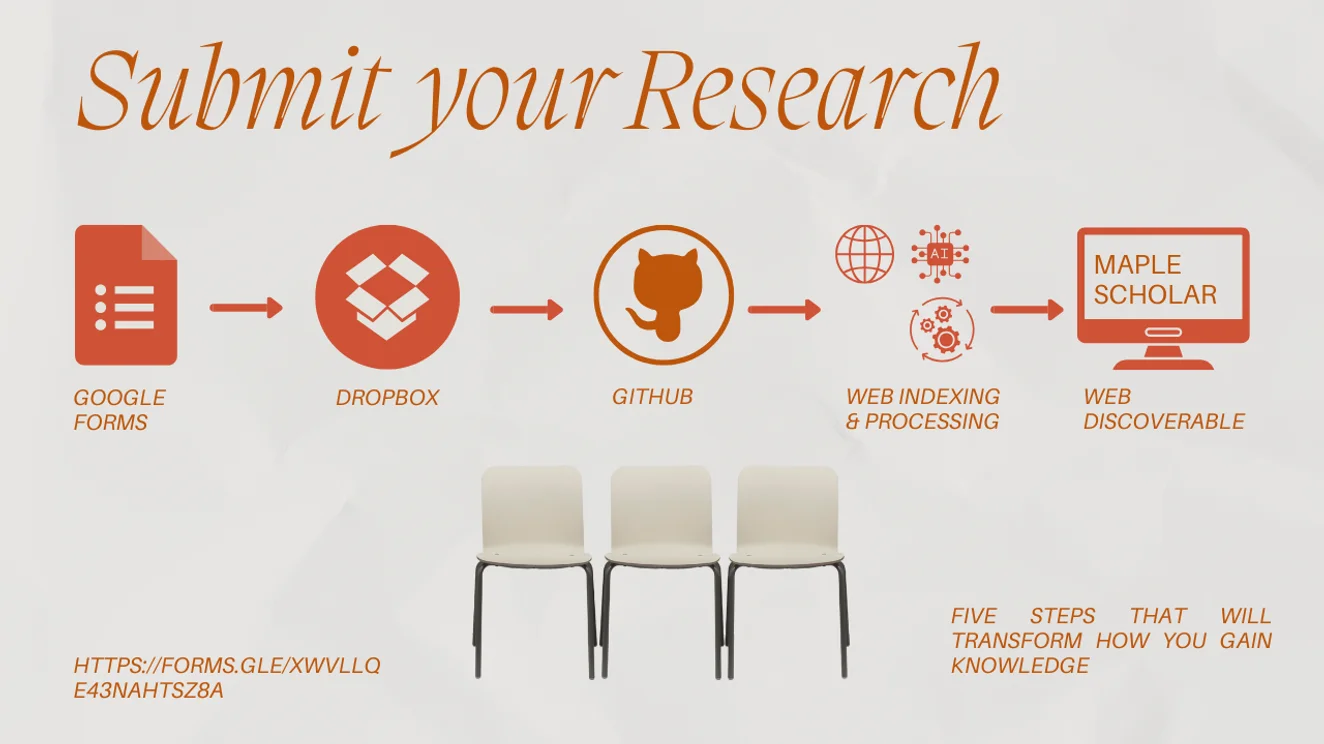
Submit your research and publications to our curated open science catalog covering all STEM disciplines. Accepting all languages.