Ueber das Gesetz der Energieverteilung im Normalspectrum
Planck 1900
One paper introduced energy quantization and two constants that now define the kilogram, limit the world’s best clock, and underpin every transistor, solar cell, and quantum computer built since. This is its verified research lineage.
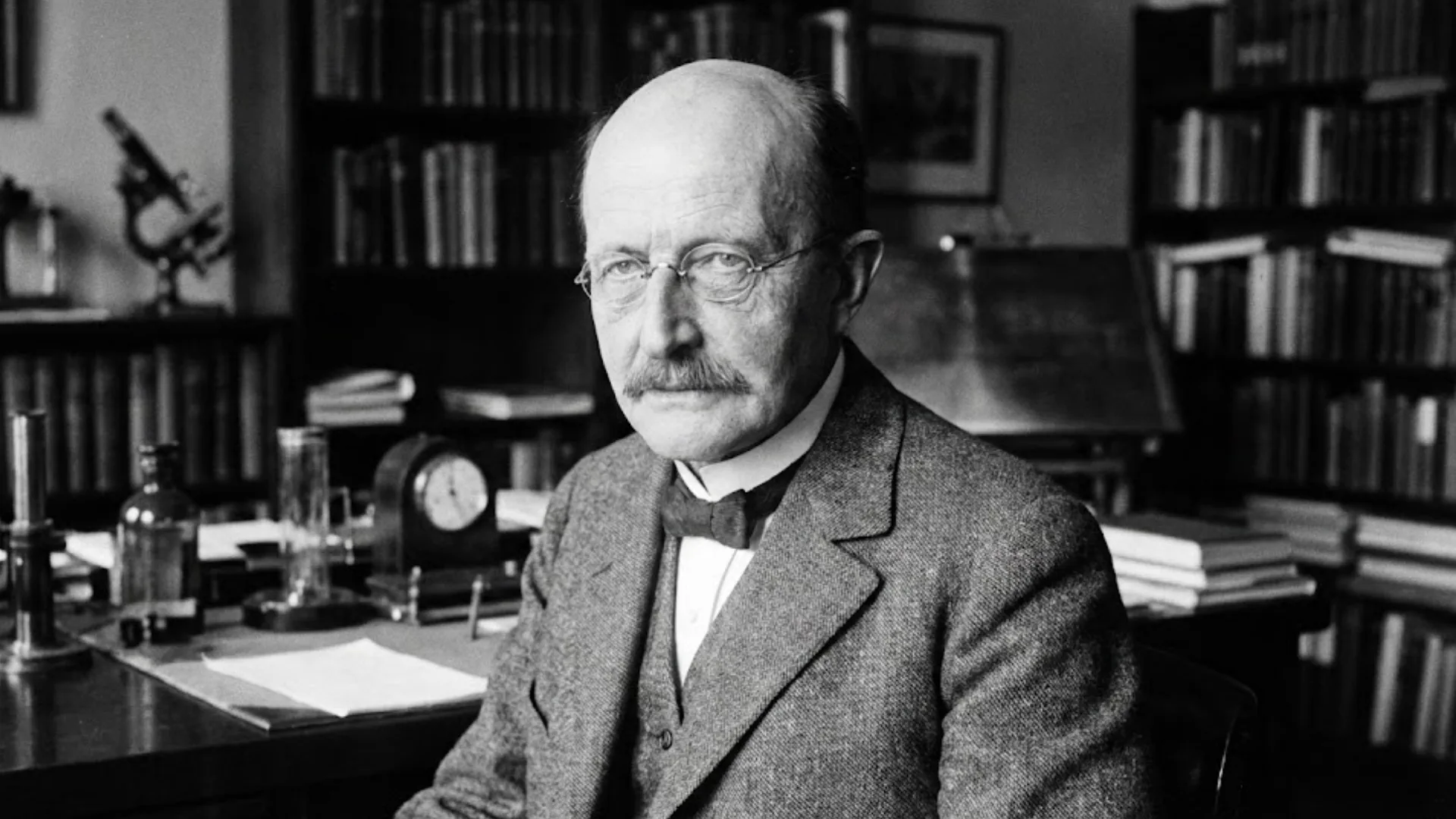
◆Max Planck, c. 1900 — Deutsche Physikalische Gesellschaft
ε = hν
Energy quantization
iThe Foundation
The Foundation: Planck 1900
In December 1900, Planck presented his derivation of the blackbody spectral distribution to the German Physical Society. Published in Annalen der Physik (1901), it assumed energy could only be exchanged in discrete elements ε = hν and introduced two constants that now underpin all of metrology: h (Planck’s constant, 6.62607015 × 10⁻³⁴ J·s) and k (Boltzmann’s constant in its modern role).
Historians of physics—Kuhn, Darrigol, Gearhart—still debate whether Planck in 1900 believed in quantization as physical reality or used it as a formal trick. But the equation, the constant, and the statistical derivation are what every descendant inherits. Five distinct lineage branches flow from this single paper: light quanta (Einstein 1905), solid-state physics (Einstein 1907), quantum statistics (Bose 1924), full quantum mechanics (Heisenberg/Schrödinger 1925–26), and blackbody law as an engineering tool for cosmology and remote sensing.
This is not a historical footnote. As of 2026, the kilogram is literally defined by Planck’s constant (since May 20, 2019), the world’s most precise atomic clock is limited by blackbody radiation from its own apparatus, and fault-tolerant quantum computers trace their hardware lineage through every step back to this paper.
iiResearch Lineage
Research Lineage Map
Einstein
Einstein
Bose
Heisenberg/Schrödinger
Blackbody law as engineering tool
1900
Planck — Blackbody quantization (ε = hν)
1905
Einstein — Light quanta (E = hν)
1961
Shockley-Queisser — Solar cell efficiency limit
2024
Perovskite tandems — Breaking 34% efficiency
2023
LIGO — Squeezed light below quantum limit
1907
Einstein — Quantum theory of solids
1948
Bardeen & Brattain — The transistor
2026
Modern semiconductors, AI, cloud computing
1924
Bose — Photon statistics from Planck’s law
1995
Cornell & Wieman — Bose-Einstein condensate
2024
JILA — Optical lattice clock (8×10⁻¹⁹)
2026
Bluvstein — 448-atom fault-tolerant QC
1925
Heisenberg/Schrödinger — Quantum mechanics
2024
Google Willow — Below error-correction threshold
1948
Blackbody law as engineering tool
1996
COBE/FIRAS — Most perfect blackbody (CMB)
2020
Planck satellite — 14,000+ citations
2024
MODIS, Landsat — Climate & urban heat mapping
Each node represents a verified research milestone. Lines trace documented citation and conceptual lineage.
descendants
iiiDirect
Direct Descendants
01
Light quanta and solar energy
In 1905, Einstein took Planck’s resonator quantization and extended it to light itself—proposing that radiation travels in discrete packets. This single step made every photodetector, camera sensor, and solar cell conceptually possible.
The connection to solar energy is direct. In 1961, Shockley and Queisser modeled both the Sun and a solar cell as blackbodies using Planck’s spectral formula to compute the theoretical maximum efficiency of any single-junction cell. That limit—with over 12,000 citations—is still the benchmark the entire photovoltaics industry measures itself against.
In 2024–2025, perovskite tandem solar cells broke through that ceiling, reaching 34.85% certified efficiency. These devices are benchmarked against a constraint that descends directly from Planck’s 1900 blackbody equation.
Two years after Einstein quantized light, he applied Planck’s average-energy formula to atoms in a solid lattice (1907), resolving an anomaly in low-temperature specific heats. Historians call this the first paper ever written on quantum theory of the solid state.
That branch grew through Debye’s lattice model (1912) and Sommerfeld and Bloch’s band theory (1928) into the theoretical scaffold that made the transistor possible. Bardeen and Brattain announced the transistor in 1948 and received the 1956 Nobel Prize.
Every semiconductor chip, cloud server, and AI accelerator inherits this chain: Planck’s quantization to solid-state quantum theory to band theory to the transistor.
Since May 20, 2019, the kilogram is defined by Planck’s constant. The CODATA collaboration fixed h at exactly 6.62607015 × 10⁻³⁴ J·s, and Kibble balances now derive mass from this value. Few people outside metrology realize that every kilogram measured anywhere on Earth now rests on a number Planck introduced in 1900.
The first full CODATA adjustment after the redefinition dramatically improved the precision of many other fundamental constants, cascading the benefit of fixing h across all of measurement science.
At the precision frontier, the JILA strontium optical lattice clock—the world’s most accurate—has reached 8 × 10⁻¹⁹ systematic uncertainty. Its dominant remaining error source is blackbody radiation from the room-temperature apparatus. Planck’s law is literally the hardest limit left to beat.
The cosmic microwave background is the most perfect blackbody ever measured. The COBE/FIRAS instrument confirmed it matches a Planck blackbody at 2.728 K to within 50 parts per million—earning John Mather the 2006 Nobel Prize. Those spectral distortion limits remain the tightest available in 2026.
The Planck satellite extended this work into full-sky cosmological mapping. Its 2018 parameters paper has over 14,000 citations, making it one of the most referenced physics papers of the past decade. The satellite is named in honor of Max Planck, but the physics lineage is independently real—CMB cosmology rests on blackbody spectrum measurements.
Closer to Earth, satellites like MODIS, Landsat TIRS, and SDGSAT-1 retrieve land surface temperature using Planck’s radiation law as the first equation in every retrieval algorithm. Climate monitoring, wildfire tracking, and urban heat island mapping all run on this chain.
§
Fixsen et al. (1996), Astrophysical Journal — 10.1086/178173
These outcomes sit further down the chain. The path to Planck passes through at least one major intermediary—but every step is documented, not thematic resemblance.
The superconducting path to quantum computing runs through quantum mechanics, BCS superconductivity theory, and Josephson junctions to today’s transmon qubits. Google’s Willow chip (2024) demonstrated exponential error suppression below the surface code threshold—the milestone fault tolerance has pursued since the 1990s.
The cold-atom path traces through Bose’s 1924 re-derivation of Planck’s law, Einstein’s BEC prediction, and ultracold atom experiments. In early 2026, Bluvstein et al. demonstrated a 448-atom fault-tolerant architecture, making neutral atoms competitive with superconducting hardware.
LIGO now routinely operates below the standard quantum limit by injecting squeezed vacuum states into the detector. This technique extends the quantum-statistics-of-light lineage that began with Planck’s radiation law, passed through Einstein’s photon concept, and developed through Bose’s photon statistics into modern quantum optics.
Privacy and surveillance law changed when thermal imaging entered law enforcement. In Kyllo v. United States (2001), the Supreme Court ruled that using thermal imagers on a private home constitutes a Fourth Amendment search. The devices that prompted this landmark case run on technology descended from Planck’s quantization through the semiconductor chain.
§
Hughes (2001), American Journal of Criminal Justice — 10.1007/BF02886856
v
Semiconductor industrial policy
Export controls, CHIPS Act investments, and national competitiveness strategy all depend on control over semiconductor manufacturing. That manufacturing rests on the solid-state physics branch that began with Planck’s quantization and became an industry through the transistor. A 2024 NBER study documents and quantifies these industrial policies across nations.
§
Goldberg, Juhász et al. (2024), NBER Working Paper — 10.3386/w32651
vi
Architecture, cities, and urban heat
Building thermography, energy-retrofit decisions, and urban heat island diagnostics rely on thermal sensors that retrieve temperature using Planck’s radiation law. A comprehensive multi-scale review classified hundreds of studies from the 1980s to 2020s showing how infrared thermography shapes building energy policy and city planning.
§
Martin, Chong, Biljecki & Miller (2022), Renewable and Sustainable Energy Reviews — 10.1016/j.rser.2022.112540
vPresent Day
Why This Matters in 2026
“Six active research fronts trace directly to Planck 1900: fault-tolerant quantum computing crossing the error-correction threshold (Willow, neutral atoms), perovskite tandem solar cells breaking through the Shockley-Queisser limit, LIGO operating below the standard quantum limit with squeezed light, optical lattice clocks pushing precision to 10⁻¹⁹ (limited by blackbody radiation), CMB cosmology constraining exotic early-universe physics, and satellite remote sensing retrieving land surface temperature using Planck’s law.
The 2019 SI redefinition made this personal: every kilogram measured anywhere on Earth is now defined by Planck’s constant. Few people outside metrology realize this—the redefinition received modest press coverage relative to its philosophical weight.
For policymakers and educators: the technologies driving quantum computing strategy, the energy transition, climate monitoring, and precision manufacturing all rest on a single 1900 paper. Investment in basic physics research continues to yield transformative returns 125 years later.
insights
viThings Often Missed
Hidden Insights and Common Misconceptions
1The kilogram has been defined by Planck’s constant since May 20, 2019. The world’s definition of mass is literally h = 6.62607015 × 10⁻³⁴ J·s, measured via Kibble balances and silicon sphere experiments. Few people outside metrology know this.
2The world’s most precise clock (JILA strontium lattice, 8 × 10⁻¹⁹ uncertainty) is limited by blackbody radiation from the room-temperature apparatus—a 300 K radiative field shifts the atomic transition frequency by amounts that must be measured to 7 parts in 10¹⁹. Planck’s law is the hardest limit to beat.
3The cosmic microwave background is the most perfect blackbody in nature. COBE/FIRAS spectral distortion limits (|μ| < 9 × 10⁻⁵, |y| < 1.5 × 10⁻⁵) remain the tightest constraints available in 2026 and bound exotic early-universe physics.
4Historians debate whether Planck believed in quantization as physical reality or used it as a formal device. Einstein 1905, not Planck 1900, was the paper that made quantization physically real—and it took until Compton 1923 to convince the broader community.
He derived the blackbody spectral distribution by treating energy exchange as discrete elements ε = hν, introducing Planck’s constant h and giving Boltzmann’s constant k its modern role. This resolved the ultraviolet catastrophe and opened the route to all quantum physics.
Systematic search across Google Scholar, arXiv, Web of Science, and institutional repositories. Forward citation tracing from the 1901 Annalen paper through experimental verification, theoretical extension, and technological application. Every paper referenced on this page includes a verified DOI for independent checking.
Yes. The Planck satellite CMB paper alone has over 14,000 citations. The Shockley-Queisser limit (a direct Planck descendant) is the benchmark for every solar cell efficiency record. Optical lattice clocks cite blackbody radiation shift corrections derived from Planck’s law.
Fault-tolerant neutral-atom quantum computing (448 atoms, below-threshold surface codes), perovskite tandem solar cells at 34.85%, LIGO operating below the quantum limit with squeezed light, and the JILA clock at 8 × 10⁻¹⁹ systematic uncertainty.
Direct: technologies that technically depend on quantization or blackbody modeling in their operation (solar cells, metrology, thermal imaging). Indirect: outcomes built on technology from direct descendants—quantum computing via the QM → BCS → Josephson chain, or semiconductor policy via the transistor lineage.
Since May 20, 2019, h is fixed at exactly 6.62607015 × 10⁻³⁴ J·s. The kilogram is derived from this value using Kibble balances that relate electrical power to mechanical power, with h linking the two. The CODATA 2017 paper by Newell et al. made this redefinition possible.
Yes. It connects physics to metrology, semiconductor policy, climate remote sensing, cosmology, quantum computing, solar energy, and law—with verified sources throughout. Designed for educators who need interdisciplinary material grounded in real research.
Every major claim includes a DOI number. Enter any DOI at doi.org to access the original publication. Use chat to explore specific papers or ask for mechanism-level explanations of any lineage branch.
Continue
Explore the Lineage in Chat
Ask about any paper in the lineage by DOI, trace the transistor branch or the cosmology branch, or explore how a 1900 blackbody formula still limits the world’s best clock.