Newton derived a single framework — three laws of motion and one inverse-square law of gravity — that governs a falling apple, the Moon, the planets, comets, and the tides alike. Three centuries later it still steers every spacecraft, underlies the first deflection of an asteroid, and supplies the templates that turn gravitational-wave signals into measurements. This is its verified research lineage across 339 years.
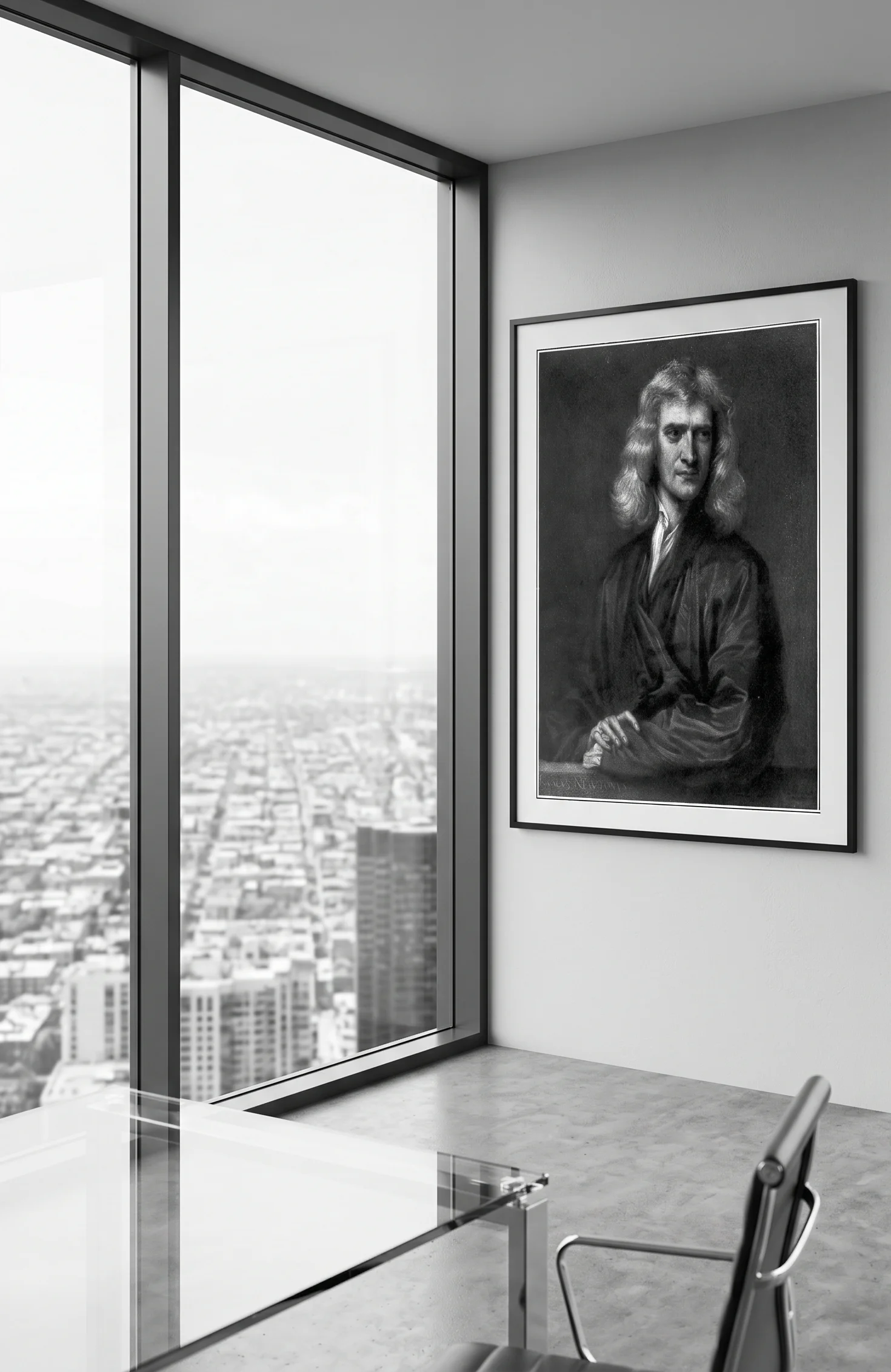
◆Sir Isaac Newton — portrait engraving (public domain)
F = G·m₁m₂ / r²
Universal gravitation
iThe Foundation
The Foundation: Newton 1687
In 1687 the Royal Society published Newton’s Philosophiæ Naturalis Principia Mathematica. In one work he derived three laws of motion and a single inverse-square law of universal gravitation, then showed that the same mathematics governs a falling body on Earth, the Moon’s orbit, the Keplerian motion of the planets, comets, the tides, and the bulge of the spinning Earth. It was the first complete deductive system in which terrestrial and celestial phenomena obey one law.
Historians of science — Cohen, Westfall, Guicciardini, Smith, Harper — note that the Principia did three irreducibly distinct things: it built the calculus-like "method of first and last ratios" into a working tool, it set the demonstrative style that became the template for theoretical physics, and it unified the heavens and the Earth under one rule. Every descendant in this lineage inherits at least one of those three.
This is not a historical relic. A 339-year chain runs from the Principia through Euler, Lagrange and Hamilton (who recast its mechanics into the form physics still uses), through Cavendish and Laplace, through the Mercury anomaly that forced general relativity, and into 2026: the ephemerides that navigate spacecraft, the first human deflection of an asteroid, and the post-Newtonian templates that decode every gravitational-wave detection.
Each node represents a verified research milestone. Lines trace documented citation and conceptual lineage.
descendants
iiiDirect
Direct Descendants
01
The analytical reformulation of mechanics
Newton wrote his mechanics in geometry. Euler (1736) recast it in the analytical language of calculus — differential equations and components along coordinate axes. Most "Newton’s laws" in modern textbooks are in fact Euler’s reformulation.
Lagrange’s Mécanique Analytique (1788), famous for containing not a single diagram, rebuilt mechanics from a variational principle and introduced generalized coordinates — the conceptual seed of every Lagrangian and Hamiltonian treatment in classical mechanics, quantum field theory, and general relativity.
Hamilton (1834) completed the arc with phase space and the canonical equations. Mathematically equivalent to Newton, his form is the one that survives wholesale into quantum mechanics, where the Hamiltonian becomes the energy operator.
§
Euler (1736), Mechanica sive motus scientia analytice exposita — Euler Archive E015
Hamilton (1834), Philosophical Transactions of the Royal Society — 10.1098/rstl.1834.0017
02
Measuring and testing gravity
Newton left the constant of proportionality in his law unmeasured — there is no G in the Principia. Cavendish’s torsion-balance experiment (1798) was the first to weigh that constant, in effect determining the density of the Earth. Every weighing of a planet and every spacecraft trajectory is calibrated against descendants of this measurement.
The assumption hidden inside Newton’s mathematics — that inertial and gravitational mass are the same — is still being tested at the precision frontier. The space-based MICROSCOPE experiment (2022) confirmed the weak equivalence principle to a few parts in 10^15, a hundredfold improvement over any ground experiment: two test masses orbiting Earth stayed together to within 100 millionths of a metre after falling 73 billion metres.
§
Cavendish (1798), Philosophical Transactions of the Royal Society — 10.1098/rstl.1798.0022
Halley applied Newton’s theory to historical comet sightings, argued the comets of 1531, 1607 and 1682 were one periodic object, and forecast its return. Refined by Clairaut’s perturbation calculations, the comet arrived in 1759 — the moment Newtonian gravity stopped being controversial.
Laplace’s Mécanique Céleste (1799–1825) carried the framework across the whole solar system, including the long-period perturbations of Jupiter and Saturn. Its modern incarnation is the JPL DE440/DE441 ephemerides (2021): Newton’s equations with relativistic corrections, integrated for over a thousand years, against which every interplanetary mission is navigated.
In 2022 the DART mission turned Book I two-body mechanics into planetary defence, shortening the orbital period of the asteroid Dimorphos by about 33 minutes — the first time a human action measurably changed the orbit of another celestial body.
§
Halley (1705), A Synopsis of the Astronomy of Comets — Philosophical Transactions 24
§
Park et al. (2021), The JPL Planetary and Lunar Ephemerides DE440 and DE441, Astronomical Journal — 10.3847/1538-3881/abd414
§
Daly et al. (2023), Successful Kinetic Impact into an Asteroid for Planetary Defence, Nature — 10.1038/s41586-023-05810-5
04
The crack that became relativity
Applied to the best observations of the 19th century, Newton’s theory predicted Mercury’s perihelion to advance by about 531″ per century — but Le Verrier (1859) found an extra ~43″ that no Newtonian mechanism explained. It is the most famous experimental crack in Newtonian gravity, and the theory had to be precise enough to generate the anomaly in the first place.
Einstein’s general relativity (1916) absorbed Newton’s gravitation as the weak-field limit of a geometric theory of spacetime and resolved the 43″ anomaly. The relationship is genuine: the Schwarzschild metric reduces to Newton’s law far from the Schwarzschild radius. Relativity replaced Newton’s picture of gravity while preserving his predictions in their domain.
That branch reaches today’s detectors. LIGO’s first gravitational-wave detection (2016) was modelled with post-Newtonian expansions of the two-body problem — a literal mathematical descendant of Book I — matched to numerical relativity.
§
Le Verrier (1859), Comptes Rendus de l’Académie des Sciences 49
§
Einstein (1916), Die Grundlage der allgemeinen Relativitätstheorie, Annalen der Physik — 10.1002/andp.19163540702
§
Abbott et al., LIGO–Virgo (2016), Observation of Gravitational Waves from a Binary Black Hole Merger, Physical Review Letters — 10.1103/PhysRevLett.116.061102
ivIndirect
Indirect Descendants
These works sit further down the lineage — the path back to the Principia passes through at least one intermediary, often general relativity, the Lagrange–Hamilton reformulation, or Cavendish. Each link is documented in the citation record, not merely thematic.
i
Chaos and the three-body problem
Poincaré’s prize memoir on the three-body problem (1890) proved Newton’s equations admit no general closed-form solution and introduced sensitive dependence on initial conditions — the origin of chaos theory. The problem still yields new mathematics: in 2025 the Liao group reported 10,059 new three-dimensional periodic orbits, integrating equations that are still Newton’s.
§
Poincaré (1890), Sur le problème des trois corps, Acta Mathematica — 10.1007/BF02392506
ii
Gravitational-wave astronomy
The machinery that turns LIGO–Virgo–KAGRA detections into black-hole masses and spins is the post-Newtonian expansion — a perturbation series around the Newtonian two-body problem. Almost no public coverage notes that the waveform templates are mathematically Newtonian-plus-corrections.
§
Blanchet (2014), Gravitational Radiation from Post-Newtonian Sources and Inspiralling Compact Binaries, Living Reviews in Relativity — 10.12942/lrr-2014-2
iii
Pulsar timing and the nanohertz sky
NANOGrav’s 15-year evidence (2023) for a nanohertz gravitational-wave background uses Newtonian celestial-mechanics ephemerides as its reference frame and detects the background as a coherent deviation from it. The Principia lineage runs through both the reference frame and the signal.
The Event Horizon Telescope’s first image of a black-hole shadow (2019) tested the strong-field geometry of spacetime as an image. The standard it is compared against is general relativity — the strong-field generalization of Newton’s law.
§
Event Horizon Telescope Collaboration (2019), First M87 EHT Results I, Astrophysical Journal Letters — 10.3847/2041-8213/ab0ec7
v
Cosmology and dark energy
DESI’s baryon-acoustic-oscillation maps (2024–2025) — the largest 3D map of the universe — constrain dark energy from the gravitational growth of structure, i.e. Newtonian dynamics on large scales feeding into a relativistic cosmology. The Newton lineage here is double.
Which asteroids may hit Earth, and when, is decided by Newtonian-celestial-mechanics propagation of orbits in the JPL ephemerides. The 2029 Apophis flyby — closer than geosynchronous orbit — has been cleared as an impact threat for a century by exactly this framework.
“Several active research fronts trace directly to Newton 1687: the JPL ephemerides that navigate every spacecraft and clear asteroid threats, the DART deflection that opened planetary defence, the equivalence-principle tests pushing to parts in 10^15, the gravitational-wave catalogs whose every entry is a post-Newtonian fit, and the three-body problem still producing new mathematics on supercomputers.
The freshest results keep landing on this branch. GW250114 (2025), the loudest gravitational-wave event ever recorded, was used to test Hawking’s area theorem and the Kerr nature of black holes — a test that rests on the post-Newtonian expansion of Newton’s two-body problem. The growing GWTC catalog is now the largest precision-test dataset in the history of gravitational physics.
For educators and policymakers: the systems behind spacecraft navigation, planetary defence, precision metrology, and the entire field of gravitational-wave astronomy all rest on a single 1687 treatise. A foundational work can keep organizing physics — and yielding new engineering — three and a half centuries later.
insights
viThings Often Missed
Hidden Insights and Common Misconceptions
1There is no G in the Principia. Newton wrote gravitation as a proportionality, not as F = G·m₁m₂/r²; the constant we now call G was first measured by Cavendish in 1798, over a century later. The familiar equation is a later, cleaner restatement of Newton’s relation.
2Newton did not derive Kepler’s laws the way textbooks suggest. He proved the inverse direction — that Kepler-obeying orbits imply an inverse-square central force (Book I, Proposition 11) — and then ran the argument the other way using the Moon test in Book III.
3Calling general relativity a "descendant" of Newton is correct in physics but contestable in philosophy: Einstein replaced Newton’s ontology (instantaneous force at a distance) while preserving his predictions in their domain. The math reduces to Newton in the weak-field limit; the picture of reality does not.
4A 2020 census found 387 surviving first-edition copies of the Principia, not the 189 of the 1953 count — implying an original print run near 500. The book circulated more widely, and Newtonian mechanics entered European culture faster, than long believed.
He derived three laws of motion and one inverse-square law of universal gravitation, then showed the same mathematics governs falling bodies, the Moon, the planets, comets and the tides — the first complete deductive system uniting terrestrial and celestial physics.
Forward citation tracing from the Principia through its analytical reformulations, experimental tests, and modern applications, cross-checked across scholarly catalogs and repositories. Modern papers on this page carry verified DOIs; 17th–19th-century works, which predate DOIs, are cited by their strongest available identifier.
Yes — directly and indirectly. The three-body problem Newton wrote down is still producing new mathematics (10,059 new periodic orbits in 2025), every gravitational-wave detection uses a post-Newtonian expansion of his two-body problem, and the ephemerides that navigate spacecraft integrate his equations forward in time.
GW250114 testing Hawking’s area law with the loudest gravitational-wave event yet, the growing GWTC catalog of compact-binary mergers, MICROSCOPE’s equivalence-principle test to parts in 10^15, and the DART asteroid deflection opening the field of planetary defence.
Direct: works that reformulate, measure, test or directly apply Newton’s mechanics in one step (Euler, Cavendish, Laplace, the JPL ephemerides, DART). Indirect: results reached through an intermediary such as general relativity or the Lagrange–Hamilton framework (gravitational-wave astronomy, EHT imaging, DESI cosmology).
In ontology, yes — gravity is spacetime curvature, not instantaneous force at a distance. In predictions, no — general relativity reduces to Newton’s law in the weak-field, low-velocity limit, which is why Newtonian mechanics still navigates every spacecraft.
Yes. It connects physics with mathematics, astronomy, engineering, metrology, and planetary defence — with verified sources throughout — for educators who need rigorous, real-research material that spans the history of science.
Modern claims include a DOI you can enter at doi.org; historical works list a library or archive identifier. Use chat to read the Principia itself, ask for a mechanism-level explanation, or trace any branch of the lineage.
Continue
Explore the Lineage in Chat
Read the Principia itself and ask questions against the original text — trace the relativity branch, the celestial-mechanics branch, or the chaos branch, or ask how a 1687 law still steers spacecraft in 2026.