Chat
ChatConventional hospital stretchers were bulky, manually operated metal frames that caused severe caregiver back strain and risky patient transfers; multi-featured ergonomic stretchers integrate motorized height adjustment and multi-angle conversion.
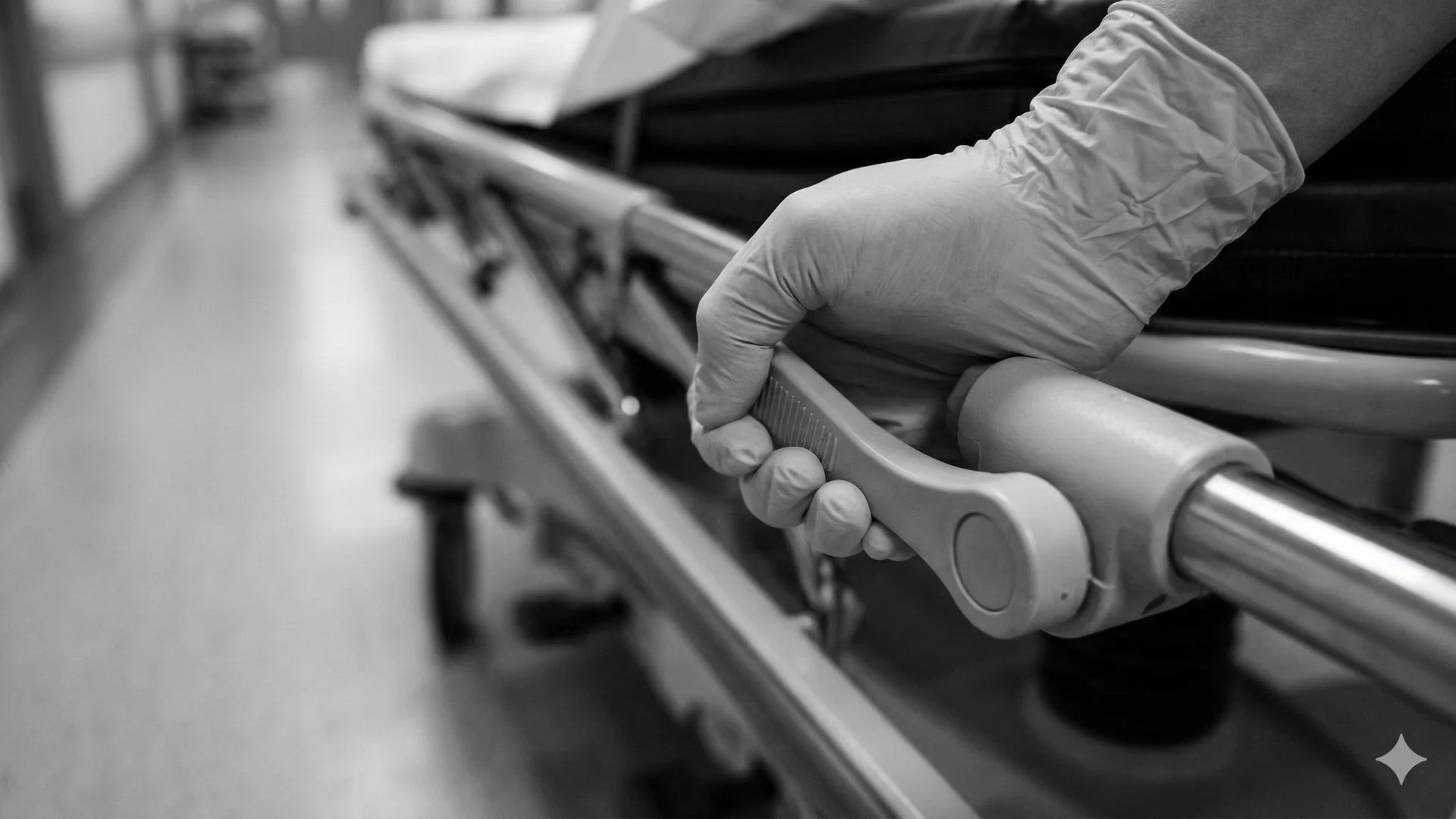
In emergency triage and hospital transport, moving trauma patients from ambulances to beds is a high-risk operation fraught with patient discomfort and chronic musculoskeletal injuries among paramedics and nurses.
Standard hospital gurneys lack adaptable modular configurations, forcing healthcare workers to manually lift heavy patient loads across differing surface heights and tight hospital corridors.
This engineering design introduces an ergonomic multi-featured medical stretcher incorporating linear actuator motorized height adjustment, instant conversion between flat-bed and upright wheelchair configurations, and integrated IV pole mounts.
By reducing physical caregiver lifting effort and minimizing patient movement during acute transfers, this modular stretcher improves emergency room triage efficiency and establishes new safety standards for medical transport hardware.
Design and Development of Multi-Featured Medical Stretcher
The multi-featured medical stretcher represents a significant leap forward in patient care and hospital operations. Its innovative design combines various features aimed at enhancing both patient comfort and healthcare worker efficiency. At the core of its design is a commitment to making patient movement easier and safer. Through its adjustable height mechanism, the stretcher can be tailored to individual patient needs and seamlessly integrated into various medical procedures. This adaptability not only enhances patient comfort but also facilitates smoother transitions between different stages of care. Furthermore, the inclusion of storage compartments ensures that essential medical supplies are readily accessible, minimizing disruptions during patient transport and treatment. This organizational feature not only saves time but also contributes to a more efficient workflow for healthcare workers. Importantly, the stretcher's ability to move patients from stretcher to bed with minimal human assistance is a game-changer. By reducing the reliance on manpower for transfers, it streamlines hospital operations and minimizes the risk of patient discomfort or injury during movement. Overall, the multi-featured medical stretcher represents a significant advancement in hospital equipment, offering a comprehensive solution to the challenges associated with patient transport. Its integration of comfort-enhancing features and efficiency-boosting functionalities marks a substantial improvement in patient care delivery and contributes to a smoother and safer hospital environment for both patients and healthcare workers alike.

Telecommunication engineers believed that static noise permanently corrupted electrical signals; Claude Shannon proved that information can be transmitted with zero errors across noisy channels by converting meaning into binary bits. Published in 1948, Shannon’s masterwork founded information theory and created the digital language of the modern world.


Physical sensors in rockets and satellites are constantly corrupted by noise, vibration, and sensor drift; Rudolf Kalman developed an optimal mathematical filter that predicts true position by fusing imperfect sensor readings with equations of motion in real time. Published in 1960, the Kalman Filter guided the Apollo spacecraft to the Moon and is the mathematical brain powering every GPS receiver, autonomous drone, and commercial jetliner on Earth.


Computer scientists believed that mastering the ancient game of Go required human intuition that machines would not achieve for decades; DeepMind’s AlphaGo paired deep neural networks with Monte Carlo tree search to defeat the world champion. Published in 2016, AlphaGo proved that deep reinforcement learning could exhibit genuine creative intuition, sparking the modern Artificial General Intelligence revolution.

For thousands of years, secret communication required sending a physical key via a trusted courier before a message could be sent; Whitfield Diffie and Martin Hellman proved that two total strangers can agree on a shared secret over a compromised public channel. Published in 1976, this mathematical breakthrough invented public-key cryptography and made secure global e-commerce possible.


Multiplying two massive prime numbers takes a fraction of a second on a computer; factoring that product back into its original primes takes millions of years. By anchoring asymmetric encryption to the asymmetry of prime numbers, Ron Rivest, Adi Shamir, and Leonard Adleman created RSA—the cryptographic algorithm that encrypts every browser connection, banking transfer, and software update on Earth.


Albert Einstein spent his final decades insisting that quantum entanglement was an incomplete illusion masking hidden common-sense variables; John Stewart Bell devised a single mathematical inequality that allowed laboratory experiments to test whether Einstein or quantum mechanics was right. Published in an obscure, short-lived journal in 1964, Bell’s Theorem proved that the physical universe is fundamentally non-local—founding modern quantum computing, quantum cryptography, and quantum teleportation.

Physical clocks drift out of sync across distributed computer networks because electrical signals cannot travel faster than the speed of light; Leslie Lamport defined time through cause-and-effect causality rather than ticking seconds. Published in 1978, Lamport’s logical clock paper is the most cited work in distributed systems, establishing the foundational physics of cloud computing.
Storing millions of search queries in computer memory wastes vast amounts of expensive hardware; Bloom filters verify whether a record exists using a tiny fraction of a single bit per item. Published in 1970 to speed up hyphenation in typesetting machines, Burton Bloom’s compact data structure now speeds up every Google search query and Bitcoin transaction on Earth.
Ask this paper your own questions, or keep browsing the verified research catalogue.