Chat
ChatDirect dark matter detection experiments were historically deaf to low-mass particle interactions; XENON1T's ultra-pure liquid xenon time projection chamber uncovered a tantalizing excess of low-energy electronic recoils deep beneath an Italian mountain.
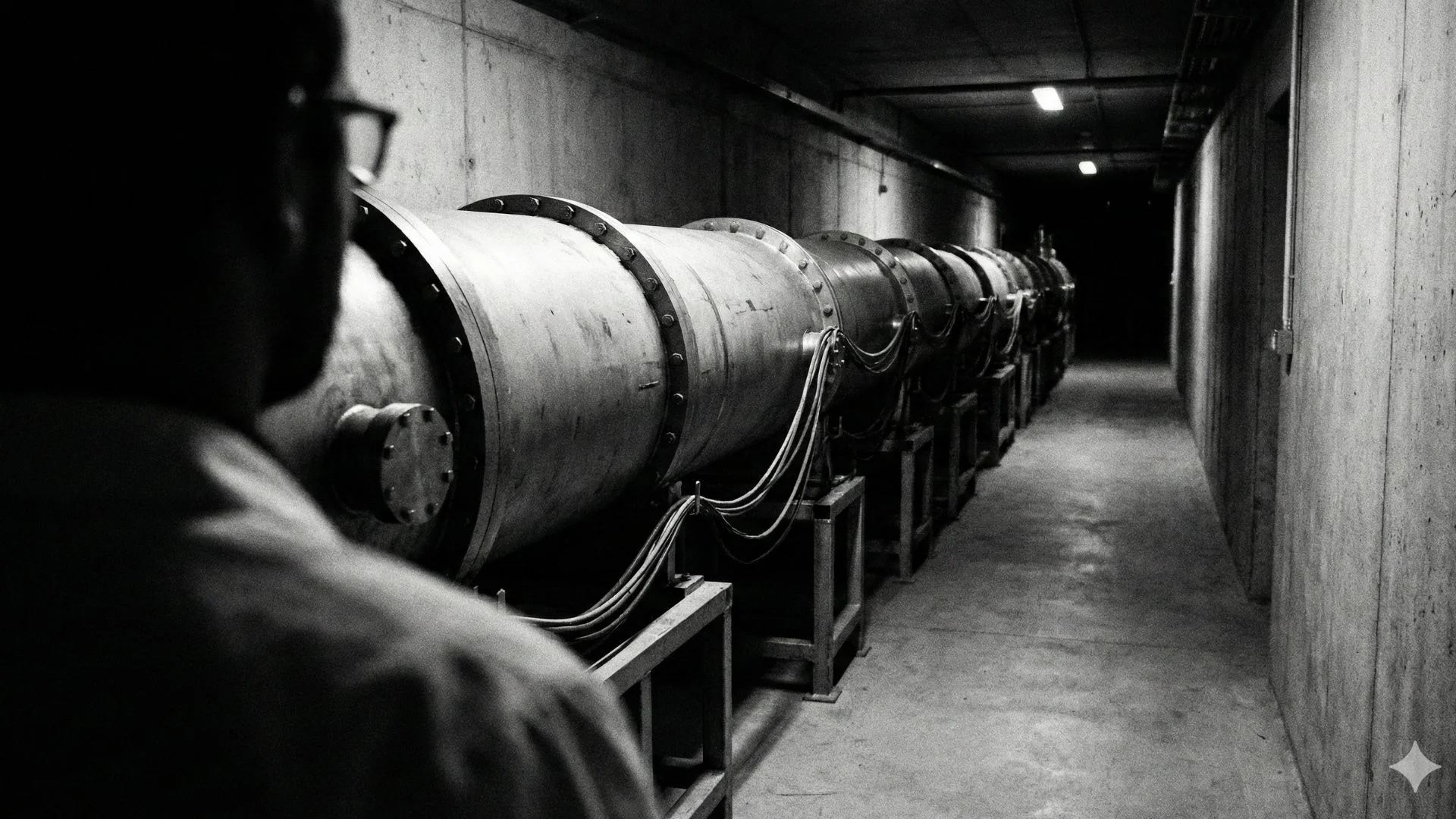
Deep beneath the Gran Sasso mountain in Italy, shielded from cosmic rays by kilometers of rock, the XENON1T detector deployed over three tons of ultra-purified liquid xenon to capture the faintest collisions between passing dark matter particles and atomic nuclei.
While standard WIMP searches focus on nuclear recoils, low-mass dark matter candidates or exotic solar particles produce subtle electronic recoils that are easily drowned out by microscopic radioactive impurities like radon and krypton.
With an unprecedentedly low background rate and 0.65 tonne-years of exposure, XENON1T detected a distinct excess of 53 events above expected backgrounds in the 1 to 7 keV energy window. The statistical signal ignited global debates between solar axions, anomalous neutrino magnetic moments, and trace concentrations of tritium atoms.
Regardless of whether the signal is new physics or subtle background isotopes, this landmark measurement pushed experimental sensitivity to unprecedented sub-keV frontiers, paving the way for next-generation multi-tonne detectors like XENONnT and LZ to resolve the nature of cosmic dark matter.
Excess electronic recoil events in XENON1T
We report results from searches for new physics with low-energy electronic recoil data recorded with the XENON1T detector. With an exposure of 0.65 tonne-years and an unprecedentedly low background rate of 76±2stat events/(tonne×year×keV) between 1 and 30 keV, the data enable one of the most sensitive searches for solar axions, an enhanced neutrino magnetic moment using solar neutrinos, and bosonic dark matter. An excess over known backgrounds is observed at low energies and most prominent between 2 and 3 keV. The solar axion model has a 3.4σ significance, and a three-dimensional 90% confidence surface is reported for axion couplings to electrons, photons, and nucleons. This surface is inscribed in the cuboid defined by gae<3.8×10⁻¹², gaeganeff<4.8×10⁻¹⁸, and gaegaγ<7.7×10⁻²² GeV-1, and excludes either gae=0 or gaegaγ=gaeganeff=0. The neutrino magnetic moment signal is similarly favored over background at 3.2σ, and a confidence interval of μν∈(1.4,2.9)×10-11 μB (90% C.L.) is reported. Both results are in strong tension with stellar constraints. The excess can also be explained by β decays of tritium at 3.2σ significance with a corresponding tritium concentration in xenon of (6.2±2.0)×10-25 mol/mol. Such a trace amount can neither be confirmed nor excluded with current knowledge of its production and reduction mechanisms. The significances of the solar axion and neutrino magnetic moment hypotheses are decreased to 2.0σ and 0.9σ, respectively, if an unconstrained tritium component is included in the fitting. With respect to bosonic dark matter, the excess favors a monoenergetic peak at (2.3±0.2) keV (68% C.L.) with a 3.0σ global (4.0σ local) significance over background. This analysis sets the most restrictive direct constraints to date on pseudoscalar and vector bosonic dark matter for most masses between 1 and 210 keV/c2. We also consider the possibility that Ar37 may be present in the detector, yielding a 2.82 keV peak from electron capture. Contrary to tritium, the Ar37 concentration can be tightly constrained and is found to be negligible.


For a century, humanity looked at the universe exclusively through telescopes that capture light; Advanced LIGO used four-kilometer laser beams to directly feel the physical vibration of two black holes colliding 1.3 billion light-years away. Awarded the 2017 Nobel Prize in Physics, the detection of GW150914 confirmed Einstein’s final prediction and gave human science ears to hear the sound of the cosmos.
Ask this paper your own questions, or keep browsing the verified research catalogue.