Chat
ChatFor a century, humanity looked at the universe exclusively through telescopes that capture light; Advanced LIGO used four-kilometer laser beams to directly feel the physical vibration of two black holes colliding 1.3 billion light-years away. Awarded the 2017 Nobel Prize in Physics, the detection of GW150914 confirmed Einstein’s final prediction and gave human science ears to hear the sound of the cosmos.

Ever since Galileo pointed the first telescope at the night sky in 1609, every astronomical discovery in human history relied on light—visible light, radio waves, X-rays, and infrared. However, violent events like the collision of black holes emit zero light, keeping the darkest regions of space completely hidden from view.
Physicists built the Advanced LIGO detectors: giant four-kilometer vacuum tunnels in Washington and Louisiana that bounce laser beams back and forth to measure changes in distance smaller than one ten-thousandth the diameter of a proton. On September 14, 2015, a 0.2-second "chirp" swept through Earth as two giant black holes collided, converting three solar masses of pure matter into gravitational energy in a fraction of a second.
Earning Rainer Weiss, Kip Thorne, and Barry Barish the 2017 Nobel Prize, GW150914 opened a new sense for humanity. By proving stellar-mass black hole pairs exist, by opening gravitational-wave astronomy, and by verifying general relativity in the extreme strong-field regime, LIGO transformed our view of the cosmos.
Observation of Gravitational Waves from a Binary Black Hole Merger
On September 14, 2015 at 09:50:45 UTC the two detectors of the Laser Interferometer Gravitational-Wave Observatory simultaneously observed a transient gravitational-wave signal. The signal sweeps upwards in frequency from 35 to 250 Hz with a peak gravitational-wave strain of . It matches the waveform predicted by general relativity for the inspiral and merger of a pair of black holes and the ringdown of the resulting single black hole. The signal was observed with a matched-filter signal-to-noise ratio of 24 and a false alarm rate estimated to be less than 1 event per 203 000 years, equivalent to a significance greater than 5.1 {\sigma}. The source lies at a luminosity distance of Mpc corresponding to a redshift . In the source frame, the initial black hole masses are and , and the final black hole mass is , with radiated in gravitational waves. All uncertainties define 90% credible intervals.These observations demonstrate the existence of binary stellar-mass black hole systems. This is the first direct detection of gravitational waves and the first observation of a binary black hole merger.
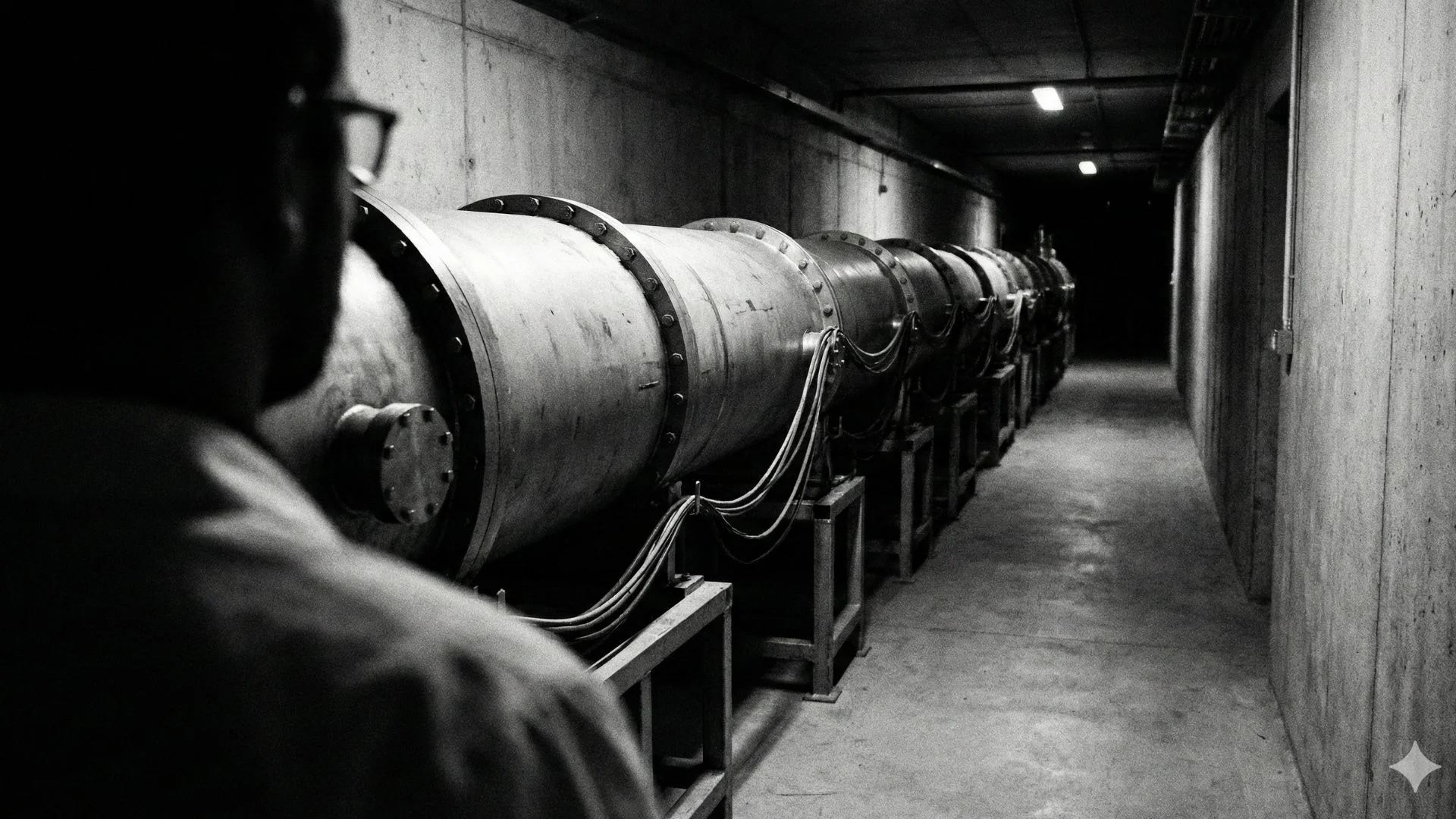

Direct dark matter detection experiments were historically deaf to low-mass particle interactions; XENON1T's ultra-pure liquid xenon time projection chamber uncovered a tantalizing excess of low-energy electronic recoils deep beneath an Italian mountain.


Traditional copper wires choke with electrical resistance when shrunk down to nanoscale dimensions; exotic topological semimetal nanowires grow more conductive as they get smaller. By exploiting topologically protected quantum surface states in niobium arsenide, semiconductor engineers have shattered the interconnect wall threatening the future of microchip miniaturization.
Ask this paper your own questions, or keep browsing the verified research catalogue.