Designing chemical catalysts historically required decades of trial-and-error laboratory experimentation; autonomous LLM-powered chemistry agents ingest academic literature, plan synthesis protocols, and command robotic wet-lab reactors without human intervention.
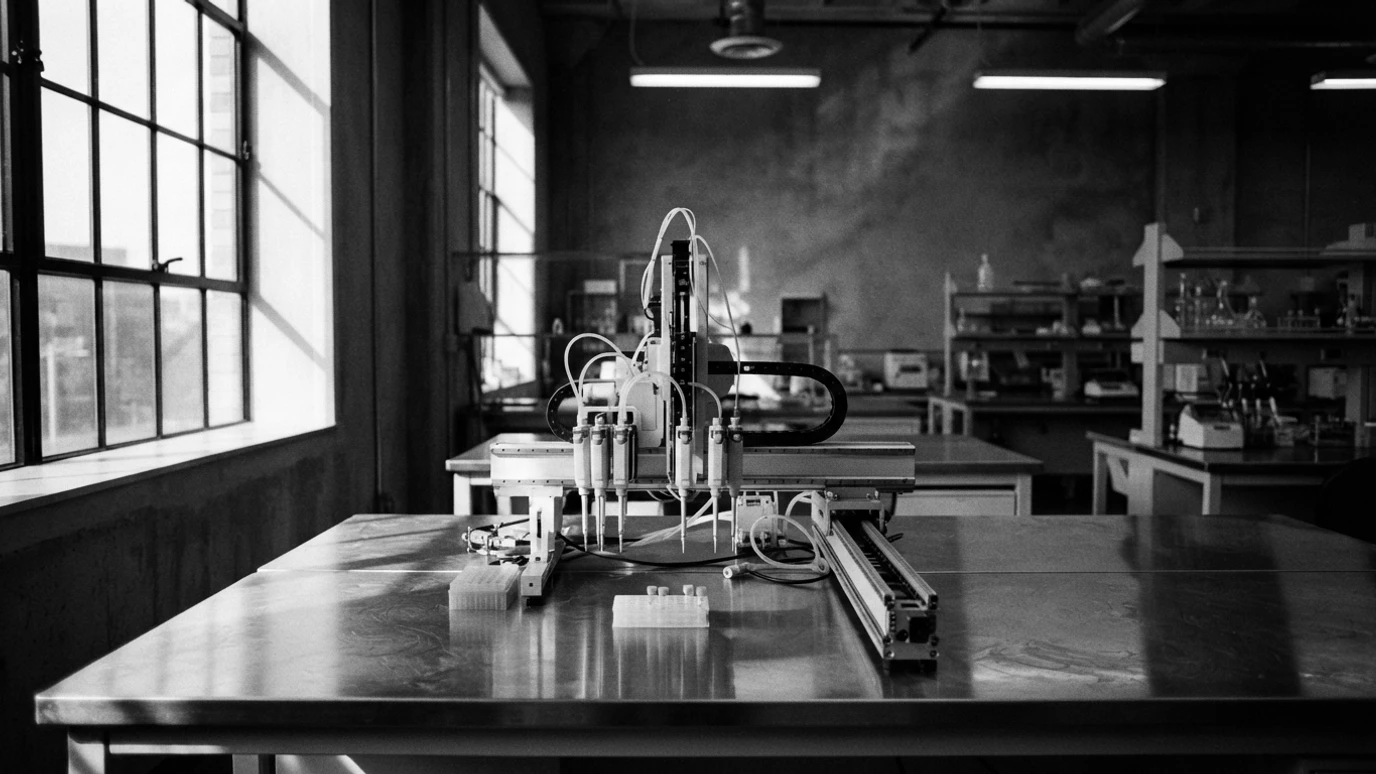
Developing new industrial catalysts for green hydrogen synthesis or plastics recycling has long been a slow, labor-intensive process of human chemists synthesizing candidate formulations one batch at a time.
While high-throughput robotic laboratories can test thousands of samples, designing the experiments, interpreting spectroscopic data, and adjusting chemical hypotheses remained an intellectual bottleneck that required senior human scientists.
This ACS Catalysis study demonstrates autonomous multi-agent software systems powered by domain-fine-tuned large language models. The agent autonomously parses chemical literature, reasons about reaction kinetics, writes execution code for liquid-handling robots, and iteratively optimizes heterogeneous catalyst compositions in real time.
The emergence of self-driving chemical laboratories marks a paradigm shift in scientific discovery, enabling continuous, autonomous experimentation that compresses years of catalyst development into days of robotic execution.
From Chatbots to Chemists: Autonomous Agents for Heterogeneous Catalysis
Large language models (LLMs) face inherent limitations in complex scientific workflows, particularly in heterogeneous catalysis, due to a lack of tool integration, autonomous planning, and closed-loop interaction with robotic platforms. While autonomous agent systems have emerged to bridge these gaps, the rapid proliferation of diverse architectural paradigms has fragmented the literature. This review provides a systematic integration of model capabilities, system design, and catalytic applications. We analyze the evolutionary roadmap across three phases: foundational LLMs (Phase 1) for passive knowledge processing, tool-equipped single-agent systems (SAS) for autonomous execution (Phase 2), and collaborative multi-agent systems (MAS) for distributed catalyst discovery (Phase 3). We critically evaluate LLM capabilities in chemical reasoning, the expansion of functionality through tool use in SAS, and the realization of closed-loop discovery via MAS. Furthermore, we assess existing benchmarking frameworks and propose standardized metrics for evaluating AI agents in catalysis. By establishing this evolutionary roadmap, this review highlights the transition of AI from conversational chatbots to specialized digital chemists, bridging the gap between passive information processing and autonomous discovery in heterogeneous catalysis.


Computational chemists assumed that increasing basis set sizes and convergence criteria in electronic structure theory guaranteed more realistic liquid water simulations; unmasking cancellation-of-error artifacts shows standard approximations break down in condensed phases.

Black-box machine learning models in credit risk suffered sudden accuracy collapse when financial market conditions shifted; probabilistic rule diagnostic layers identify and explain structural concept drift in real time.

Telecommunication engineers believed that static noise permanently corrupted electrical signals; Claude Shannon proved that information can be transmitted with zero errors across noisy channels by converting meaning into binary bits. Published in 1948, Shannon’s masterwork founded information theory and created the digital language of the modern world.


Neoclassical economists spent two centuries assuming that humans calculate money like rational, emotionless computing robots; Daniel Kahneman and Amos Tversky proved that the human brain feels the pain of losing 100. Awarded the 2002 Nobel Prize in Economics, Prospect Theory shattered rational-choice theory and founded Behavioral Economics, revolutionizing financial markets, consumer design, and government policy worldwide.


Physical sensors in rockets and satellites are constantly corrupted by noise, vibration, and sensor drift; Rudolf Kalman developed an optimal mathematical filter that predicts true position by fusing imperfect sensor readings with equations of motion in real time. Published in 1960, the Kalman Filter guided the Apollo spacecraft to the Moon and is the mathematical brain powering every GPS receiver, autonomous drone, and commercial jetliner on Earth.

Mechanical scotch-tape peeling produces only microscopic flakes of pristine graphene; William Hummers’ 1958 chemical recipe exfoliates bulk graphite into tons of water-dispersible two-dimensional sheets. Dormant for nearly half a century, "Hummers' Method" is now the indispensable global manufacturing route for 2D water-purification membranes and conductive composites.


Philosophy taught that human reason was an immaculate engine of pure logic and objective truth; Amos Tversky and Daniel Kahneman proved that our daily decisions are run by quick mental shortcuts that systematically trick our brains into predictable cognitive illusions. Published in Science in 1974, "Judgment under Uncertainty" mapped the universal cognitive biases governing the human mind, revolutionizing behavioral psychology, courtroom legal jury decisions, and medical diagnostics.


Computer scientists believed that mastering the ancient game of Go required human intuition that machines would not achieve for decades; DeepMind’s AlphaGo paired deep neural networks with Monte Carlo tree search to defeat the world champion. Published in 2016, AlphaGo proved that deep reinforcement learning could exhibit genuine creative intuition, sparking the modern Artificial General Intelligence revolution.
Ask this paper your own questions, or keep browsing the verified research catalogue.