Galactic dark matter halos are invisible to telescopes, forcing astronomers to infer their shapes through complex gravitational lensing; a novel dynamical technique measures the 3D triaxial shape of dark matter halos using only the positions and velocities of tracer stars.
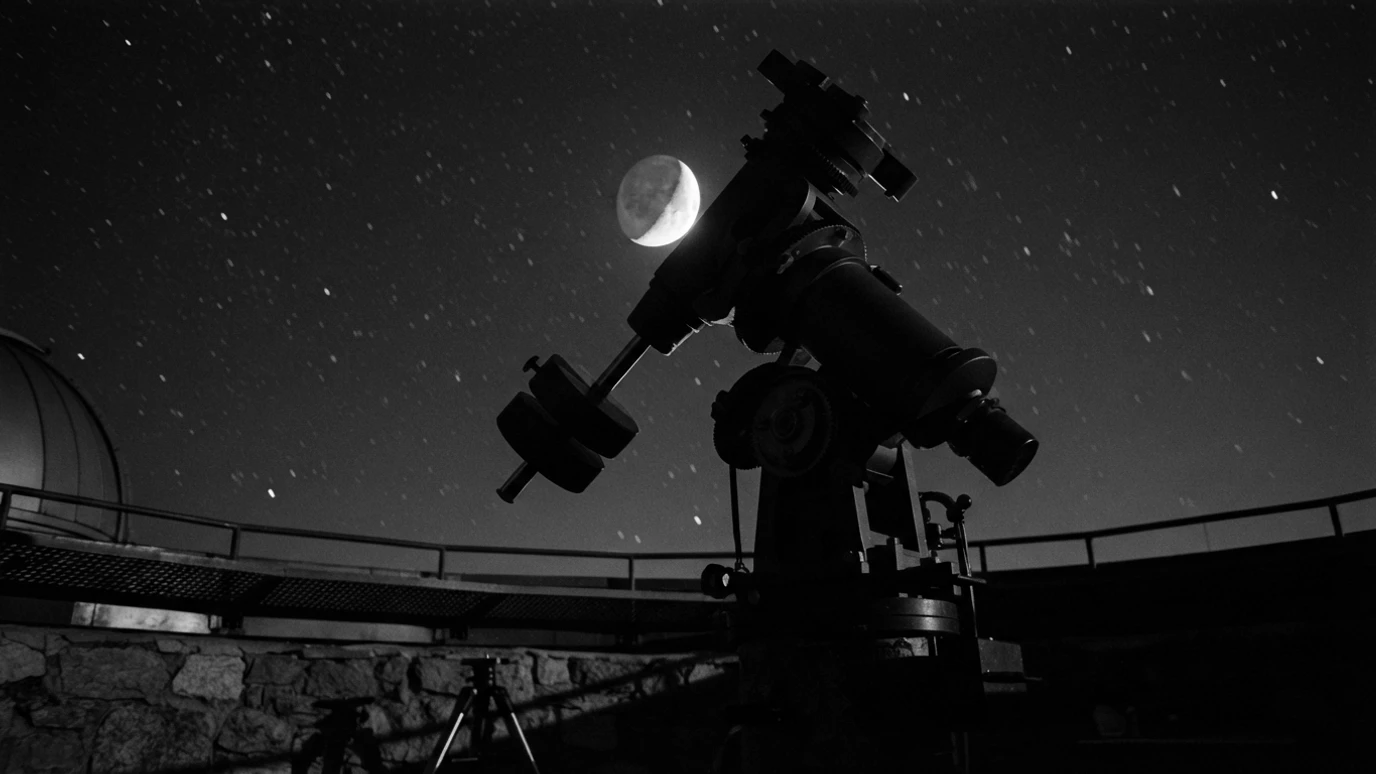
Galaxies reside inside colossal, invisible envelopes of dark matter called halos. While astronomers know halos exist, measuring their true 3D geometric shape (whether spherical, prolate like a football, or oblate like a pancake) is critical to testing dark matter particle physics.
Measuring halo geometry traditionally required deep gravitational lensing of distant background galaxies or extensive X-ray gas mapping, both of which are plagued by projection degeneracies and observational noise.
This astronomical study establishes a pure stellar-kinematic framework to constrain the 3D triaxial geometry of dark matter halos using only starlight data from wide-field spectroscopic surveys. By modeling the action-angle coordinates of halo tracer stars, the algorithm extracts halo flattening parameters with unprecedented precision.
Mapping dark matter halo shapes directly from stellar surveys tests cold dark matter (CDM) predictions of halo triaxiality, providing a sharp experimental test against warm or self-interacting dark matter alternatives.
Constraining the shape of dark matter haloes using only starlight II. Tests of the technique with objects of known gravitational potential
Under the collisionless cold dark matter (CDM) paradigm, galaxies with stellar masses below 10**(5-6) Msun are expected to preserve primordial cuspy dark matter (DM) profiles. Because baryonic feedback should be too weak to transform cusps into cores at these masses, such galaxies provide especially sensitive tests of DM physics. If cores are observed in these systems, they could indicate departures from CDM. To address this problem, Sanchez Almeida et al. (2025) introduced the Eddington Inversion Method tool (EIM-tool), a photometry-based diagnostic that avoids the need for long-term spectroscopic observations and is suitable for the analysis of the forthcoming large photometric surveys of galaxies. The method relies on the fact that embedding a stellar distribution with a central core inside a cuspy NFW halo can require a negative phase-space distribution function f, which is physically impossible. By fitting observed stellar surface densities using f as a free parameter, EIM-tool tests whether an assumed gravitational potential is physically consistent with an observed stellar distribution. This paper validates EIM-tool using globular clusters, dwarf spheroidal galaxies (dSphs), and numerical simulations with independently known potentials. Applied to 21 globular clusters, the method rejected NFW cusps in 71\% of cases while consistently favoring cored Schuster-Plummer models, accurately recovering expected core radii. Applied to dSphs, EIM-tool reproduced conclusions from classical dynamical studies: Sculptor and Fornax favored cored halos, whereas Draco remained compatible with a cusp. Tests on EDGE and FIRE simulations further showed that the tool reliably rejects cuspy NFW profiles when the true DM distribution is core-like. Overall, these results establish EIM-tool as a robust and efficient photometric method for distinguishing cored and cuspy DM halos.


People assumed that close friends and family members were the most important allies for finding a new job and getting ahead in life; Mark Granovetter proved that casual acquaintances you barely talk to are the single most valuable source of new career opportunities and fresh ideas. Published in 1973, "The Strength of Weak Ties" is one of the most influential sociology papers in history, providing the network blueprint that built LinkedIn and modern professional networking.


Physical sensors in rockets and satellites are constantly corrupted by noise, vibration, and sensor drift; Rudolf Kalman developed an optimal mathematical filter that predicts true position by fusing imperfect sensor readings with equations of motion in real time. Published in 1960, the Kalman Filter guided the Apollo spacecraft to the Moon and is the mathematical brain powering every GPS receiver, autonomous drone, and commercial jetliner on Earth.


Adam Smith taught that individuals acting in pure rational self-interest would automatically enrich society; Garrett Hardin proved that when everyone acts in their own self-interest on shared public land, they inevitably destroy the shared resource for everyone. Published in Science in 1968, "The Tragedy of the Commons" became the defining environmental manifesto of the modern era, guiding global ocean fisheries quotas, clean air regulations, and international climate agreements.


Cosmologists spent a century assuming that the mutual gravitational pull of galaxies was slowing down the expansion of the universe; two competing teams measuring exploding white dwarf stars discovered that cosmic expansion is speeding up faster and faster. Awarded the 2011 Nobel Prize in Physics, this discovery of Dark Energy proved that empty space contains a repulsive anti-gravity energy that makes up seventy percent of our universe.

For a century, humanity looked at the universe exclusively through telescopes that capture light; Advanced LIGO used four-kilometer laser beams to directly feel the physical vibration of two black holes colliding 1.3 billion light-years away. Awarded the 2017 Nobel Prize in Physics, the detection of GW150914 confirmed Einstein’s final prediction and gave human science ears to hear the sound of the cosmos.


For nearly fifty years, the greatest minds in quantum mechanics failed to explain why frozen metals lose all electrical resistance; John Bardeen, Leon Cooper, and Robert Schrieffer proved that electrons pair up into synchronized couples gliding through atomic lattices without a single collision. Awarded the 1972 Nobel Prize in Physics (giving Bardeen his historic second Nobel), BCS Theory solved the greatest mystery in solid-state physics, enabling MRI hospital scanners, fusion reactor magnets, and superconducting quantum computers.

Classical physics predicted that messy defects in a crystal would merely scatter moving electrons like pinballs; Philip Anderson proved that quantum wave interference traps electrons in place, freezing electrical currents completely. Awarded the 1977 Nobel Prize in Physics, Anderson Localization unlocked the physics of disordered materials, topological insulators, and light-trapping photonic metamaterials.

Albert Einstein spent his final decades insisting that quantum entanglement was an incomplete illusion masking hidden common-sense variables; John Stewart Bell devised a single mathematical inequality that allowed laboratory experiments to test whether Einstein or quantum mechanics was right. Published in an obscure, short-lived journal in 1964, Bell’s Theorem proved that the physical universe is fundamentally non-local—founding modern quantum computing, quantum cryptography, and quantum teleportation.
Ask this paper your own questions, or keep browsing the verified research catalogue.