Chat
ChatThe James Webb Space Telescope stunned astronomers by discovering thousands of mysterious glowing red dots that appeared to be impossibly massive galaxies formed right after the Big Bang; deep infrared imaging proved that these dots are dense cosmic cocoons where baby supermassive black holes are rapidly devouring gas. Published in The Astrophysical Journal, this discovery solves JWST’s "Little Red Dot" mystery, explaining how giant supermassive black holes grew in the early universe without breaking cosmological laws.

When the James Webb Space Telescope pointed its golden mirrors at the dawn of time, it spotted thousands of tiny, intensely red glowing dots across the early universe. Astronomers were in a panic: if these were normal galaxies, they contained far more stars than could have formed so quickly after the Big Bang, threatening to break our standard cosmological model.
High-resolution infrared spectroscopy resolved the heart of a cosmic dot. The red glow is not from trillions of impossible stars—it is a thick, dusty blanket of gas surrounding an infant supermassive black hole. The monster is gorging on surrounding gas at super-speed, heating the dust cloud into a glowing red ruby.
This observation saved the standard model of cosmology while solving the origin of supermassive black holes. By revealing how black holes grew exponentially in the infant universe, by explaining the true nature of JWST's Little Red Dots, and by charting the dawn of cosmic structure, infrared astronomy unlocks the early universe.
Beyond the Dot: An LRD-like Nucleus at the Heart of an IR-bright Galaxy and its Implications for High-redshift LRDs
Little red dots (LRDs) are compact, red sources discovered by JWST at high redshift (z ≳ 4), marked by distinctive “V-shaped” spectral energy distributions (SEDs) and often interpreted as rapidly accreting active galactic nuclei (AGNs). Their true nature remains unclear though, and their evolutionary connection to their lower-redshift counterparts is still poorly constrained. Thus, we present WISEA J123635.56+621424.2 (here dubbed the Saguaro), a z = 2.0145 galaxy in GOODS-North, as a possible analog of high-redshift LRDs and a potential missing link in their evolutionary path toward lower-redshift systems. It features a compact LRD-like nucleus surrounded by a face-on spiral host. Its connections to LRDs include the following: (1) its nuclear spectrum shows a clear “V-shaped” SED, and (2) when redshifted to z = 7, surface brightness dimming makes the host undetectable, thus mimicking an LRD. This suggests that high-redshift LRDs may be embedded in extended hosts. To test this, we stack rest-frame UV images of 99 photometrically selected LRDs, revealing faint, diffuse emission. Stacking in redshift bins reveals mild radial growth, consistent with the expected galaxy size evolution. A simple analytic model confirms that surface brightness dimming alone can explain their compact appearance. Lastly, we show that the Saguaro is not unique by describing similar objects from the literature at z ≲ 3.5. Taken together, our results support a scenario in which LRDs may not be a distinct population, but could be the visible nuclei of galaxies undergoing a short-lived, (perhaps) AGN-dominated evolutionary phase, with their compact, red appearance driven largely by observational biases.


Physicists universally believed that the laws of nature look completely identical when viewed in a mirror; Chien-Shiung Wu proved that radioactive atoms preferentially shoot electrons in only one direction, proving that nature has an intrinsic left-handed bias. Executed at cryogenic temperatures in 1957, the "Wu Experiment" shattered the sacred law of Parity Conservation, revolutionizing particle physics and laying the foundation for the electroweak Standard Model.


Most fast-conducting solid electrolytes corrode into useless sludge when they touch pure metallic lithium; garnet-type ceramic crystals conduct lithium ions rapidly while remaining completely impervious to corrosive lithium metal. Discovered in 2003 by Thangadurai and Weppner, this sleeping beauty crystal is now the foundational solid electrolyte behind multi-billion-dollar solid-state battery startups like QuantumScape.
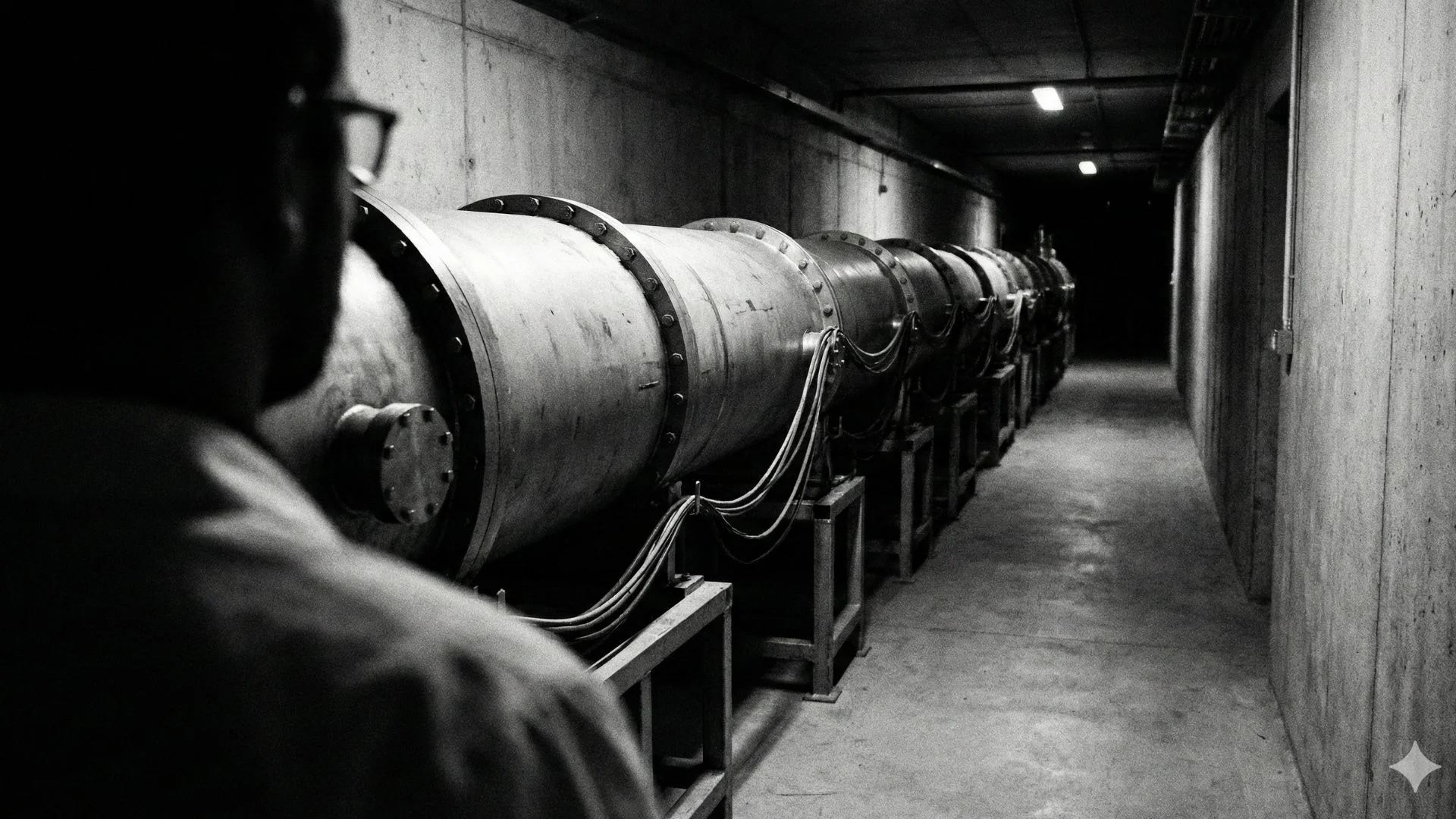

Direct dark matter detection experiments were historically deaf to low-mass particle interactions; XENON1T's ultra-pure liquid xenon time projection chamber uncovered a tantalizing excess of low-energy electronic recoils deep beneath an Italian mountain.

Traditional optical chipmaking lenses become completely opaque to deep ultraviolet wavelengths; Hiroo Kinoshita carved microchip circuits using extreme ultraviolet soft X-rays reflected off atomic-precision multilayer mirrors. Published in 1989 when the industry deemed X-ray lithography an impossible fantasy, Kinoshita’s experimental setup became the physical foundation of the multi-billion-dollar ASML EUV machines that print the world's most advanced computer chips.

First-order cosmological phase transitions in the early universe expand as seething vacuum bubbles whose speed determines gravitational wave signatures; first-principles hydrodynamic calculations establish exact bubble wall velocity benchmarks without phenomenological friction.


Telecommunication engineers believed that static noise permanently corrupted electrical signals; Claude Shannon proved that information can be transmitted with zero errors across noisy channels by converting meaning into binary bits. Published in 1948, Shannon’s masterwork founded information theory and created the digital language of the modern world.


People assumed that close friends and family members were the most important allies for finding a new job and getting ahead in life; Mark Granovetter proved that casual acquaintances you barely talk to are the single most valuable source of new career opportunities and fresh ideas. Published in 1973, "The Strength of Weak Ties" is one of the most influential sociology papers in history, providing the network blueprint that built LinkedIn and modern professional networking.


Physical sensors in rockets and satellites are constantly corrupted by noise, vibration, and sensor drift; Rudolf Kalman developed an optimal mathematical filter that predicts true position by fusing imperfect sensor readings with equations of motion in real time. Published in 1960, the Kalman Filter guided the Apollo spacecraft to the Moon and is the mathematical brain powering every GPS receiver, autonomous drone, and commercial jetliner on Earth.
Ask this paper your own questions, or keep browsing the verified research catalogue.